Shiba Daijingū: A Shinto Shrine and Center of Ise Worship in Tokyo


Site at a Glance
- Rating
- 4.3
- Popularity
- Medium
- Country
- Japan
- Primary era
- Modern
- External website
- Open
- Eras represented
- Early Modern, Modern
- Civilizations
- Japanese, Tokugawa
- Site type
- Religious
- Remains
- Sanctuary
On this page10 sections
History
Shiba Daijingū is a Shinto shrine in Tokyo, Japan, whose traditional foundation dates to 21 October 1005, during the reign of Emperor Ichijo. It originated as a Shinmei shrine associated with the Ise Grand Shrine estate in Musashi Province and became an important center of Ise worship in the Kantō region. The shrine’s principal deities are Amaterasu, associated with Ise’s Inner Shrine, and Toyouke, associated with its Outer Shrine. Minamoto no Yoritomo and Tokugawa Ieyasu are also enshrined as accompanying deities.
Foundation and Early Associations
The shrine was initially established on Mount Iikura, in the area now occupied by Shiba Park. Shrine tradition says that the deities of Ise’s Inner and Outer Shrines were ceremonially invited there in 1005. A sacred stone from Udo in Hyuga Province and a sword were dedicated as treasures. Another tradition connects the sword with Yoritomo, who is said to have recovered it from a nearby stream and placed it in the sanctuary.
The institution was known successively as Hibiya Shinmei, Iikura Shinmei, and Shiba Shinmei, names reflecting its changing associations with Hibiya, Iikura, and Shiba. It received the name Shiba Daijingū on 2 October 1872, with the approval of the government and Tokyo Prefecture.
Medieval and Early Modern Patronage
Shiba Daijingū became known as the “Ise of Kantō,” offering a locally accessible focus for devotion to Ise at a time when pilgrimage to Ise required considerable time and expense. Minamoto no Yoritomo is traditionally said to have donated shrine lands in 1185 and again in 1193. During the second donation, he reportedly visited the shrine and assigned more than 1,300 kan of land as sacred rice-field territory.
The shrine received further attention from military leaders. In 1337, Ashikaga Tadayoshi dedicated a letter of thanksgiving for a military victory. Ōta Sukemasa, better known as Dōkan, also became a devotee, while Hōjō Ujinao issued a prohibition notice concerning Shiba Village in 1588. Toyotomi Hideyoshi is said to have prayed there before leaving Edo for the pacification of Ōshū in 1590. Tokugawa Ieyasu visited the shrine when entering Edo that year and donated 15 koku of shrine territory in Hibiya in 1592.
In 1598, the shrine moved from its former grounds in present-day Shiba Park to its current location in Shiba-Daimon because Zōjōji was being transferred onto the former site. Ieyasu visited again before the Battle of Sekigahara in 1600 to pray for victory. During the Osaka campaigns of 1614 and 1615, Kasuga no Tsubone visited as the representative of Sugen’in, the wife of Tokugawa Hidetada.
The Shrine under the Tokugawa Shogunate
Under the Tokugawa shogunate, Shiba Daijingū received official protection. The shogunate ordered the construction and repair of shrine buildings, commissioned prayers including those for the safe birth of a shogunal heir, and encouraged visits by feudal lords. Its location along the Tōkaidō, near the boundary between Edo and the surrounding districts and close to Kanesugi Bridge and Zōjōji, helped make it a focus for pilgrimage. Travelers prayed for safe journeys when leaving Edo and gave thanks when returning.
The approach developed into a busy commercial and entertainment district. Teahouses stood alongside archery and blowpipe ranges, flower and cosmetic vendors, sumō, magic and acrobatic performances, swordsmanship, lotteries, and theaters. Shiba Shinmei’s daidai-mochi rice cakes became a recognized local souvenir, and the publisher Izumiya Ichibē reportedly operated nearby during the 1780s.
Religious administration combined Shinto and Buddhist institutions until the Meiji period. Two hereditary Shinto priest families shared responsibility with a Buddhist bettō, a supervising cleric attached to the shrine, who held the leading position. The bettō institution was abolished when the Meiji government separated Shinto and Buddhism. The senior office then changed successively from chief priest to Shinto official and shrine administrator, before becoming the modern office of chief priest in 1946. The former Buddhist bettō was Kongō-in of Rinkai-zan Henshōji, a subsidiary temple first associated with Enryakuji and later with Kan’eiji. Its temple tradition dates its foundation near the shore of Shiba to 1194.
Fire, Earthquake, and Institutional Change
The shrine was repeatedly damaged by fire and rebuilt. Major disasters included the great fire of 1657 and fires in 1762, 1806, 1824, and 1850. An earthquake in 1855 caused a partly rebuilt complex to collapse again.
In October 1868, Emperor Meiji rested at the shrine during his journey to Tokyo. In December of that year, Shiba Daijingū was briefly designated a semi-imperial shrine. After that system was abolished in 1870, it became a Tokyo prefectural shrine, and the name Shiba Daijingū was formally adopted in 1872. A fire destroyed the shrine in January 1876, and reconstruction finished in March 1877.
The Kantō Earthquake of 1 September 1923 caused the buildings to collapse and burn. Reconstruction of the principal buildings took place between 1927 and 1938, but the shrine was again destroyed by fire during the Tokyo air raid of 26 May 1945. The principal shrine was rebuilt in January 1947, followed by another rebuilding of the principal sanctuary completed in September 1964. After the war, the shrine joined the Association of Shinto Shrines. Work connected with the 2005 ceremony marking 1,000 years since the traditional foundation included rebuilding the shrine office and other facilities.
Ritual Traditions and Local Beliefs
Edo-period worship included Shiba Shinmei kagura, ritual music and dance performed in a Shinto setting. The annual festival is held on 16 September. Other observances include the Small Bell Festival on 3 February, the Dadarā Festival from 11 to 21 September, and the Savings Festival on 17 October.
Ginger has long been associated with the shrine. Tradition says it was cultivated around the site at the time of the foundation, offered before the deities, and later distributed during the annual festival. Eating the returned offering was believed to help prevent colds. The traditional explanation of the place-name Iikura also connects it with ancient grain storage and the cultivation of crops, including ginger.
Chigi-bako boxes are distributed as offerings or gifts. Their modern symbolism connects the word chigi with “many garments.” Other traditions derive the boxes from rice containers made from unused roof finials or from vessels used to serve rice cakes. Beans placed inside were traditionally said to protect against lightning.
Remains
Sanctuary and Shrine Grounds
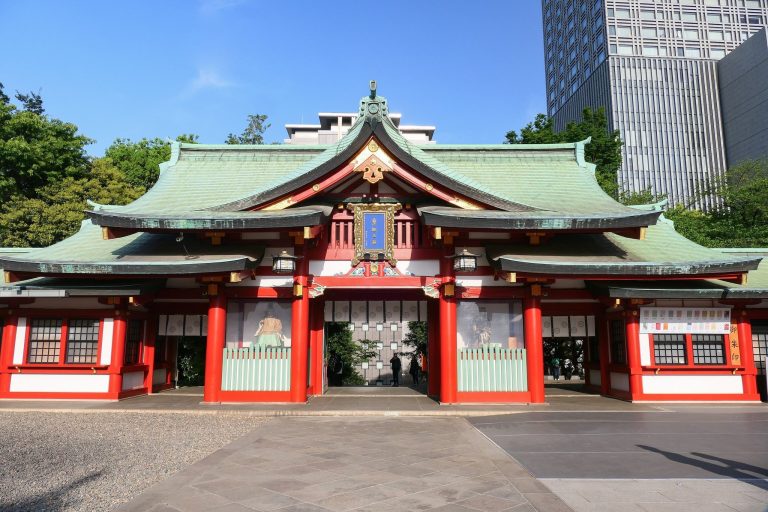
The principal sanctuary follows Shinmei-zukuri, a formally simple Shinto architectural style associated especially with the buildings of Ise Grand Shrine. The present complex reflects successive rebuilding after fires, the 1855 earthquake, the Kantō Earthquake, and the 1945 air raid. Its principal sanctuary was rebuilt in 1947 and again in 1964, while the shrine office and related facilities were renewed in connection with the 2005 anniversary.
The original precinct on Mount Iikura was described as facing east, with a horse ground in front, several rows of trees, and three torii gates, including one near the eastern seashore. Roads and waterways surrounded the grounds, including the Sakura River and a smaller stream that flowed from behind the sanctuary toward the sea. Fields, deep rice paddies, and agricultural settlements extended around the precinct, while fishing communities occupied the eastern shore. Roads connected the site with the inland plateau and the wider eastern provinces.
Water Shrine and Consolidated Subsidiaries
The former Mitarai Shrine protected a spring-fed pond within the grounds until the prewar period. Tradition says that Tokugawa Iemitsu cured an eye ailment by washing his eye with the spring water in 1633, after which the pond became associated with prayers for recovery from eye disease.
Former subsidiary shrines inside and outside the precinct were eventually consolidated into the principal sanctuary. A subsidiary shrine reconstructed in 1936 enshrined deities including Ōkuninushi, Sukunahikona, and Kotoshironushi. It was associated with protection during milestone birthdays before being destroyed by wartime fire.
Objects and Recorded Materials
The shrine preserves 33 kagura masks, some of them registered cultural properties. They are associated with the Edo-period tradition of Shiba Shinmei kagura. Other shrine-held historical materials include a letter attributed to Ashikaga Tadayoshi, Hōjō Ujinao’s prohibition notice concerning Shiba Village, and a letter by the official Ina Hanjuurō Tadaharu.
A sword and a sacred stone from Udo are traditionally regarded as foundation offerings. The sword also belongs to the tradition connecting it with Yoritomo’s recovery of a weapon from a nearby stream. The shrine’s associated Shiba Daijingū chikara-ishi is traditionally identified as a stone used for testing strength.