Žihobce Castle: A Medieval Fortress Transformed into a Baroque Castle
Site at a Glance
- Rating
- 4.5
- Popularity
- Very Low
- Country
- Czechia
- Primary era
- Early Modern
- Eras represented
- Early Modern, Modern
- Civilizations
- Habsburg, Holy Roman Empire, Kingdom of Bohemia
- Site type
- Domestic
- Remains
- Castle
On this page9 sections
History
Žihobce Castle is a historic castle in Czechia, developed from a medieval fortified manor and later remodeled in the Baroque period. Žihobce belonged to Břevnov Monastery, a Benedictine monastery in Prague, from the eleventh century. During the fourteenth century, the estate passed to the Žihobice noble family, whose first known member to hold it was Racek ze Žihobic, recorded between 1350 and 1383. A fortified manor probably stood in the village by this time.
Medieval Fortress and the Hussite Wars
Racek was followed by Jakůbek ze Žihobic, Vintíř ze Žihobic, and another Racek ze Žihobic, who held the property between 1383 and 1412. The original fortress and its court fell into ruin during the Hussite Wars, the fifteenth-century religious and political conflicts in Bohemia associated with the followers of Jan Hus.
A tradition entered in the Žihobce parish book in 1799 attributes the fortress’s capture and destruction to Jan Žižka during the siege of Rabí Castle. Žižka was a leading Hussite military commander, but this account is presented as a legend. The fortress and court were still deserted in 1461. After the deaths of Jošt and Jitka, their property passed to George of Poděbrady, the fifteenth-century king of Bohemia.
Restoration and Repeated Conflict
In 1462, George of Poděbrady granted the deserted fortress to Jan, known as House, of Žihobice, who repaired it. Jan later joined the Green Mountain Union, a political alliance formed by opponents of the king. In 1467, Duke Henry I the Elder of Minsterberg captured and damaged the fortress again.
During the first half of the sixteenth century, Žihobce belonged first to Zvěst of Malkov and then to Břetislav of Rýzmberk. Jan Šťastný of Říčany bought the estate with Dražovice in 1548. He retained Dražovice and sold the deserted Žihobce fortress, its demesne farm, and half of the village to Kryštof Koc of Dobrš in 1556 for 850 kops of Bohemian groschen. A kop was a Bohemian unit equal to 60 groschen.
The Dobrš Estate and the Seventeenth Century
Kryštof Koc incorporated Žihobce into the Dobrš estate and granted the property to his wife, Kateřina of Běšiny, for her lifetime use. The fortress remained attached to Dobrš until the division of Václav Koc of Dobrš’s inheritance in 1609. The newly created estate included the fortress, which Václav had restored, together with Věšíno, Rozsedly, Kačice, Šimanov, Ostružno, Ždánov, Nezdice, Strašín, and Maleč.
The estate passed to Jan Václav Koc of Dobrš of the Bystřice branch. In 1613, his sons sold it to their widowed mother, Lidmila, née Černín of Chudenice, who later remarried and became known as Lokšanová. Her estate included a brewery, fountain, sheepfold, brickworks, lime kiln, limestone quarry, and Lomecký Mill, as well as numerous villages.
After three or four years, Lidmila sold the estate to Jaroslav Bukovanský of Bukovany. His participation in the Bohemian Estates Revolt of 1618 to 1620, an uprising by the Bohemian estates against the Habsburg monarchy, led to the confiscation of half his property in 1623, including Žihobce. Martin de Hoeff-Huerta bought the confiscated estate in 1627.
Following Huerta’s death, Žihobce passed among imperial colonels. Antonio Lopez de Gradin acquired the estate and left it to his wife, Barbora. In 1635, it passed to their ward, Mikuláš de Nogrell, who died fighting the Swedes in 1641. His widow, Anna Desfoursová, then inherited the estate and later married Baron František Klaudius Iselin of Lanau.
Baroque Castle and the Lamberg Family
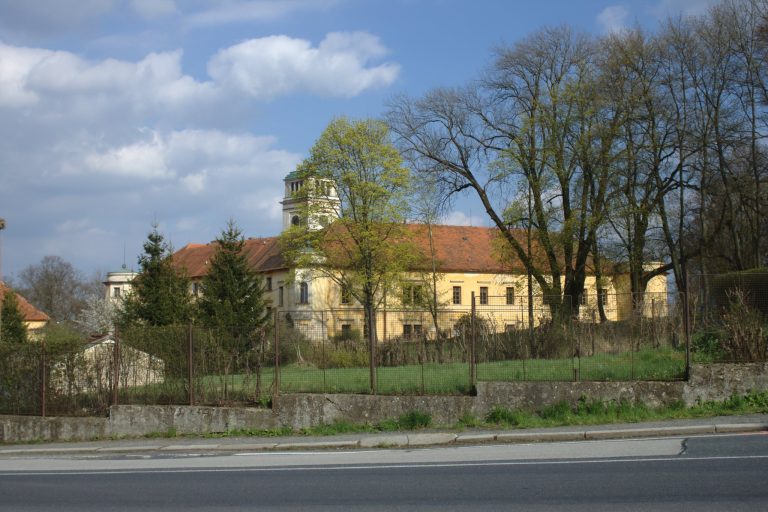
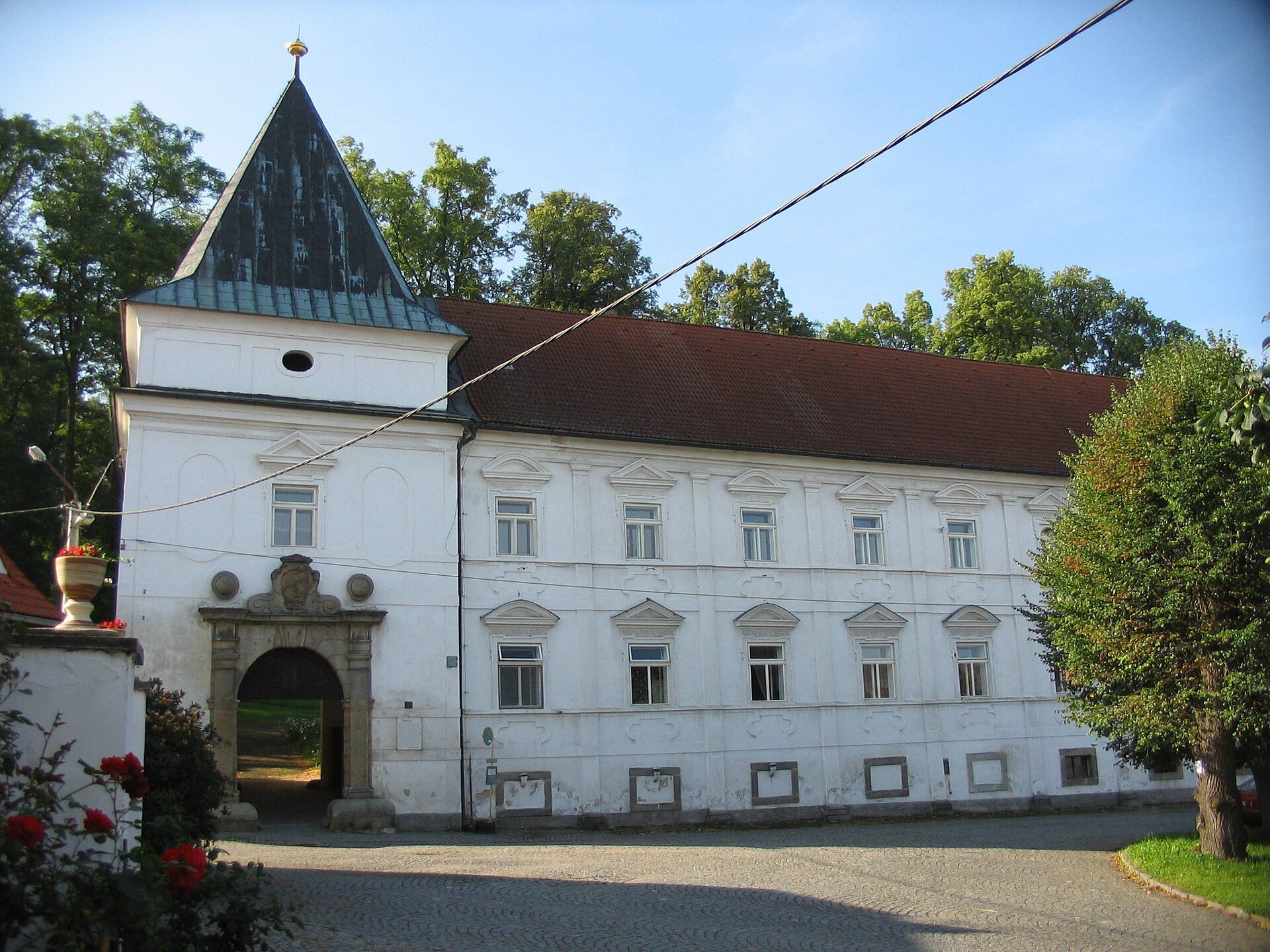
Ferdinand Iselin of Lanau remodeled the old fortress as a Baroque castle. The completion of the work is marked by the date 1688 on the second floor. Ferdinand died in 1700, and Anna Iselinová of Lanau bought the indebted estate. Johann Philipp von Lamberg, Bishop of Passau, acquired it in 1709 or 1710, beginning the Lamberg family’s long ownership, which continued until 1945.
Prince Karel Evžen of Lamberg was the first member of the family to live permanently at the castle. He settled there in the early nineteenth century. During the second half of the twentieth century, the building was used as a school. Since 2012, it has also housed the Lamberg Trail Museum and the municipal information centre.
The castle complex has been protected as a cultural monument since 1964. Since 2013, it has also held designation as a site of European importance because a colony of lesser horseshoe bats occupies the castle attic. This designation concerns the conservation of habitats or species considered important at the European level.
Remains
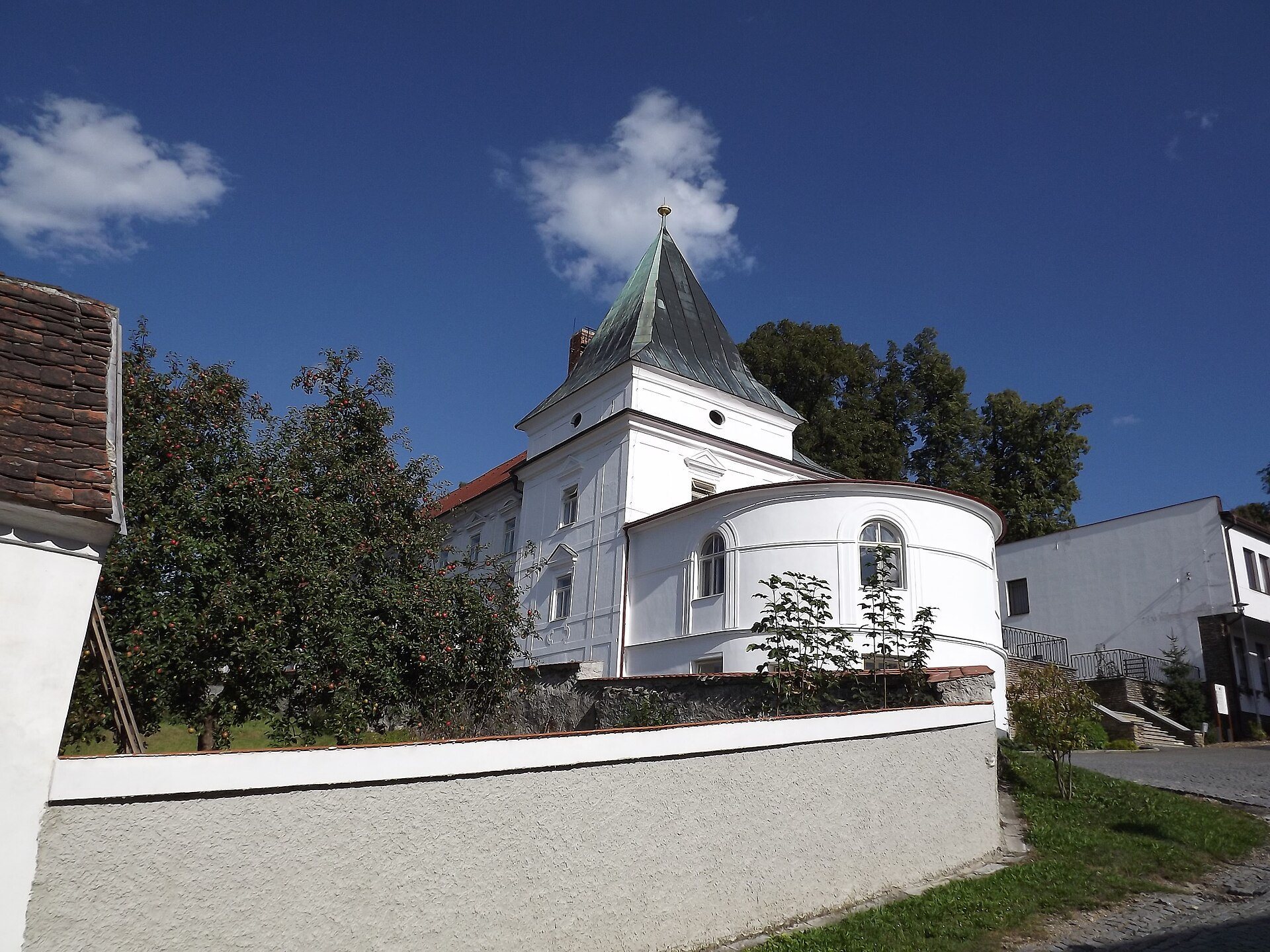
Žihobce Castle occupies the site associated with the medieval fortress, although the precise location of that earlier structure has not been established. The surviving castle building has towers at both ends and combines the remains of earlier phases with its principal Early Baroque exterior. Its facade is organized by tall pilasters, shallow supports attached to the wall, while the windows have decorative elements above them known as supraportas.
Castle Building
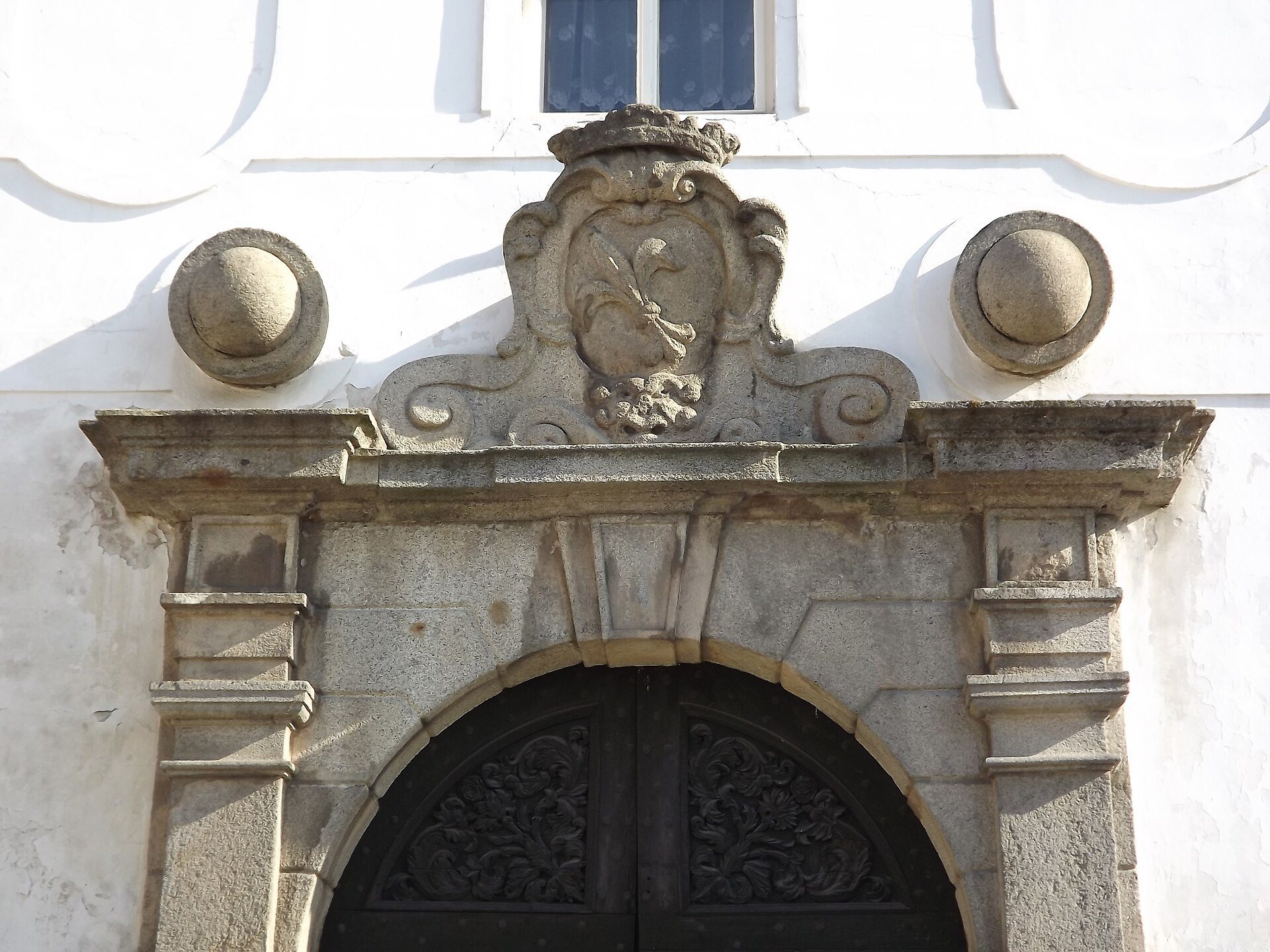
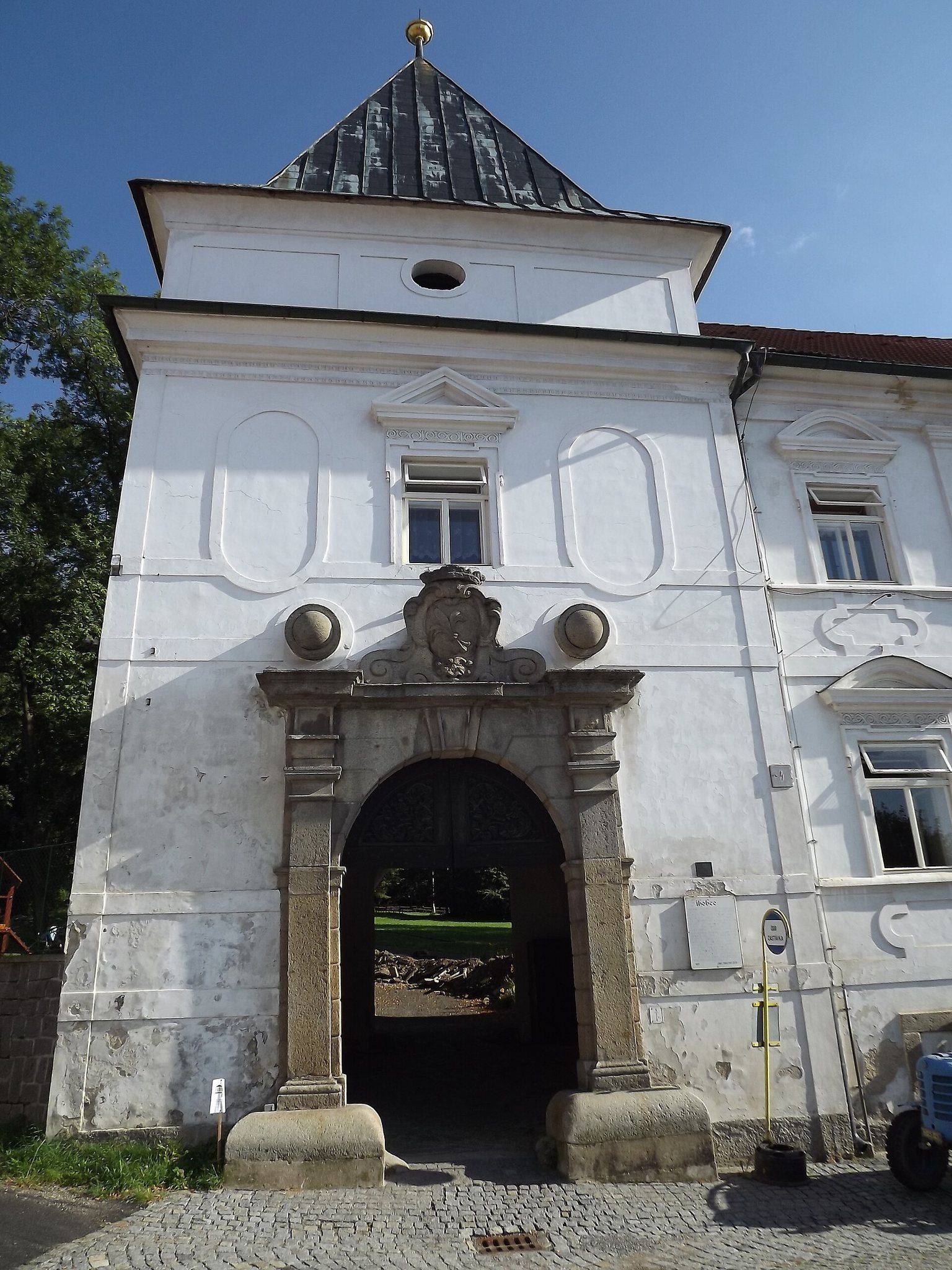
The entrance is set in the left-hand tower and opens into a passage covered by a barrel vault, a continuous curved ceiling. Barrel vaults also cover the other ground-floor and basement spaces, with two rooms instead covered by ridge vaults formed where curved vault surfaces intersect. Renaissance sgraffito survives in the plaster. This decorative technique scratches through an upper surface layer to expose a contrasting layer beneath, preserving evidence of the building’s earlier appearance within the later castle.
Associated Buildings
The protected complex includes the main castle building, an Empire-style riding hall, house no. 93 from around 1800, a greenhouse, and house no. 114. Empire style was the formal architectural and decorative style associated with the Napoleonic era and the early nineteenth century. These buildings form part of the wider historic complex surrounding the castle.
Park
The castle park contains a protected small-leaved lime tree. Its trunk measures 448 centimetres in circumference, and the tree reaches a height of 29 metres.