Church of Saint Maurice: A Medieval Fortified Church in Czechia


Site at a Glance
- Rating
- 4.8
- Popularity
- Low
- Country
- Czechia
- Primary era
- Medieval
- External website
- Open
- Eras represented
- Medieval, Early Modern
- Civilizations
- Holy Roman Empire, Kingdom of Bohemia
- Site type
- Religious
- Remains
- Fortified Church
On this page14 sections
History
The Church of Saint Maurice is a medieval fortified Roman Catholic church in Czechia, above Annín and Rajsko near Dlouhá Ves. Built as a late Romanesque church between 1220 and 1230, it was dedicated to Saint Maurice, a Christian martyr and Roman military commander traditionally associated with the Theban Legion. The church served as the parish church for surrounding villages and hamlets and remains associated with the Mouřenec parish, the Sušice-Nepomuk vicariate, and the České Budějovice diocese.
Foundation and medieval development
The dedication and historical connections of the church point to the Benedictine monastery of Niederaltaich in Lower Bavaria, whose religious network was active in the Sušice area during the 1240s. The church’s origins are also traditionally linked with Saint Gunther, a medieval Christian hermit associated with the Bohemian Forest who lived several kilometres to the west at Gunthersberg. Its position above a bend of the Otava suggests that a fortification may have occupied the site before the present church was built.
The first documented reference to the church dates from 1360. Alterations followed during the second half of the thirteenth century or in the fourteenth century, while a substantial rebuilding and enlargement took place during the Gothic period, particularly in the fifteenth century. The church was renovated again in the Baroque period and altered further during the nineteenth century. Dendrochronology, the dating of timber through annual growth rings, indicates that a new roof was installed in 1542.
Abandonment and renewal
A settlement once surrounded the church. In 1890 it had 23 permanent inhabitants, but it disappeared after the expulsion of the German population in 1946. Only the school and several fruit trees remained. The church was then left to decay, and much of its Baroque furnishing was lost.
After 1989, especially between 1991 and 1993, the church was restored through the efforts of former German inhabitants and their descendants, a German preservation association, and Czech firms. Bishop Antonín Liška reconsecrated it in 1993, and the restored church was intended to function as a Czech-German meeting place. Services in both languages have since been held several times a year, including a New Year’s service, while the Friends of Mouřenec association has organized concerts, theatrical performances, lectures, and other events.
A small museum established in the church in 2015 presents parish life at Mouřenec, including religious celebrations, funerals, and schooling. The church is a protected cultural monument. Its restoration also led to the discovery and conservation of important medieval wall paintings, which document extensive artistic contacts in the Sušice region during the Middle Ages.
Remains
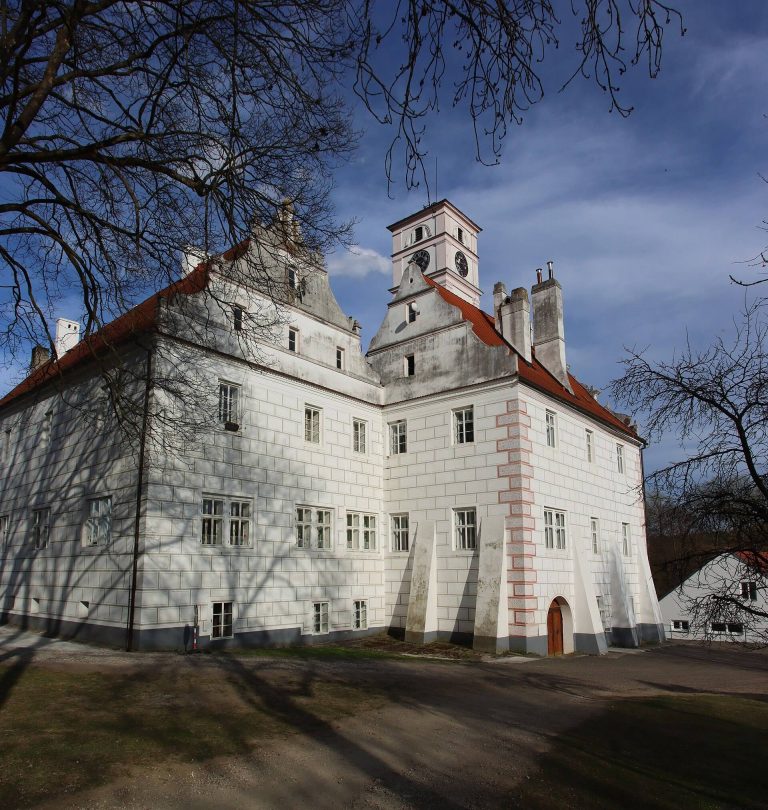
The Church of Saint Maurice stands on Mouřenec hill at an elevation of about 620 metres, on a promontory within a bend of the Otava. The river surrounds the promontory on three sides, and a cemetery belonging to the former parish surrounds the church. The building combines a late Romanesque granite core with Gothic, Baroque, and later additions, while its compact tower and surrounding ossuary give the site a fortified character.
Setting and structure
Church and cemetery
The church is a single-nave building constructed from quarry granite. Its original nave was almost square, but it was extended westward during the Gothic period and is now rectangular. The flat-ceilinged nave adjoins a square chancel, the part of the church surrounding the main altar, which is covered by a late Gothic star vault. A small horseshoe-shaped apse, a rounded termination of the building, adjoins the tower and retains a Romanesque axial window.
Tower and later additions
A substantial Romanesque quadrangular tower rises above the chancel. A sacristy, a room for storing sacred vessels and vestments, is attached to the west side of the tower. A Baroque octagonal chapel adjoins the south side of the nave. The cemetery wall system incorporates an ossuary, a structure for storing human skeletal remains after burial space has been reused.
Paintings and interior features
Medieval wall paintings
Medieval wall paintings were accidentally uncovered during the complete reconstruction of 1991–1993 and restored by the academic painter and conservator Miroslava Houšťová. They cover the interior spaces except for the south wall. On the north wall of the nave, an elaborate Last Judgment is arranged in three horizontal bands and dates from around 1310–1320.
The apse contains a multi-figure Crucifixion of Jesus Christ from around 1360. Its imagery includes unusually represented Eucharistic motifs, meaning scenes and symbols connected with the Christian ritual of bread and wine. Symbols of the Evangelists, Matthew, Mark, Luke, and John, with inscription bands, are concealed within the starry, ribbed vault. The church also contains a fresco expressing the grandeur of the Baroque period.
Ossuary
The Baroque ossuary was created from an earlier chapel. It once held an estimated 5,000 skeletal remains, although perhaps only about half survive. The origin of the bones is unknown, and they most probably came from the local cemetery. Wall paintings are also preserved inside the ossuary.
Bells and furnishings
A bell cast in 1329 remains in the church and escaped the metal-requisition campaigns of both world wars. Two further bells were installed in 2003, made by the Rudolf Perner bell foundry in Passau. The church’s Baroque interior furnishings, largely lost after the Second World War, were restored during the 1991–1993 campaign.
Museum and commemorative sculpture
Parish museum
The sacristy contains historical photographs used by the museum. The manorial gallery or oratory, a private worship gallery, contains displays about the former parish’s religious, funerary, and educational life.
Statue of Saint Maurice
A sandstone statue of Saint Maurice was carved over fourteen days in the summer of 2017 directly in front of the church by the sculptor Bartoloměj Štěrba. Intended for a niche above the entrance steps, the statue can be viewed within the church.