Yuzuki Castle: A Medieval Hill Castle in Matsuyama, Japan


Site at a Glance
- Rating
- 3.9
- Popularity
- Low
- Country
- Japan
- Primary era
- Medieval
- External website
- Open
- Eras represented
- Medieval, Early Modern
- Civilizations
- Ashikaga shogunate
- Site type
- Military
- Remains
- Castle
On this page11 sections
History
Yuzuki Castle is a Japanese hill castle in Matsuyama, Japan, constructed around 1335 during the Kenmu era, a brief period from 1334 to 1338, under Kōno Michimori, the shugo, or provincial military governor, of Iyo Province. The Kōno family moved its base from its ancestral territory in Kōno district to the castle, which became the center of its authority in Iyo during the Muromachi period, the era of the Ashikaga shogunate.
The Kōno family in Iyo
The Kōno family’s position in Iyo originated in the late twelfth-century Genpei War, a conflict between the Minamoto and Heike, or Taira, factions. Kōno Michinobu supported Minamoto no Yoritomo, founder of the Kamakura shogunate, and received extensive territory in Iyo. The clan later lost its position after supporting Emperor Go-Toba, the retired emperor who led the failed Jōkyū uprising against the Kamakura government. Following the Mongol invasions of Japan in 1274 and 1281, Kōno Michiari helped restore the family’s status as shugo.
During the fourteenth century, the Kōno position faced pressure from local warlords based in Iyo’s separate river valleys, intervention by the Hosokawa family from neighboring Sanuki Province, and divisions within the Kōno family itself. Fighting in 1364 and 1365 forced the Kōno to withdraw temporarily to another castle. They recovered Yuzuki Castle in 1365 and expelled the Hosokawa faction from Iyo, but the family later took part in the Ōnin War and gradually lost power.
Expansion and Sengoku-period conflict
Yuzuki Castle developed further during the Sengoku period, an era of prolonged warfare among competing regional lords. Around 1535, an outer moat was added, and the retainers’ residences were arranged around it. The Kōno lord then in power sought to strengthen the family by taking a prominent leader of the Murakami maritime forces as a son-in-law. Opposition from retainers and relatives forced him to withdraw to Kurushima Castle. The Kōno later recovered some influence, but their effective control had already weakened substantially.
The Kōno were allied with the Murakami maritime forces of the Seto Inland Sea and with the Mōri family of Aki Province. These relationships did not prevent attacks by Chōsokabe Motochika of Tosa, who sought to unify Shikoku, or by Toyotomi Hideyoshi’s armies. The Mōri also attacked from the north after abandoning their alliance with the Kōno.
From 1581, Chōsokabe Motochika invaded Iyo as part of his effort to bring Shikoku under his control. The Kōno fought him but eventually became subordinate to the Chōsokabe family. In 1585, forces led by Kobayakawa Takakage, a major commander acting under Toyotomi Hideyoshi’s orders during the campaign to conquer Shikoku, invaded Iyo. After destroying Kaneko Castle and defeating its lord, Kaneko Motoyasu, the army besieged Yuzuki Castle for approximately one month. The Kōno then surrendered. The Kōno lord who remained at the castle was spared, but died of illness two years later.
Abandonment and archaeological rediscovery
Hideyoshi granted Yuzuki Castle to Kobayakawa Takakage, whose domain was later transferred to Chikuzen. In 1587, Fukushima Masanori became the castle’s lord and soon moved his residence to Kokubuyama Castle. Yuzuki Castle was then abandoned, ending its use from the fourteenth century through the Muromachi and Sengoku periods.
Construction of Matsuyama Castle began on Katsuyama, also called Shiroyama, in 1602. Roof tiles and other building materials from Yuzuki Castle were reused in that construction. After the former prefectural Dōgo Zoo closed in 1987, archaeological excavation at Yuzuki Castle began in 1988. Reconstruction and improvement of the site between 1998 and 2001 produced a samurai residence, a yakui-mon gate, a traditional Japanese gate with a distinctive roofed design, and earthen walls. The ruins became part of Dōgo Park and were designated a National Historic Site of Japan in 2002. In 2006, Yuzuki Castle was selected as one of Japan’s Top 100 Castles.
Remains
Hilltop layout and defenses
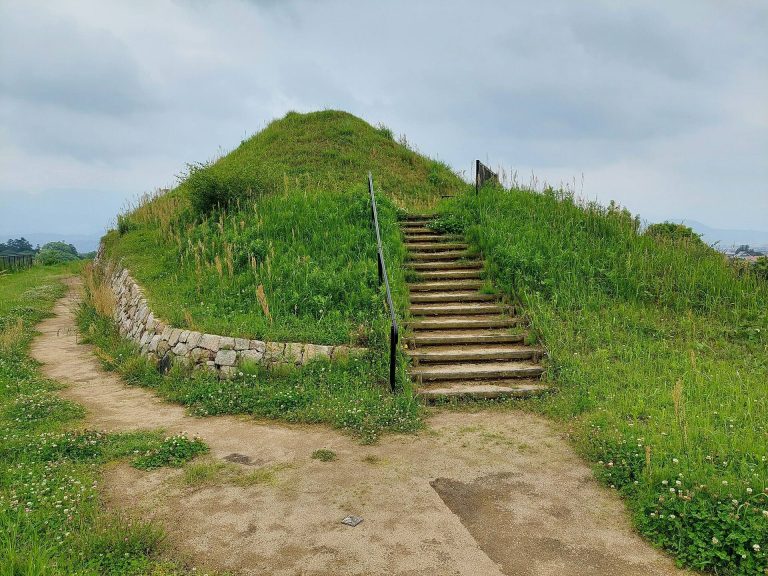
Yuzuki Castle was a tiered-plan hill castle without a keep. It occupied a hill enclosed by two water moats and formed a motte-and-bailey complex, combining a fortified mound or hill with an adjoining enclosed area. Several separately bounded enclosures occupied the hill, and clay or earthen walls protected them. The castle gradually expanded from an earthen fortification centered on the hill. The later outer moat and the residences arranged around it created a more developed hill-castle layout.
The castle’s overall diameter was approximately 400 meters. The preserved castle-park area has an approximately circular form, measuring about 300 meters from east to west and 350 meters from north to south, with an area of approximately 86,000 square meters. Earthen ramparts, water moats, and enclosure areas survive within Dōgo Park, where these elements remain visible. An Edo-period map indicates that the eastern side of the park served as the castle’s main entrance, while Matsuyama Castle lies to the west.
Reconstructed castle buildings
Samurai residence
A samurai residence has been reconstructed in wood and earth as part of the former castle complex. It represents the residential spaces associated with the castle’s retainers and the expanded arrangement that developed around the outer moat.
Yakui-mon gate
A yakui-mon gate has also been reconstructed in wood and earth. Its distinctive roofed form represents an entrance component of the former castle complex rather than a surviving castle keep.
Earthen walls
Sections of earthen walls have been reconstructed alongside the residence and gate. Together with the surviving ramparts, moats, and enclosure areas, they convey the castle’s use of raised ground, bounded spaces, and water defenses.
Reused building materials
Archaeological investigation found that roof tiles and other construction materials from Yuzuki Castle were later reused at Matsuyama Castle. These materials connect the abandoned medieval stronghold with the construction of the early seventeenth-century castle on Katsuyama, also known as Shiroyama.