Hōgon-ji Temple: A Ji-shu Buddhist Temple and Birthplace Tradition of Ippen


Site at a Glance
- Rating
- 4
- Popularity
- Low
- Country
- Japan
- Primary era
- Medieval
- External website
- Open
- Eras represented
- Medieval
- Civilizations
- Japanese
- Site type
- Religious
- Remains
- Temple
On this page11 sections
History
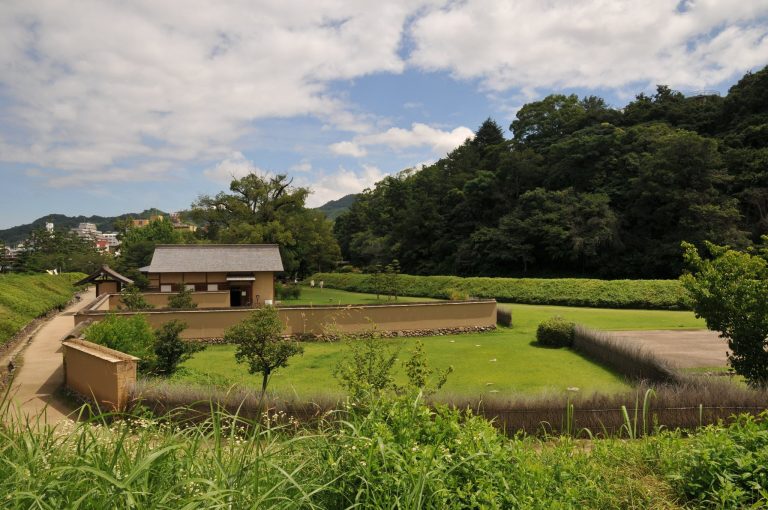
Hōgon-ji Temple is a Ji-shu Buddhist temple in Matsuyama, Japan, dedicated to Amida Buddha, the central Buddha of Pure Land Buddhism. Its foundation is traditionally dated to 665, while another tradition places it in 668. The temple’s origin is attributed to a request by the abdicated Empress Saimei and to Ochi Morioki, a provincial governor.
Early affiliations and medieval revival
Hōgon-ji was first affiliated with the Hosso school and later with the Tendai school. At its height, the temple reportedly had twelve subsidiary temples in the Matsugae district. In 1292, three years after Ippen’s death, Sen’a revived the temple and converted it into a Ji-shu temple. Sen’a is identified in the historical tradition as Ippen’s brother. Hōgon-ji then became the head temple of the Okutani branch, one of the twelve branches of Ji-shu, a movement founded by Ippen that developed from the Jodo, or Pure Land Buddhist, tradition.
Ippen and the temple precinct
Ippen is traditionally said to have been born within the temple precinct in 1239, when the area formed part of Iyo Province, although another tradition places his birth elsewhere. Known as Shojomaru in childhood, he became a monk named Zuien after his mother died in 1248. In 1251, he went to Dazaifu to study under Shodatsu.
After his father’s death, Ippen returned to Iyo in 1263 and married. In 1271, he vowed to abandon domestic life. Following a revelation at Kumano Shrine in 1274, he spent the remaining sixteen years of his life traveling throughout Japan. He is regarded as the founder of Ji-shu and is associated with itinerant religious practice and the movement’s spread.
In 1334, Michitsuna Tokunō erected a monument at the entrance to Matsugae to commemorate Ippen’s birthplace. The monument was moved into the temple precinct in 1926. The grounds were designated an Ehime Prefectural Historic Site in 1949 as “the birthplace of Ippen.”
Fire and reconstruction
A fire on August 10, 2013, destroyed the main hall and the priests’ quarters. It also destroyed Hōgon-ji’s wooden standing image of Ippen, an Important Cultural Property. No remains of the statue were found, but its destruction was determined from the circumstances. In 2014, the designation of a fire-damaged hanging Buddhist image and fragments as a Matsuyama municipal tangible cultural property was withdrawn. Surviving fragments and small Buddhist images from Hōgon-ji were instead newly designated as historical materials.
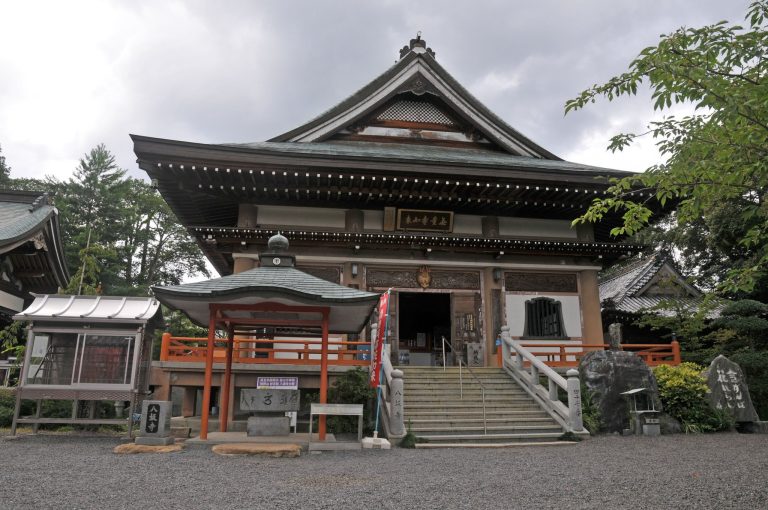
A reconstruction plan for the main hall and related buildings was approved in September 2014, and work began in November that year. The main hall’s roof-raising ceremony took place on July 4, 2015, followed by the corresponding ceremony for Ippen Hall on July 21. Completion rites for both buildings, together with an eye-opening ceremony for a new image of Ippen, were held on May 14, 2016.
Remains
Temple layout and surviving entrance
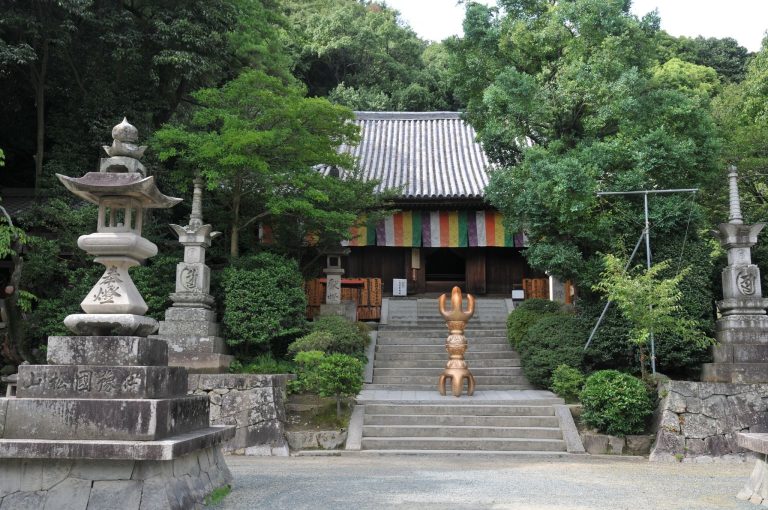
The temple’s formal name is Toyokuni-zan Henjō-in Hōgon-ji. It is associated with Shonin-zaka, an approach that developed as a settlement in front of the temple. The main gate stands at the upper end of Shonin-zaka and was the only structure to survive the 2013 fire.
Reconstructed worship halls
Main hall
The reconstructed main hall contains newly made images of the Amida Triad, representing the temple’s dedication to Amida Buddha.
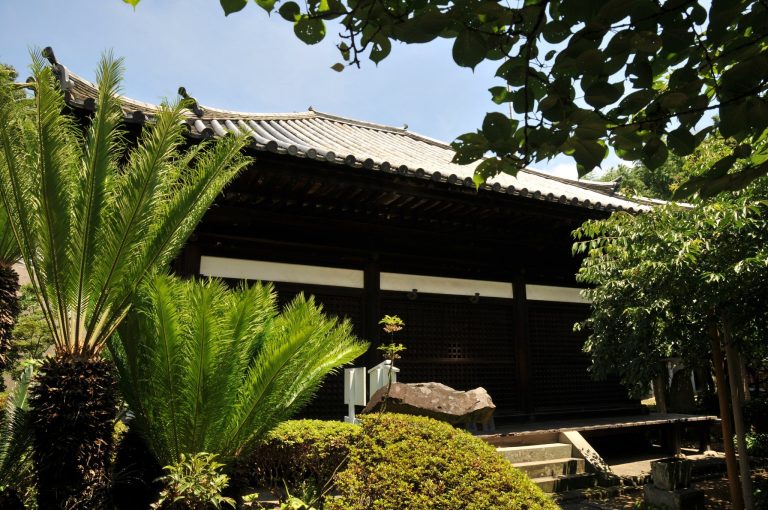
Ippen Hall
Ippen Hall contains a newly made bronze image of Ippen. The image is lacquered and measures 113 centimeters in height. The hall also displays four copies of the illustrated biography of Ippen.
Gardens and stone monuments
The grounds include a dry rock garden, several stones bearing haiku poems, and other stone monuments. The haiku stones include poems by the Matsuyama poet Masaoka Shiki, as well as by Mokichi Saito and Kawada Jun. A haiku stone, or kuhi, is a stone monument inscribed with a haiku poem.
Lost medieval image
The former wooden standing image of Ippen was made in 1475 during the Muromachi period, the Japanese historical period conventionally dated from the fourteenth to the sixteenth century. It measured 114 centimeters in height and was designated an old National Treasure in 1901, a status corresponding to today’s Important Cultural Property. The image was lost in the 2013 fire, and its designation was cancelled in 2014.