Myōkensan Kofun: An Early Kofun-Period Keyhole Burial Mound in Japan

Site at a Glance
- Rating
- 4.2
- Popularity
- Very Low
- Country
- Japan
- Primary era
- Classical
- External website
- Open
- Eras represented
- Classical
- Civilizations
- Yamato
- Site type
- Burial
- Remains
- Burial Mound
On this page8 sections
History
Myōkensan Kofun is an early Kofun-period burial mound in Imabari, Ehime, Japan, built during the first half of the early Kofun period, probably at the beginning of the fourth century. It forms part of the Myōkensan Kofun Group, a set of three burial mounds in the Onishi area on Shikoku. The Kofun period, generally dated from about the third to the sixth centuries, was an era when large burial mounds were constructed for powerful members of society.
An early coastal burial mound
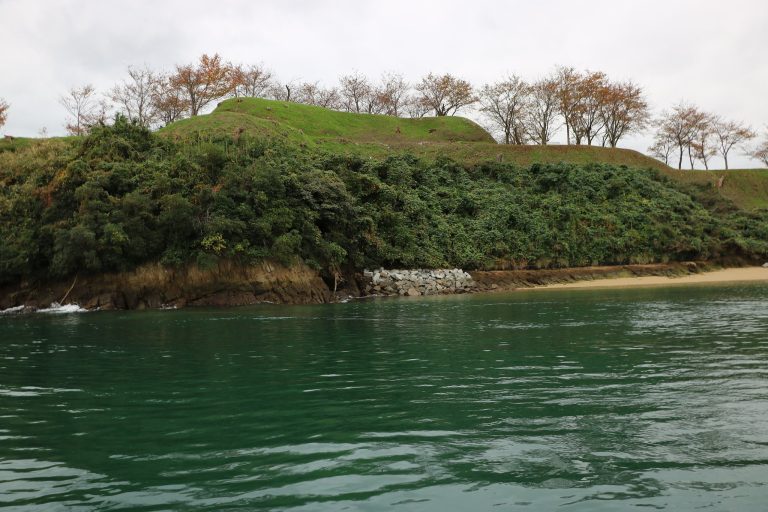
Myōkensan Kofun, also called Myōkensan No. 1, belongs to a category known as coastal keyhole burial mounds. Japanese archaeologist Kazuo Hirose and other researchers use this term for early Kofun-period mounds deliberately built in coastal areas. The mound stands on a hill overlooking the Iyo-nada waters of the Seto Inland Sea, placing it within a landscape where the burial monument could be associated with the coastal environment.
The tomb was constructed as a keyhole-shaped mound, combining a circular rear section with a roughly rectangular front section. Its two burial facilities were placed separately, one beneath the rear circular section and the other beneath the front section. Each chamber contained grave goods and is thought to have held a single coffin made from a hollowed tree trunk.
Excavation and preservation
Seven excavation campaigns took place between 1990 and 1993. They were carried out by the former Onishi Town Board of Education and the Archaeological Research Laboratory of Ehime University. Site improvements and preservation work followed in 1995 and 1996, helping conserve the mound and its burial facilities.
Myōkensan Kofun became a National Historic Site of Japan on August 5, 2010. The mound has since been conserved as a publicly accessible historic site, while pottery, grave goods, and other excavated materials are preserved and displayed at the Onishi Fujiyama Historical Museum.
Remains
Mound form and construction
Myōkensan Kofun is a keyhole-shaped mound with a short, fan-shaped front section that widens outward. The front faces east, and the mound occupies a hill about 80 meters above sea level. Its total length is approximately 56 meters, with a recorded length of 55.2 meters. The rear circular section measures 39 meters across and 7 meters high, while the narrowed connection between the two sections is 25.5 meters wide. The front section is about 17 meters long, approximately 33 meters wide, and 4 meters high.
The mound was formed in two stepped stages, mainly by cutting and shaping the natural ground, with additional earth fill used in places. Rows of stones run around the stepped sections and along the foot of the mound. Fukiishi, which are stones laid over the slopes or surface of a burial mound, have not been identified here. Double-mouthed jars and pedestal-shaped pottery, including an Iyo-type special vessel-stand form, were found on the mound surface, especially near the narrowed connection. Thousands of pottery fragments were recovered from around the mound.
Stone burial chambers
Burial Chamber No. 1
Burial Chamber No. 1 lies beneath the center of the summit in the rear circular section. Its east-west alignment follows the axis of the mound, with the head positioned to the west. The chamber is 6.7 meters long, 0.9 to 1.1 meters wide at its western side, and 0.8 to 0.9 meters deep. A hollowed wooden coffin is thought to have stood inside it.
Iron swords, an iron axe, iron knives, iron chisels, and related tools were found in or around the coffin, together with traces of a mirror. The chamber is protected by a covering structure. Its ceiling stone has been moved outside the mound for display.
Burial Chamber No. 2
Burial Chamber No. 2 was placed beneath the center of the summit in the front section. Like Chamber No. 1, it runs east-west parallel to the mound, with the head at the western end. It measures 3.9 meters long, 0.7 to 0.75 meters wide, and 0.5 to 0.6 meters deep. A hollowed wooden coffin is also thought to have been installed here.
The chamber contained a broken imported slant-edge four-animal mirror and fragments of iron implements. Its ceiling stone has been relocated outside the mound for display. Together with the pottery and other grave goods, these finds are preserved and displayed at the Onishi Fujiyama Historical Museum.