Iimoriyama Castle: A Sengoku Mountain Fortress in Osaka, Japan


Site at a Glance
- Rating
- 4
- Popularity
- Low
- Country
- Japan
- Primary era
- Medieval
- External website
- Open
- Eras represented
- Medieval
- Civilizations
- Unclassified
- Site type
- Military
- Remains
- Castle
On this page15 sections
History
Iimoriyama Castle was a Japanese mountain fortress on Mount Iimori in Daito and Shijonawate, Osaka Prefecture, Japan. Its permanent form took shape in the early sixteenth century during the Sengoku period, an era of intense rivalry among regional warlords, and its position between Kawachi and Yamato gave it an important military role.
Origins and the Kizawa period
The site may have begun as a temporary fortified position during the Nanboku-cho period, the fourteenth-century conflict between rival Northern and Southern imperial courts. A tradition attributes its construction to the monk Sasame Kenpo, although that story may concern another Iimoriyama Castle in Kii. The Taiheiki describes supporters of the Southern Court, probably members of the Onchi family, occupying Mount Iimori during the Battle of Shijonawate on January 5, 1348. The position at that time was probably a wartime field fort rather than a permanent castle.
A permanent fortress was established or substantially rebuilt in the early sixteenth century under Kizawa Nagamasa, deputy provincial governor for the Hatakeyama clan. The Hatakeyama were a powerful warrior family who held the provincial governorship of Kawachi. The castle’s construction is placed in either the Kyoroku or Tenbun period. Hatakeyama Yoshitaka and Miyoshi Katsumune attacked it in 1531 and again in 1532 during their contest for control of Kawachi.
During the second attack, Kizawa received help from Hosokawa Harumoto. Harumoto asked Shonyo, head of the Yamashina Honganji, to mobilize an Ikko uprising, a military movement of followers associated with the Honganji branch of Pure Land Buddhism. On June 15, 1532, the uprising struck the besieging army from behind, killing more than 200 men, including Miyoshi Katsumune. Hatakeyama Yoshitaka was pursued into southern Kawachi and committed suicide on June 17. The movement later expanded and contributed to the Tenbun Disturbance.
From Hatakeyama control to the Miyoshi base
Kizawa Nagamasa was later killed by Miyoshi Nagayoshi at the Battle of Taiheiji. Yasumi Munefusa, a senior Hatakeyama retainer, then held Iimoriyama Castle. In 1559, Nagayoshi supported Hatakeyama Takamasa against Yasumi. After both men were driven from Kawachi, Takamasa reconciled with Yasumi and restored him to the castle. Nagayoshi responded by attacking Takamasa’s Takaya Castle, while defeating the relief force sent by Yasumi.
Miyoshi Nagayoshi entered Iimoriyama Castle on November 13, 1560. He moved his residence there from Akutagawayama Castle and made Iimoriyama his principal base. Nagayoshi carried out major renovations, and these works probably created much of the arrangement visible in the surviving remains.
Hatakeyama Takamasa counterattacked in 1561 with troops from Negoro. His forces captured Sanga Castle, a subsidiary fort of Iimoriyama, and in 1562 killed Nagayoshi’s brother Miyoshi Jikkyu at the Battle of Kumeda. The Hatakeyama army then launched a general attack on Iimoriyama. Reinforcements led by Nagayoshi’s brother Ataka Fuyuyasu and Matsunaga Hisahide helped defeat the attackers at the Battle of Kyokoji.
Nagayoshi died in 1564 at the age of 43, following the deaths of his son Miyoshi Yoshioki in 1563 and Ataka Fuyuyasu in 1564. His death was reportedly concealed for three years. His body was temporarily buried in the Gotaitsuka Enclosure before being moved to Shinkanji in Yao.
Abandonment and modern recognition
Miyoshi Yoshitsugu and the Miyoshi Triumvirs controlled the castle after Nagayoshi’s death. During Oda Nobunaga’s campaign to pacify Settsu and Kawachi, the Triumvirs submitted to Nobunaga, and the castle passed to Hatakeyama Akitaka. When Akitaka was killed during Yusa Nobunori’s rebellion, Nobunaga attacked Nobunori at the Battle of Takaya Castle. Iimoriyama Castle fell and was abandoned in 1576.
In 1930, the Higashiosaka Electric Railway developed an amusement park on the site as part of a planned railway project between Morinomiya and Nara. The project never installed rides, although the facilities reportedly included a mountain house, tent village, and restaurant. The park closed after about ten years as the war intensified. Excavations from 2016 to 2018 revealed extensive stone walls, whose construction is considered earlier than the stone-wall system at Mount Komaki, traditionally described as Japan’s earliest castle extensively reinforced with stone. Iimoriyama Castle was selected as No. 160 on the Continued Top 100 Japanese Castles list in 2017 and became a National Historic Site on October 11, 2021.
Remains
Iimoriyama Castle occupies the ridges of Mount Iimori, whose summit reaches approximately 315.9 metres above sea level. This large ridge-top mountain castle extends for roughly a kilometre from north to south and several hundred metres across the mountain. More than 70 enclosures have been identified, while another survey counted more than 90. The principal enclosures follow the main north-south ridge, with further enclosures placed along east-west ridges. Ditches, earthen ramparts, stone walls, entrances, and subsidiary fortified positions formed a connected defensive layout.
Principal ridge enclosures
Gotaitsuka and Sanbonmatsu
The northern part of the main ridge includes the Gotaitsuka and Sanbonmatsu Enclosures. Gotaitsuka contains a building foundation with rows of roof tiles, interpreted as the base of a defensive tower. A pedestal-footed dish found there may point to a religious installation, since similar vessels are known from Kasuga Taisha in Nara. The Gotaitsuka Enclosure also preserves one of the principal concentrations of rough granite stonework.
Main Enclosure
The Main Enclosure lies north of the Takayagura Enclosure and has a stone wall below it. This wall is unusual for a mountain castle. It may have protected the approach from the Takitani and eastern sides and may belong to Miyoshi Nagayoshi’s renovations. Another interpretation places its rebuilding after the castle fell to Oda Nobunaga. Other stonework around the enclosure probably supported earthen ramparts.
Takayagura Enclosure
The Takayagura Enclosure occupies the mountain’s highest point. Its levelled area measures approximately 25 by 15 metres. A bronze statue of Kusunoki Masatsura stands on its northern side. Masatsura was a fourteenth-century commander who supported the Southern Court during the Nanboku-cho conflict.
Senjoshiki Enclosure
South of Takayagura, the Senjoshiki Enclosure measures approximately 40 by 32 metres. An FM radio transmission facility now occupies the enclosure, while a ditch and the remains of an entrance passage survive nearby. Stone-foundation buildings and everyday utensils found in this area suggest that it served as part of the castle lord’s residence and as a place for reception or meetings.
South Enclosure
The South Enclosure preserves earthen ramparts and a square-form entrance compound, known as a controlled gateway arrangement. Near the entrance is a group of sawtooth-shaped vertical ditches, a rare type of defensive earthwork in the Kinki region. Additional stonework was present at the entrance. Finds of stone-foundation buildings and everyday utensils indicate that this area also served residential and reception functions.
Side enclosures and defensive works
Bamba Enclosure
The Bamba Enclosure lies east of Senjoshiki and is occupied by Nankoji Temple. Its name refers to its large size, although it was probably not a horse ground. It may instead have been used to station troops.
Ditches and earthen bridge
Cut ditches separated Gotaitsuka from the northern enclosure group and divided Takayagura from Senjoshiki. At the latter ditch, a former earthen bridge survives as part of the approach between the two sides of the castle.
Stone walls and surrounding strongholds
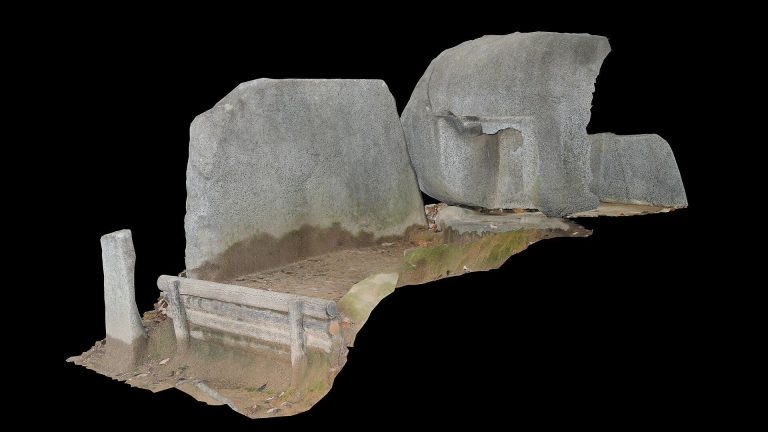
The castle’s stone walls were built mainly from granite laid as rough, unworked stones. The largest concentrations lie on the eastern sides of the Takayagura and Gotaitsuka Enclosures. An approach road on the eastern side may have been arranged to expose these walls to visitors and reinforce the authority of the castle lord. Retainer settlements and subsidiary strongholds lay to the west at Suna, Okayama, and Sanga, while Tawara and Kitatahara castles stood to the east and Nozaki and Tatsuma castles guarded the southern approach.
The surviving site includes enclosures, granite walls, earthen ramparts, cut ditches, vertical ditches, sawtooth-shaped ditch groups, square entrances, an earthen bridge, and a well site. The ruins have been damaged in places by the widening of mountain paths, and planting within the enclosures has been regarded as a potential threat to the archaeological remains. The bronze statue of Kusunoki Masatsura was restored after the Second World War through the efforts of the local notable Tabuki Kanematsu. A separate bronze statue of Miyoshi Nagayoshi stands in front of Daito City Hall.