Yasaka-ji Temple: A Shingon Buddhist Temple on the Shikoku Pilgrimage


Site at a Glance
- Rating
- 4.2
- Popularity
- Low
- Country
- Japan
- Primary era
- Modern
- External website
- Open
- Eras represented
- Modern
- Civilizations
- Japanese
- Site type
- Religious
- Remains
- Temple
On this page12 sections
History
Yasaka-ji Temple is a Shingon Buddhist temple in Matsuyama, Japan, traditionally founded in 701 and associated with the religious traditions of Shugendo and Kumano worship. Formally called Kumanozan Myoken-in Yasaka-ji, it belongs to the Daigo-ha branch of Shingon Buddhism, a branch connected with the Daigo-ji tradition. Its principal deity is Amida Nyorai, the Buddha of the Western Pure Land, and the temple is number 47 on the Shikoku 88-temple pilgrimage and number 10 among the Thirteen Buddhist Sites of Iyo.
Traditional Foundation and Early History
Tradition identifies En no Gyōja as the founder of the first religious site at Yasaka-ji. Regarded as the founder of Shugendo, a Japanese mountain religion combining ascetic practice, Buddhist teachings, and local kami worship, En no Gyōja is said to have established the site in 701. The Iyo provincial governor Ochi Tamazumi supposedly built the original hall at the request of Emperor Monmu. The name Yasaka is traditionally explained either by the opening of eight roads on slopes or by an association with increasing prosperity.
The temple later declined, and Kūkai is said to have rebuilt it in 815 during his travels in Shikoku. Kūkai, also known as Kōbō Daishi, was the ninth-century founder of the Shingon school of Japanese Buddhism. The temple’s principal Amida image is traditionally attributed to Genshin, a Heian-period priest remembered for teachings on Amida devotion and rebirth in the Pure Land. The wooden seated image now associated with Yasaka-ji, however, dates from the late Kamakura period.
Kumano Worship and Medieval Growth
During the late Kamakura period, the local notable Myoken-ni invited Kumano worship to Yasaka-ji. Kumano worship centers on the sacred Kumano region and its deities, whose identities were historically interpreted through Buddhist teachings as well as kami worship. Because Amida was regarded as the original Buddhist manifestation of the Kumano deity, the Kumano Twelve Shrines and related deities were installed in a long shrine building measuring 25 ken, a traditional architectural unit whose length varied by context.
Yasaka-ji then developed into a central Shugendo training center and became responsible for the Kumano shrine complex. Shugendo practitioners, often called yamabushi, trained through mountain pilgrimage, ritual, and ascetic practice. The temple supported numerous warrior monks and controlled 12 sub-temples and 48 branch temples, reflecting the breadth of its medieval religious organization.
Destruction and Later Continuity
Fire destroyed Yasaka-ji during the wars of the Tenshō era, from 1573 to 1592. The precinct was subsequently reduced, while Kumano worship declined across Shikoku. The temple continued through devotion to Mount Ishizuchi and its place on the Shikoku pilgrimage, preserving its religious role despite the loss of its earlier scale.
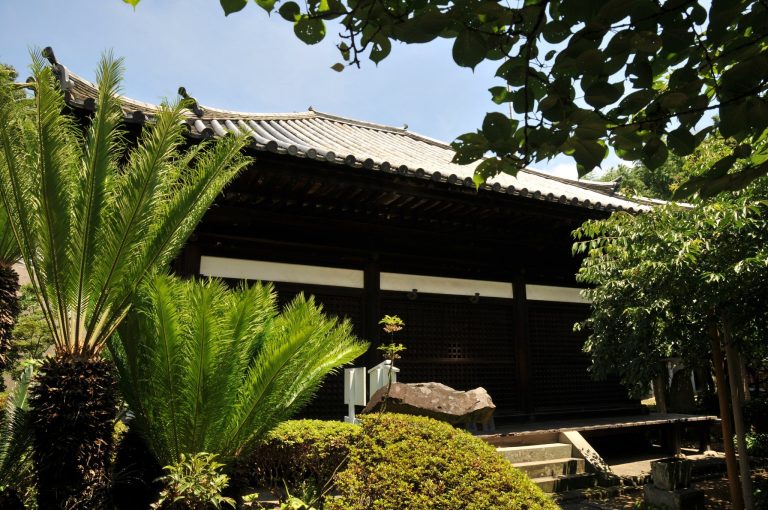
The present precinct occupies the former site of the Kumano Twelve Shrines. Construction of the current Main Hall began in 1972 and ended in 1984. The earlier Main Hall was then used as the Kumano Twelve Shrines Gongen Hall. Here, Gongen means a Buddhist manifestation of a kami, reflecting the historical interaction between Buddhist and kami worship in Japan.
Modern Religious and Historic Status
The principal Amida image is normally shown only once every 50 years. A special public viewing took place in 2014, and the next regular viewing is scheduled for 2034. The precinct forms part of the Iyo Pilgrimage Road historic site. Sections of the pilgrimage route had already been designated, and the Yasaka-ji precinct was added to the designated area on February 21, 2024.
Annual religious observances also continue within the precinct. A fire-offering ritual has been held every April 29 since the stone Fudo triad was established in 2005. An image of En no Gyōja, also honored by the title Jinben Daibosatsu, was consecrated in an eye-opening ceremony on March 28, 2021.
Remains
Gate and Approach
The precinct begins with a small, single-story Sanmon gate that spans a stream like a covered bridge. Its ceiling carries painted images of 22 bodhisattvas and Amida Nyorai. Beyond the gate, the approach includes a purification basin. The priests’ quarters and pilgrimage office stand on the right, while the Hōkyō-in pagoda is on the left and the bell tower lies farther ahead.
Central Worship Buildings
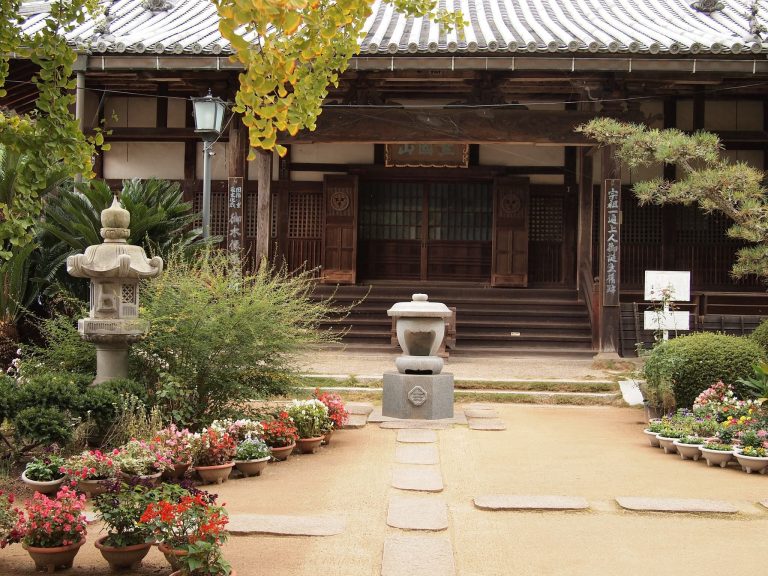
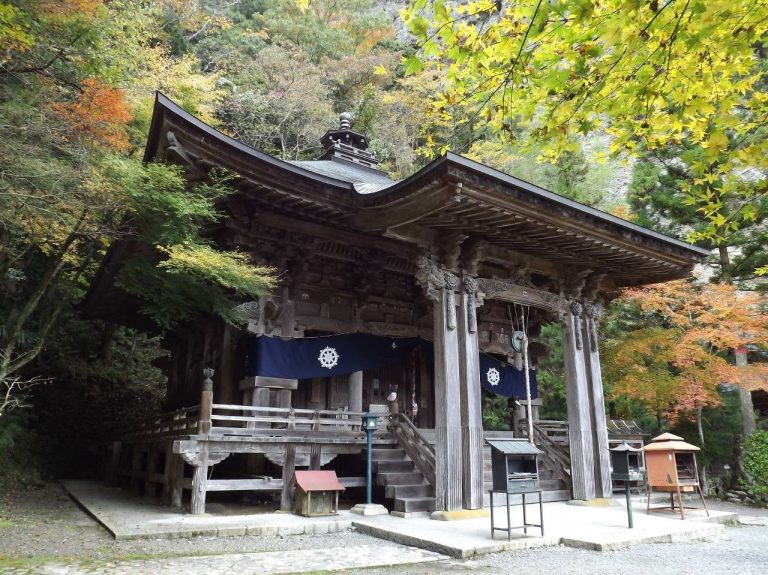
The Main Hall occupies the center of the rear precinct. Built between 1972 and 1984, it houses the principal worship associated with the late-Kamakura-period seated Amida image, which is designated as a cultural property of Ehime Prefecture. Fudo Myōō and Bishamonten serve as attendant images. Fudo Myōō is a protective deity associated with immovable resolve, while Bishamonten is a guardian deity linked with protection and prosperity.
To the right of the Main Hall stands the Kumano Twelve Shrines Gongen Hall. It consists of a worship hall and a sanctuary behind it, with the former Main Hall serving as the worship hall. The surviving arrangement preserves the connection between the temple and the Kumano deities whose Buddhist manifestations were incorporated into the religious complex.
Daishi and Enma Halls
The Daishi Hall contains an image of Kūkai. A seated image of Shōbō stands on the left, and a Buddhist image cabinet on the right holds two standing Amida images. Shōbō was a tenth-century Japanese Buddhist monk associated with the Shingon tradition and with the revival of religious practice at Mount Daigo.
The Enma Hall presents separate routes representing the way to paradise and the way to hell. It also issues a “pass for rebirth in paradise,” traditionally placed in a deceased person’s coffin and cremated with the body. The hall therefore combines visual religious teaching with a funerary practice connected to hopes for rebirth.
Pagodas, Staircase, and Protective Images
A Hōkyō-in pagoda stands near the pilgrimage office, and a multi-level pagoda stands near the Daishi Hall. A Hōkyō-in pagoda is a Buddhist memorial structure traditionally associated with the Hōkyō-in-darani scripture and the accumulation of religious merit. The pagoda at Yasaka-ji is designated as a cultural property of Matsuyama City.
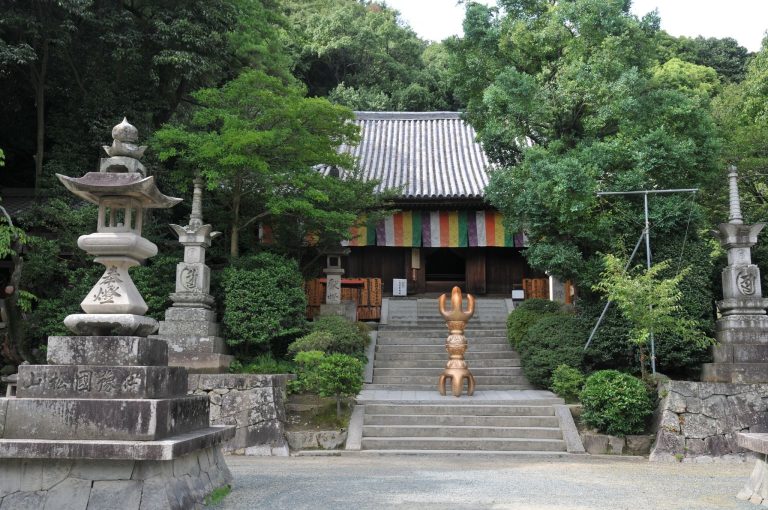
The “Hand of Salvation” is placed beside the tenth step of the stone staircase leading to the Main Hall. It is associated with removing nine difficulties. At the edge of the precinct stands the stone Fudo triad, consisting of Fudo Myōō and two smaller attendants. The triad was erected in 2005. The image of En no Gyōja, also called Jinben Daibosatsu, was consecrated in 2021.
Poetry, Cemetery, and Burial Mounds
A poetry monument by Mori Hakuzo stands opposite the bell tower. Since 2010, further monuments bearing selected poems have been placed one at a time in front of the Daishi Hall. A large cemetery surrounds the temple on its western and northern sides, extending the precinct’s religious landscape beyond the principal buildings.
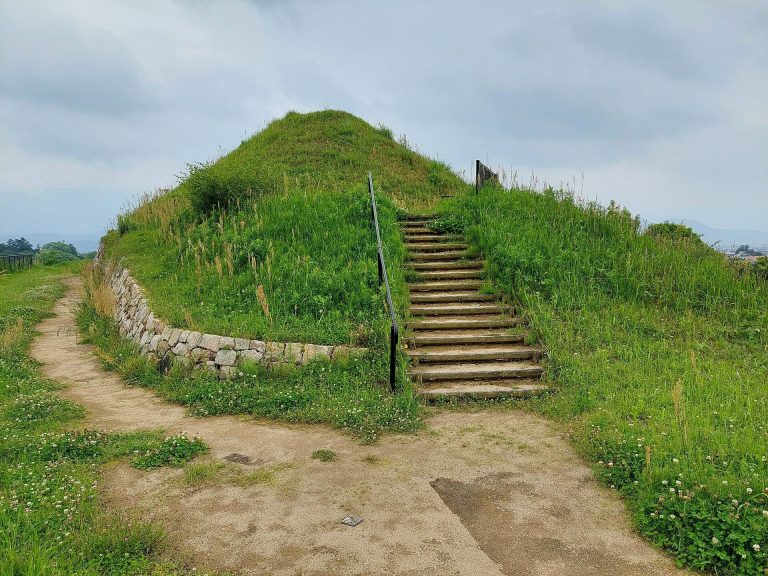
Eight burial mounds near the temple are traditionally said to be the graves of the sons of Emon Saburo. One interpretation connects these mounds with the name Yasaka, while another preserved tradition links the name to eight roads on slopes. The two explanations remain part of the temple’s associated traditions.
Images and Devotional Objects
Approximately 8,000 ceramic Amida images are displayed at the temple. Each bears the name of the devotee who purchased it. Together with the wooden seated Amida image in the Main Hall, these objects express the central place of Amida devotion in Yasaka-ji’s surviving religious life.