Taihō-ji Temple: A Shingon Buddhist Temple on the Shikoku Pilgrimage


Site at a Glance
- Rating
- 4
- Popularity
- Very Low
- Country
- Japan
- Primary era
- Medieval
- External website
- Open
- Eras represented
- Medieval
- Civilizations
- Kamakura shogunate
- Site type
- Religious
- Remains
- Temple
On this page12 sections
History
Taihō-ji Temple is a Buddhist temple in Matsuyama, Japan, traditionally founded in 701 during the Taihō era. It belongs to the Buzan branch of Shingon Buddhism, a Japanese esoteric tradition centered on ritual practice, sacred images, mantras, and mandalas. Its principal image is a seated Amida Nyorai, and the temple is traditionally counted as the 44th of the 88 temples on the Shikoku pilgrimage, a circuit associated with Kūkai. For this reason, it is also called “Nakafuda,” meaning approximately “the middle marker.”
Foundation and Shingon Affiliation
The temple’s origin is preserved through more than one tradition. One account attributes its establishment to a leader of the local Ochi clan who held the title Iyo-no-kami. Another says that a priest from Baekje first created a devotional site for an eleven-faced Kannon, a form of the Buddhist bodhisattva of compassion. In this version, the brothers Myōjin Ukyo and Hayato renewed the site in 701 after finding the sacred image in grass, and Emperor Mommu ordered a temple to be built under the name Taihō-ji, taken from the era name.
In 822, the monk Kūkai visited Taihō-ji and transferred it from the Tendai tradition to Shingon Buddhism. Kūkai, also known after his death as Kōbō Daishi, established Shingon in Japan during the early ninth century. The temple’s principal image and its later role in the Shikoku pilgrimage connect it to the religious traditions associated with him.
Destruction and Rebuilding
Taihō-ji almost completely burned in 1152. After Emperor Go-Shirakawa prayed at the temple and recovered from illness, he ordered its complete rebuilding. The temple was also known as Sugōzan, after the mountain behind it, and it reportedly flourished with 48 hermitages.
During the civil wars of the sixteenth century, troops of the Chōsokabe destroyed the temple. It was later rebuilt with support from the lords of Matsuyama, a wealthy branch of the Matsudaira-Hisamatsu family, and became their prayer temple. Throughout the Edo period, successive lords of the Matsuyama domain continued to use Taihō-ji for prayer. Matsudaira Sadanao, the domain’s fourth lord, ordered repairs to the main hall in 1685.
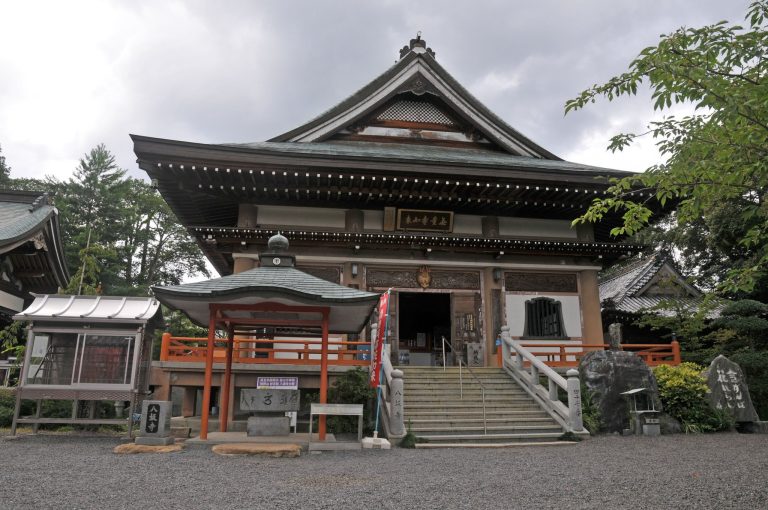
A third major fire struck in 1874, despite attempts to extinguish it. The main hall survived the temple’s successive fires and is now designated a National Treasure of Japan. The temple’s principal image and two other Buddhist statues are designated Important Cultural Properties.
The Uba-sakura Legend
Taihō-ji is associated with the Uba-sakura, or “nurse cherry,” legend. It tells of Tsunoki Chōja, a wealthy local man whose prayers to Yakushi Nyorai, the Buddha associated with healing, led to the birth of his daughter Tsuyu. He employed a wet nurse named Osode, and after prayers restored her milk supply, he built a hall in gratitude. This act was said to mark the beginning of Taihō-ji.
When Tsuyu became seriously ill at the age of 15, Osode prayed to exchange her own life for the girl’s. After Tsuyu recovered, Osode refused treatment and, before dying, asked for a cherry tree to be planted as an offering to Yakushi Nyorai. The tree reportedly produced two or three flowers directly from its trunk before its branches had extended. Their shape was said to resemble breasts and their color to resemble breast milk, leading women with difficulty producing milk to visit the temple. During the Meiji period, Lafcadio Hearn translated the story into English and included it in Kwaidan.
Remains
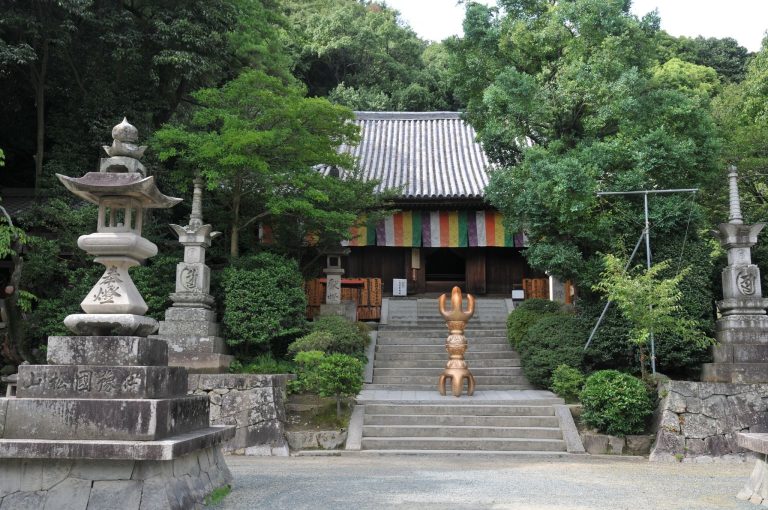
Taihō-ji stands on a rise reached by a long staircase. The tiled-roof main hall occupies the front of the upper grounds, while other buildings and the mountainside cemetery extend behind it. Cherry trees associated with the Uba-sakura tradition form part of the temple grounds, and Hanami Park lies below the temple on its right.
Temple Buildings
Hondō
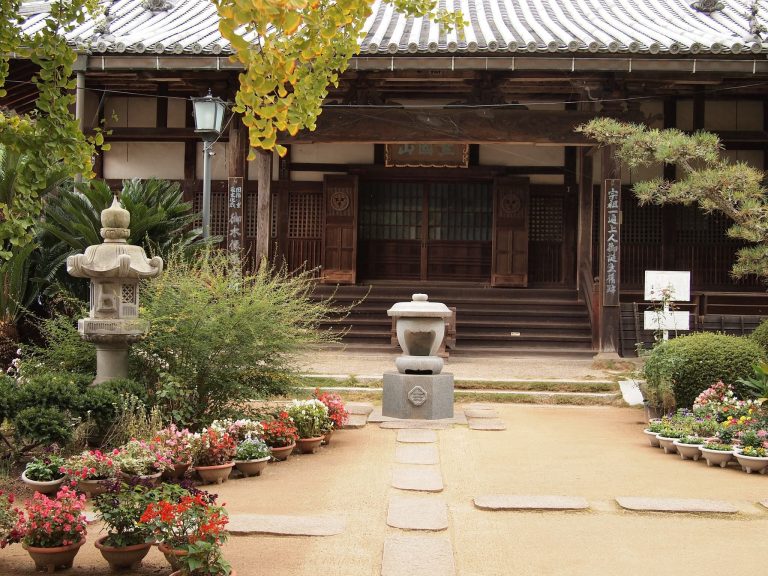
The Hondō, or principal hall, dates from the early Kamakura period, conventionally dated from 1185 to 1333. It is the oldest surviving wooden building in Ehime Prefecture. Its tiled roof and timber construction give the upper grounds their principal architectural focus, and the hall has survived the fires that destroyed much of the temple at different times.
Daishidō and Cemetery
The Daishidō, a hall dedicated to Kūkai, stands to the right of the Hondō. It is a plain building, contrasting with the principal hall. A cemetery occupies the mountainside behind the Daishidō.
Yumedono and Bell Tower
A small octagonal pavilion called the Yumedono, or “Hall of Dreams,” stands within the grounds. Its name refers to the famous Hall of Dreams associated with Prince Shōtoku at Hōryū-ji. A bell tower stands near the pavilion.
Buddhist Images and Cherry Trees
Buddhist Images
The temple preserves two seated wooden statues of Amida Nyorai from the Heian period, conventionally dated from 794 to 1185, together with a seated wooden statue of Shaka Nyorai from the same period. All three statues are Important Cultural Properties. One of the Amida figures serves as Taihō-ji’s principal image.
Uba-sakura Tradition
Cherry trees on the temple grounds are associated with the Uba-sakura tradition and its story of Osode, Tsuyu, and Yakushi Nyorai. The trees connect the physical setting with a local religious tradition centered on healing, nursing, and offerings.