Yashima no Misasagi: Imperial Mausoleum of Prince Sawara in Nara


Site at a Glance
- Rating
- 3.7
- Popularity
- Very Low
- Country
- Japan
- Primary era
- Medieval
- Eras represented
- Medieval
- Civilizations
- Unclassified
- Site type
- Religious
- Remains
- Tomb
On this page16 sections
History
Yashima no Misasagi is an imperial mausoleum in Japan, in Yashimacho, Nara City, associated with Prince Sawara, a member of the imperial family. Sawara was later honored posthumously as Emperor Sudo, although he never reigned as emperor. The mausoleum’s history begins in the late eighth century and reflects the political crisis surrounding his death, later efforts to pacify his spirit, and the transformation of the surrounding religious precinct.
Prince Sawara and the imperial mausoleum
Prince Sawara was implicated in the assassination of Fujiwara no Tanetsugu. He was deprived of his position in 785 and died at the age of 35 while being exiled to Awaji Province. His body was initially buried in Awaji.
Calamities were attributed to the anger of Sawara’s spirit, and in 800 he was posthumously honored as Emperor Sudo. His grave in Awaji was then treated as an imperial mausoleum, with two households assigned to protect it. In 805, an official responsible for reburial was appointed, and Sawara’s remains were transferred to Yashima no Misasagi.
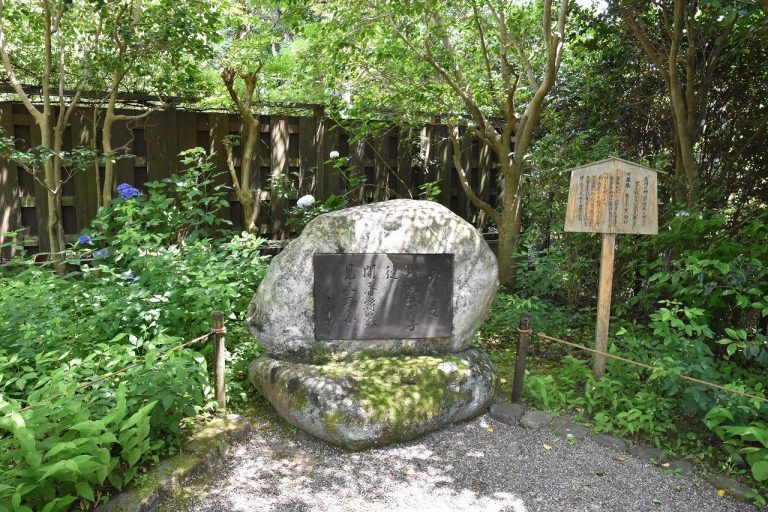
Local tradition gives a different explanation for the move. In one version, Sawara appeared in a dream and threw nine stones eastward, commanding that his mausoleum be moved to the place where they landed. Eight of the stones were believed to have fallen in the Yashima area. Another version says that the remains were brought to Yashima and buried there in 798. These traditions preserve the connection between Sawara, the mausoleum, and the stones known locally as the Eight Stones.
Shinto and Buddhist institutions at Yashima
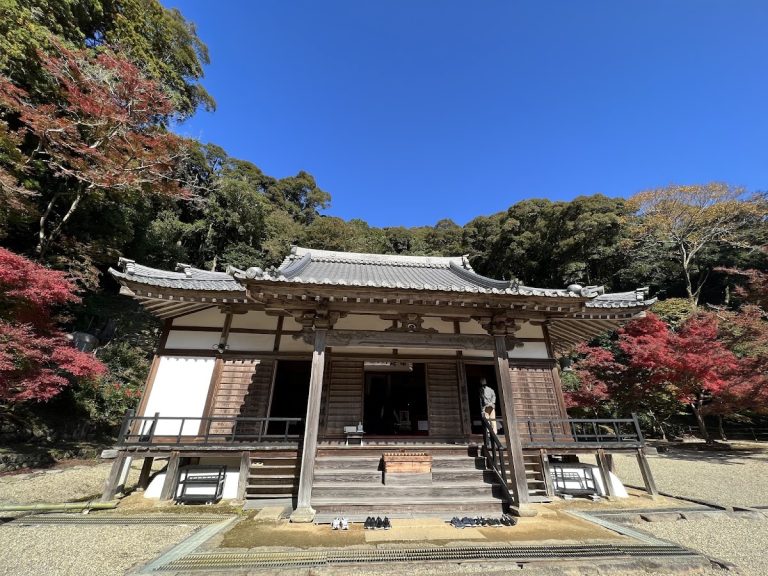
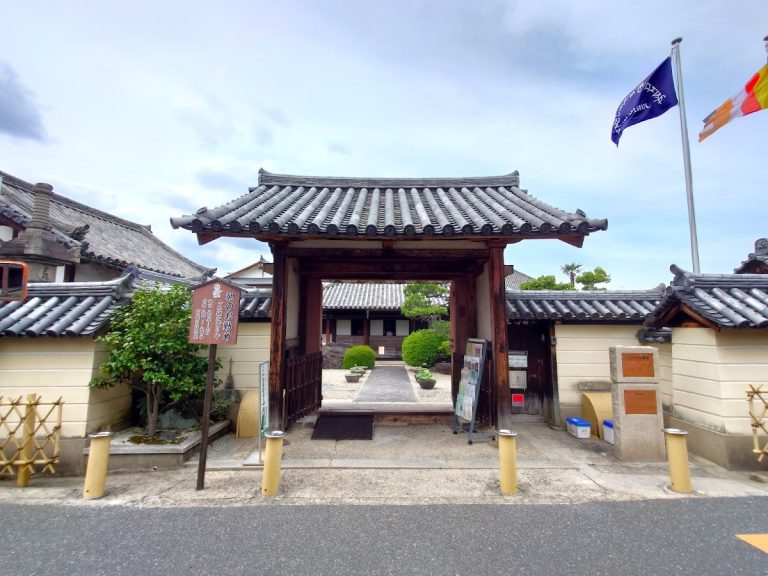
Yashima’s religious landscape developed around the mausoleum. A record from 1627 mentions a shrine to Emperor Sudo and a Buddhist temple at the site. The temple is identified with Yashimadera, which occupied the mausoleum’s present location and surrounding area during the early-modern period.
Until Yashima no Misasagi was officially identified as the mausoleum of Emperor Sudo in 1865, the former Sudo Tenno Shrine was revered as the village shrine of twelve nearby villages. It stood at the center of the mausoleum precinct until it was moved in 1886. The shrine held an annual August gathering to pray for rain. Local residents presented sumo, dengaku and sarugaku performances, along with dancing accompanied by Buddhist prayers. The gathering drew such large crowds that the weight of spectators once caused the roof of a temporary shelter to collapse.
The shrine’s main hall had originally been transferred from Kasuga Taisha during that institution’s periodic rebuilding. When the Sudo Tenno Shrine was combined with Shimada Shrine in 1886, the hall was moved again and became Shimada Shrine’s main hall.
Yashimadera and the Meiji reorganization
Yashimadera was abolished in 1875. It had been founded to pacify Prince Sawara’s spirit, although traditions differ about its origin. One account says that Sawara’s relics were divided and enshrined at a temple in Yashima in 800. Other traditions place the temple’s foundation at Yamashina in 806 and identify Yamashina-dera as another name for it.
The temple traditionally enshrined a seated image of Yakushi Nyorai, the Buddhist Buddha of healing and medicine, as its principal image. A miraculous event was associated with Yashimadera in 814, when eighteen ears of rice were said to have grown from a single stalk.
During the anti-Buddhist movement of the Meiji period, a government-backed campaign that separated Buddhism from state-supported Shinto, Yashimadera was abolished and its statue of Bishamonten, a Buddhist guardian deity associated with protection and military power, was offered for sale. The proceeds were reportedly used in the Showa period to establish a community hall and a Bishamonten hall, and a new image of Bishamonten was acquired.
Several small shrines near the mausoleum are thought to have developed through the transfer of worship from the former Sudo Tenno Shrine. Each enshrines Prince Sawara as its principal deity. Yashima, Deyashiki, Shinden, and Kita-Nagai appear to have belonged to the medieval district of Yashima, which comprised nineteen villages.
Changes to the precinct
A historical map copied in 1901 shows the religious complex before its reorganization was complete. It includes a worship hall, a torii gateway, shrine buildings, a Yakushi hall, the site of a hall associated with the Ten Rakshasis, priestly quarters, and a storehouse. From the Meiji period onward, these buildings were moved or abolished as the mausoleum precinct was reorganized.
Remains
The mausoleum and surrounding mound
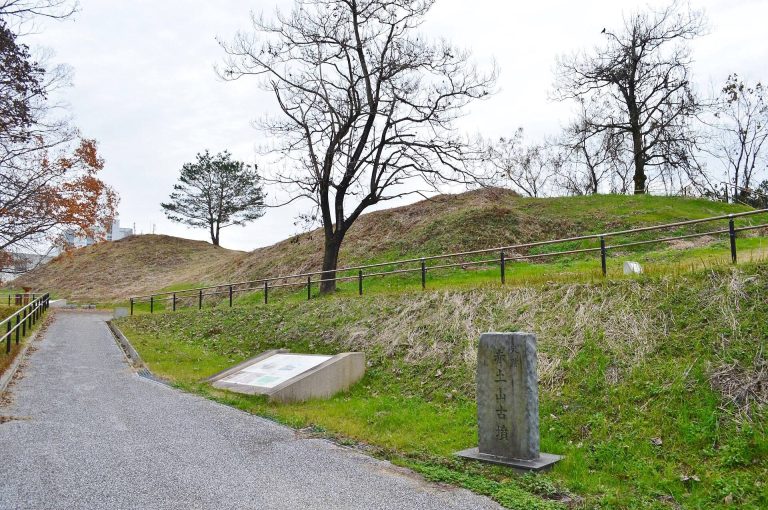
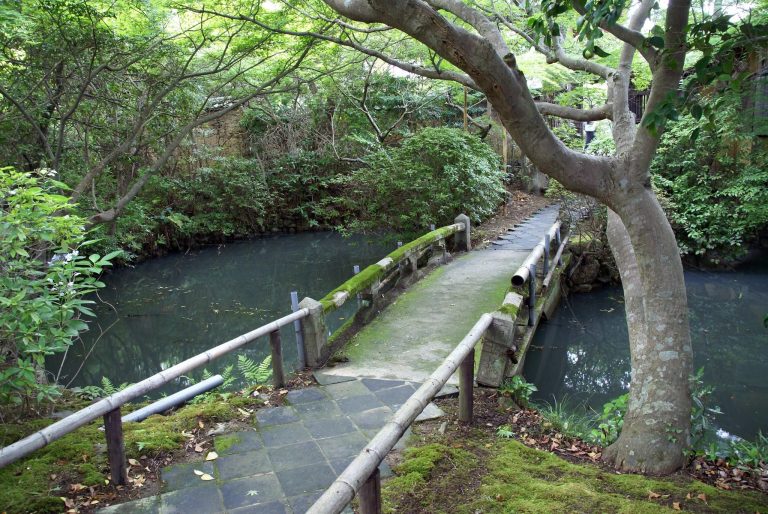
Yashima no Misasagi is a circular mound described as slightly elliptical. A square earthen wall encloses the precinct. Dense pine and broad-leaved trees make the mound appear square when viewed from a distance, although it is classified as a circular tomb in the Imperial Mausolea Handbook.
The Engishiki gives the mausoleum precinct dimensions of approximately 545 meters from east to west and 436 meters from north to south, and notes that two households were assigned to guard it. A later survey gives smaller dimensions of approximately 109 meters east to west and 69 meters north to south.
The Eight Stones and adjacent tomb
Immediately in front of the mausoleum, within the road, is a separate ancient tomb whose burial mound has been lost. Large natural roofing stones from its horizontal stone chamber, a later burial structure entered from the side, remain exposed. The surviving remains measure approximately 7 meters from north to south and 3 meters in width.
The exposed stones are locally called the Eight Stones. Tradition identifies them with eight of the nine stones attributed to Prince Sawara and links them to the establishment of Yashima, and possibly to the place-name itself. Archaeologically, the tomb appears to date from the later Kofun period, the era of ancient Japanese burial mounds, and probably has no direct connection with Sawara. Another tradition says that attempts to remove the stones caused death or illness among construction workers because of a curse.
Yashimadera and surviving religious objects
Temple site
Yashimadera stood northwest of the mausoleum on a plot measuring approximately 23.6 meters from east to west and 41.5 meters from north to south. It was also called Eight-Stone Mountain Temple, a name associated with the nearby Eight Stones.
Nirvana painting
An old Nirvana painting believed to have come from Yashimadera remains in private ownership. It is a large silk painting made with colored pigments, measuring 164 centimeters in height and 118.5 centimeters in width. Its storage box identifies it as permanent temple property of Eight-Stone Mountain Yashimadera, and an inscription records its refurbishment in 1732.
Former shrine precinct
The former shrine precinct shown on the 1901 map contained a worship hall for offerings and prayer, a torii gateway, shrine buildings, a Yakushi hall, the site of a hall associated with the Ten Rakshasis, priestly quarters, and a storehouse. These features occupied the area at and around the mausoleum before later movements and abolitions altered the religious layout.
Nearby Sudo Tenno shrines
Deyashiki Sudo Tenno Shrine
The Deyashiki Sudo Tenno Shrine has a precinct of approximately 760 square meters. A stone torii stands on its eastern side, while the south-facing main hall, which houses the shrine’s principal deity, is positioned to the west. The precinct has no subsidiary shrines. A pair of stone lanterns outside the surrounding fence bears an inscription dated 1781. The lanterns and guardian figures inside the fence date from 1919.
Shinden Sudo Tenno Shrine
The Shinden Sudo Tenno Shrine has a south-facing main hall covered with copper sheets and fitted with elaborate metalwork. Its precinct includes a subsidiary shrine to Ame-no-Koyane, a Shinto deity associated with ritual prayer and the Fujiwara lineage. South of the worship hall is an Inari Shrine dedicated to Ukemochi-no-kami, a food deity. A Jizo hall contains small stone images of Jizo, a Buddhist bodhisattva commonly represented in this form.
Parts of a five-ring pagoda stand beside the Jizo hall, including its fire ring and lotus pedestal. A five-ring pagoda is a Buddhist monument composed of five symbolic elements associated with earth, water, fire, wind, and space. These elements are thought to have come from Anyoji Temple, whose former site was later occupied by the neighboring community hall.
Kita-Nagai Sudo Tenno Shrine
The Kita-Nagai Sudo Tenno Shrine has a south-facing main hall flanked by Ichikishima Shrine and Yasaka Shrine. Ichikishima Shrine enshrines Ichikishima-hime-no-mikoto, a water-associated Shinto deity, while Yasaka Shrine enshrines Susanoo-no-mikoto, a major storm-associated deity in Japanese mythology. The precinct also contains a worship hall and storehouse and is relatively extensive.