Shin-Yakushi-ji Temple: A Nara-Period Buddhist Temple in Japan


Site at a Glance
- Rating
- 4.5
- Popularity
- Medium
- Country
- Japan
- Primary era
- Medieval
- External website
- Open
- Eras represented
- Medieval
- Civilizations
- Kamakura shogunate
- Site type
- Religious
- Remains
- Monastery
On this page20 sections
History
Shin-Yakushi-ji Temple is a Buddhist temple in Nara, Japan, founded in 747 under the Nara-period state and associated with the Kegon school of Buddhism. Its formal name is Nirinzan Shin-Yakushi-ji, and its principal deity is Yakushi Nyorai, the Buddhist Buddha of healing and medicine. The temple was an officially sponsored institution whose foundation was traditionally connected with the recovery of Emperor Shōmu from an eye illness.
Imperial foundation traditions
Shin-Yakushi-ji has more than one foundation tradition. The most widely repeated account says that Empress Kōmyō established it in 747 and commissioned images of the Seven Buddhas of Healing for her husband’s recovery. Another tradition attributes the foundation to Emperor Shōmu, who is said to have established the temple in 745 for Kōmyō’s recovery from an eye disease. The Seven Buddhas of Healing were a group of healing Buddhas associated with devotion to Yakushi.
The foundation was linked to an imperial order issued in 745. This order called for Yakushi repentance rites at temples in the capital and nearby region and for the construction across the country of seven images of Yakushi, each six shaku and three sun high. Late-Heian records from Tōdai-ji state that Kōmyō founded the institution, then called Kōyaku-ji, in 747. The temple was also known as Kōzan Yakushi-ji or Kōyaku-ji.
Kōzan-ji and the early complex
The relationship between Shin-Yakushi-ji and the separately named Kōzan-ji, or Kōzan-dō, remains debated. One interpretation treats Kōzan-ji and Shin-Yakushi-ji as different names for the same institution and identifies Kōzan-dō as Kōzan-ji. Another regards Kōzan-ji as a separate temple in the Kasuga mountains that later merged with Shin-Yakushi-ji and became an inner sanctuary. A further interpretation sees it as an independent institution that disappeared during the middle Heian period.
A cadastral map from 756 shows a Shin-Yakushi-ji hall at the present site and a Kōzan-dō in the eastern Kasuga mountains, indicating that the two buildings existed at the same time. A field investigation in 1966 identified temple remains on a ridge near the source of the Saho River. The style of the roof tiles places construction there before 745. A temporary government office responsible for constructing Kōzan Yakushi-ji was still operating in 762, showing that building work continued after the traditional foundation date.
At its height, Shin-Yakushi-ji occupied an area of about four chō, approximately 440 metres, on each side. Its grounds extended roughly to the present campus of Nara University of Education and covered about 200,000 square metres. The temple was a complete seven-building compound, known in Japanese as a shichidō garan, with more than 100 monks, monks’ quarters, pagodas, and other structures.
Fire, decline, and medieval revival
Lightning caused a fire in 780 that destroyed the western pagoda and spread to several other halls. The temple declined after the disaster. In 962, a typhoon brought down the original main hall and other principal buildings. Shin-Yakushi-ji was later restored, but it did not recover its earlier scale.
When the original main hall was destroyed during the Heian period, another building, probably the former refectory, was converted into the principal hall. The present image of Yakushi was probably not among the images installed in the original hall, and its precise origin remains uncertain.
Shin-Yakushi-ji survived the military fire of 1180 associated with Taira no Shigehira. That conflict destroyed the principal compounds of Tōdai-ji and Kōfuku-ji. During the Kamakura period, the priests Jōkei and Myōe helped revive the temple after its decline. The present East Gate, South Gate, belfry, and Jizō Hall were built during this period, and most of the principal buildings other than the surviving Nara-period main hall also date from it.
Archaeology and preservation
Archaeological excavation during rebuilding work at Nara University of Education in 2008 revealed a large building foundation about 150 metres west of the present temple. It is believed to be the original Kondō, or main worship hall, associated with the Seven Buddhas of Healing. The foundation corresponds to the Shin-Yakushi-ji hall shown on the 756 cadastral map.
Eight early-Heian Lotus Sutra scrolls were found inside the principal Yakushi image in 1975. Conservation work on the image’s halo began in 2023. The main hall, the seated Yakushi image, and eleven of the Twelve Heavenly Generals are National Treasures of Japan. The South Gate, East Gate, Jizō Hall, belfry, and several related cultural properties are Important Cultural Properties.
Remains
Nara-period sacred ensemble
Main hall
The surviving Hon-dō, or main hall, is an eighth-century Nara-period building and the oldest extant structure at Shin-Yakushi-ji. It is also among Japan’s oldest surviving wooden buildings. The structure was not originally intended to serve as the temple’s main hall, since the larger Kondō stood elsewhere and the two buildings existed together until approximately the middle of the Heian period.
The Hon-dō underwent thorough restoration in 1302 and 1303. It has a large hip-and-gable roof, known as an irimoya roof, whose lower section is hipped and whose ends are gabled. Whitewashed walls rise above thick pillars set on an earthen floor. An open ceiling exposes the sheathing beams and rafters, while the east wall contains a stained-glass window. The ceiling was formerly painted red.
Yakushi Nyorai
The seated wooden Yakushi Nyorai is 191.5 centimetres high and is generally dated to the late eighth century or the early Heian period. It may instead belong to the period when the present main hall was built. The figure was carved principally from a single Japanese nutmeg tree. The legs, parts of the arms, and other elements were joined from the same timber while preserving the vertical direction of the wood grain.
The image has an unpainted wood surface, with black ink on the eyebrows, pupils, and beard and red pigment on the lips. Its large eyes, prominent lips, sharply defined curls, broad nose, and narrow pointed eyebrows give the face a distinctive appearance. The raised right hand forms the mudra of fearlessness, a symbolic Buddhist hand gesture, while the left hand rests palm-up on the leg and holds a medicine jar.
Yakushi stands on a circular platform about nine metres across and 90 centimetres high, occupying almost the entire Hon-dō. Six smaller Buddha figures on the halo bring the total to seven and represent the Seven Buddhas of Healing. The halo also carries a decoration interpreted as acanthus foliage derived from artistic traditions of the Silk Road.
Twelve Heavenly Generals
Approximately life-sized clay sculptures of the Twelve Heavenly Generals stand in a circle around Yakushi, facing outward. Dated to about 729 to 749, they are regarded as the oldest surviving group of their kind in Japan. The figures were made from unbaked clay and were originally painted. Salmon-colored skin, ink-drawn beards, bright clothing and armor, and areas of gold leaf once animated the group, although only small portions of the original decoration survive.
Eleven figures are National Treasures. The twelfth, the Haira figure in the temple’s current naming, is a twentieth-century replacement. Individual names differ between temple usage and the National Treasure designation. In counter-clockwise order from the front-right, or southeast, the figures are Bazara, also called Meikira, with raised hair, an open mouth, and a sword; Anira, wearing a helmet and examining an arrow; Haira, also called Kubira, with a bow and arrows; Bigyara, lifting a three-pronged vajra, a Buddhist ritual implement; and Makora, carrying an axe.
The sequence continues with Kubira, also called Shōtora, holding a sword; Shōtora, also called Santera, with a downward-pointing sword, wild hair, and differently colored eyes; Shintara, holding a sacred jewel and staff on a sandbar-shaped pedestal; Santera, also called Antera, leaning on a trident; Meikira, also called Indara, with one arm raised and one leg bent; Antera, also called Bazara, carrying a fly whisk; and Indara, also called Haira, holding a trident. Their helmets, weapons, armor patterns, pedestals, and gestures vary from figure to figure.
The original clay figure now called Haira was damaged in an earthquake at the end of the Edo period. Hosoya Jiraku made the present wooden replacement in 1931. A different general, identified in temple usage as Meikira and standing immediately to the right of the principal image, was reproduced on a Japanese 500-yen postage stamp.
Lotus Sutra scrolls
The eight Lotus Sutra scrolls discovered inside the Yakushi image in 1975 date from the early Heian period. They are designated as an associated National Treasure and form part of the material history preserved with the principal sculpture.
Kamakura-period buildings
South Gate
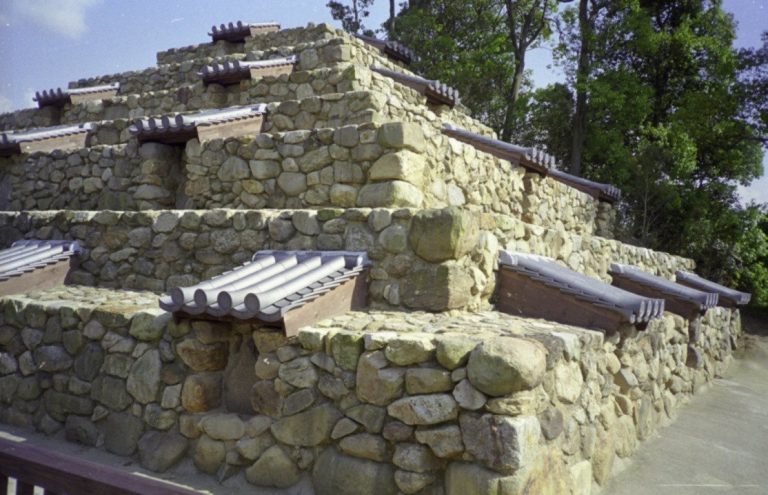
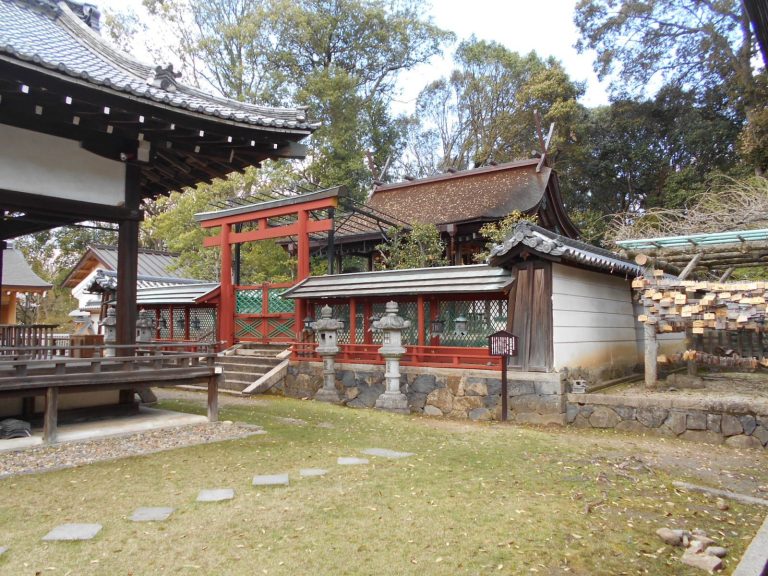
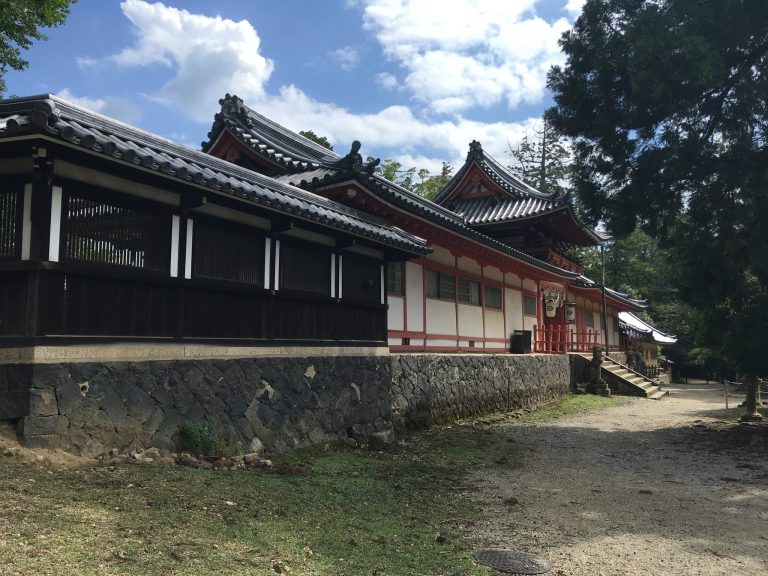
The South Gate is a four-legged gate from the Kamakura period, built between the late twelfth and early thirteenth centuries. A four-legged gate has two principal posts and two supporting posts. The gate’s four posts have unusually broad chamfered edges and stand on a platform made from unhewn rocks. It is the oldest surviving example of this gate type in Japan.
East Gate
The East Gate has upper main posts divided into two and supported by solid-board frog-leg struts. These unusual construction details indicate an early Kamakura-period date.
Jizō Hall
The Jizō Hall is a small Kamakura-period building in the Japanese architectural style, measuring 3.05 by 3.05 metres. Its name derives from the Jizō image formerly believed to have been enshrined there. An image of the Eleven-faced Goddess of Mercy is currently worshipped inside.
Belfry
The belfry was built in 1279. Its lower section flares outward in a skirt-like form called hakamagoshi, a design that became popular from the late Heian period onward. The structure contains a Nara-period bell said to have been transferred from the bell tower of Gangō-ji after that building burned. Scars on the bell are traditionally interpreted as fingernail marks left by an ogre from a Gangō-ji legend.
Other images and displaced works
Kōyaku Yakushi
The bronze standing Yakushi known as Kōyaku Yakushi was a 75-centimetre gilt-bronze image from the Hakuho period. It was regarded as an outstanding example of Hakuho-period art and was popularly called the Golden Buddha. The statue was stolen in 1890 and recovered at nearby Naramachi Tenjin Shrine with its right hand broken.
After a second theft in 1911, the image was found in a field in Osaka with both feet and the right hand damaged. The feet were taken away. A Kōyaku Yakushi Hall was later built at Shin-Yakushi-ji partly for security, but the statue was stolen for a third time on March 26, 1943, and remains missing.
Pre-theft photographs and several replicas made from a 1942 plaster mold now represent the lost image. Its original right hand was separated from the statue after the earlier thefts and eventually passed to Shigesaku Sasaki, a writer and enthusiast of Buddhist images. His heirs donated it to Tōkei-ji in Kamakura in 2000. Masako Kida located it there in 2015, and it was returned to Shin-Yakushi-ji in 2016.
Jizō images
Two wooden standing Jizō figures are Important Cultural Properties. The clothed figure, popularly called Kagekiyo Jizō, dates from the Kamakura period and was moved from the nearby Kagekiyo Jizō Hall in 1869.
When the clothed figure was dismantled and repaired in 1983, the body of a naked Jizō was found inside it. A document dated 1238 within the statue states that the figure was commissioned by the disciple Sonpen for memorial rites for Jitsuzon, who had served as head administrator of Kōfuku-ji. The naked image had originally been dressed in actual cloth. A wooden garment was later attached to its body. After restoration, it received a newly made head and was installed independently as the Otama Jizō in the Kōyaku Yakushi Hall.
Former temple images
Two former Shin-Yakushi-ji images are now held elsewhere. One of the two wooden Eleven-faced Kannon figures once placed beside Yakushi as the attendants Nikko and Gakko is in the Nara National Museum. A wooden Juntei Kannon image left the temple after the Second World War and is now held by the Agency for Cultural Affairs after passing through private ownership.