Tōdaijiyama Kofun: A Keyhole-Shaped Burial Mound in Japan

Site at a Glance
- Rating
- 4.3
- Popularity
- Very Low
- Country
- Japan
- Primary era
- Classical
- External website
- Open
- Eras represented
- Classical
- Civilizations
- Yamato
- Site type
- Burial
- Remains
- Burial Mound
On this page13 sections
History
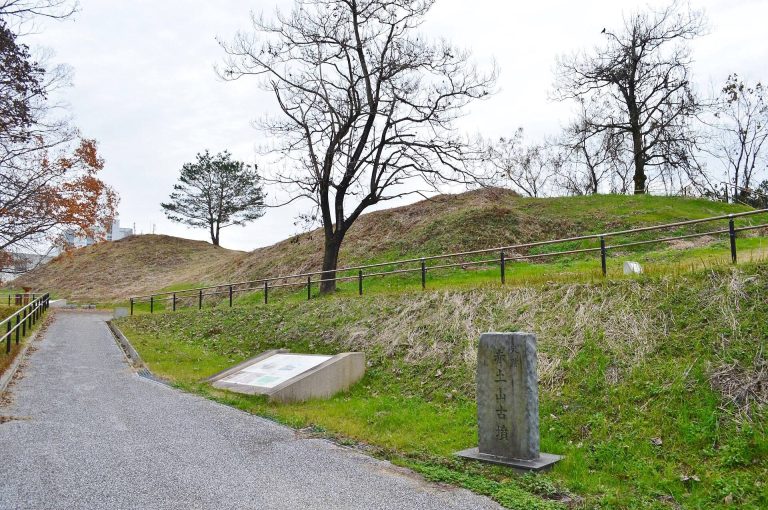
Tōdaijiyama Kofun is a keyhole-shaped Japanese burial mound in Tenri, Japan, probably built during the latter half of the fourth century in the middle part of the early Kofun period. The Kofun period was an era when large elite burial mounds accompanied expanding political authority across the Japanese archipelago. The mound was constructed on a hill about 70 meters above the adjacent plain, in an area associated with the Wani clan.
The Wani clan landscape
The area extending from Wani to Ichinomoto was a stronghold of the Wani, an ancient lineage group connected with the Yamato region of central Japan. Burial mounds on the surrounding hills are thought to have been built by related families. Tōdaijiyama Kofun therefore formed part of a wider funerary landscape rather than standing as an isolated monument.
A large elevated settlement of the Late Yayoi period had previously occupied the same hill. Its use ended approximately 150 to 200 years before the kofun was built, and the later burial mound overlapped the former settlement area. This succession placed an elite tomb within a landscape that had already been used for a substantial community.
Evidence of contact with Later Han China
The mound became especially important because one of its swords bears the era name Zhongping of the Later Han, the Chinese dynasty that ruled from AD 25 to 220. Zhongping was a reign-era name used under Emperor Ling, whose rule lasted from AD 168 to 189, and the inscription dates the sword to AD 184–189.
The sword is generally understood to have been bestowed by the Later Han court after the conflicts known as the Wa disturbances, or Great Wa disturbances. The circumstances and date of its arrival at the mound remain unknown. Its presence is regarded as possible evidence of contact between the people of the area and Later Han China.
The excavated assemblage was designated an Important Cultural Property in 1972 and a National Treasure in 2017. It is kept by the Tokyo National Museum.
Remains
Tōdaijiyama Kofun measures an estimated 140 meters in length and has the characteristic keyhole plan of a circular rear burial area joined to a rectangular front section. Cylindrical haniwa, clay objects placed around or on Japanese burial mounds, surrounded the mound. The principal burial installation occupied the rear section and was aligned parallel to the mound’s main axis.
Burial installations
Clay-covered wooden coffin
The principal burial facility consisted of a wooden coffin enclosed in a prepared clay encasement. The structure was estimated to be 9.4 meters long, and its principal area had been looted. The clay covering nevertheless formed the central installation around which other burial pits and their contents were arranged.
Eastern and western burial pits
Separate pits were cut to the east and west of the clay-covered coffin. They contained abundant weapons and armor, placing military equipment among the principal material associated with the burial. The eastern pit yielded the sword with the Zhongping inscription.
Weapons and decorated swords
The Zhongping sword
The Zhongping sword is 110 centimeters long and carries a 24-character inscription in gold inlay on the back of its blade. Gold inlay places gold into engraved lines cut into another material. The inscription uses an auspicious formula, stating that the sword was made on a Bingwu day in the fifth month of a Zhongping year, repeatedly forged into a clear and strong blade, responsive to the stars in heaven, and able to ward off misfortune below.
The sword has a bird-patterned ring pommel, the ring-shaped fitting at the end of a hilt, and an inward-curving blade. This form differs from the straight blades characteristic of early Japanese kofun. The blade is considered Chinese-made, while the Chinese blade was probably modified in Japan and fitted with a Japanese-style ring pommel.
Other ring-pommel swords
Five iron swords, including the Zhongping sword, had decorated ring-shaped pommels. Their designs included three-leaf motifs enclosed within rings, while some pommels took house-shaped forms. The three-leaf ring design resembles examples from a tomb at Seokam-ri in the former Lelang region and also occurs on a fourth-century sword from Wakahachiman-gu Kofun in Fukuoka. The house-shaped pommels resemble houses depicted on the back of the House-pattern Mirror from Samida Takarazuka Kofun in Kawai, Nara.
A flower-decorated ring-pommel sword was found among swords and spears in the clay covering outside the eastern side of the coffin. Its bronze pommel was cast separately from the iron blade. The pommel included a ring engraved with a straight-and-arc pattern and a three-leaf motif, a flower-shaped ornament at the top, two angular projections, and two bird-shaped ornaments. Three swords with this type of decorated pommel were excavated, including the Zhongping sword.
The weapons included 20 iron swords, nine iron blades, iron spears, and bronze and iron arrowheads. The assemblage also contained a bronze ring-pommel sword, plain ring-pommel swords, a wooden-pommel sword, and short-armor and skirt-armor components, together with other bronze and iron weapons and fittings.
Ornaments and haniwa
Stone and bronze objects
Personal and ceremonial objects included seven comma-shaped beads, 47 tubular beads, five jujube-shaped beads, and a steatite jar. Other stone objects included cylindrical pieces, hoe-shaped stones, wheel-shaped stones, bracelet-shaped stone objects, a vessel-shaped stone object, and a pedestal vessel-shaped stone object. Seven bronze objects shaped like tomoe, a comma-like or swirling form, were also excavated.
Clay figures and boundary objects
Cylindrical haniwa formed rows around the mound, while fragments of quiver-shaped haniwa were also recovered. Haniwa commonly marked burial mounds or represented equipment and military imagery, giving the mound’s clay enclosure both a boundary function and a material connection with the weapons placed inside the burial complex.