Byakugō-ji Temple: A Shingon Ritsu Buddhist Temple in Nara


Site at a Glance
- Rating
- 4.2
- Popularity
- Low
- Country
- Japan
- Primary era
- Early Modern
- External website
- Open
- Eras represented
- Early Modern
- Civilizations
- Tokugawa
- Site type
- Religious
- Remains
- Temple
On this page19 sections
History
Byakugō-ji Temple is a Buddhist temple of the Shingon Ritsu tradition in Nara, Japan, on the western lower slope of Mount Takamado. Its principal image is Amida Nyorai, the Buddha associated with the Western Pure Land and vows of salvation. The temple is formally called Takamado-san Byakugo-Ritsu-ji, while the name Byakugō refers to the curl of white hair between the Buddha’s eyebrows, one of the thirty-two traditional physical characteristics of the Buddha.
Early traditions and medieval development
The temple’s beginnings are uncertain. A tradition places an imperial prince’s mountain villa on the site during the Wadō era, from 708 to 715. The Sugawara family’s Collection of Temple Histories describes Byakugō-ji as a sub-temple of Iwabuchi-dera, an earlier temple founded at the foot of Mount Takamado by Gonso, a monk of the Sanron school and a teacher of Kukai, the founder of the Shingon tradition in Japan.
The earliest known written occurrence of the name Byakugō-ji appears in a sutra scroll dated 1220 and preserved at Kōshō-ji. The scroll’s colophon refers to the Byakugō-ji sutras. By the thirteenth century, the temple had become associated with major Buddhist scholarship and the preservation of scripture. The Nanto Byakugō-ji Issaikyō Engi, dated 1335, records that Eison restored the temple. Eison was a thirteenth-century monk who founded the Shingon Ritsu movement and led the revival of Saidai-ji.
A second restorer, Dosho, brought a complete Buddhist canon to Byakugō-ji in 1261 and built a sutra repository the following year. The temple consequently also became known as Issaikyō-ji, a name referring to the complete Buddhist canon.
Wartime destruction and reconstruction
In 1497, during conflict between the Furuichi and Tsutsui clans, fire destroyed the main hall, Enma Hall, the Tahōtō pagoda, the sutra repository, and other buildings. Buddhist statues from the Kamakura period were taken out of their halls but were damaged by the fire. An inscription inside the statue of Taizan-ō records repairs carried out in 1498.
Continuing conflict between the two clans brought another destructive fire in 1520. Kukei, an Edo-period monk-scholar associated with Kōfuku-ji, rebuilt the temple during the Kan’ei era, from 1624 to 1645. An accidental fire destroyed it again in 1757. The present complex therefore does not retain any of the earlier buildings.
Later history and cultural status
The Tahōtō, a Japanese pagoda with a square lower section and rounded upper structure, was sold and moved from the temple grounds in 1917. Its new location at a villa in Takarazuka, Hyōgo, remained unidentified for many years. The pagoda was destroyed by a forest fire there in 2002, while its former foundation stones remain at Byakugō-ji.
Byakugō-ji is now the 63rd site on the Eighty-Eight Sacred Sites of the Northern Yamato pilgrimage route. Its principal Amida image, other Buddhist sculptures, and specified cultural properties are designated nationally as Important Cultural Properties. The main hall is a tangible cultural property designated by Nara City, and the Five-Color Camellia is a natural monument of Nara Prefecture.
Remains
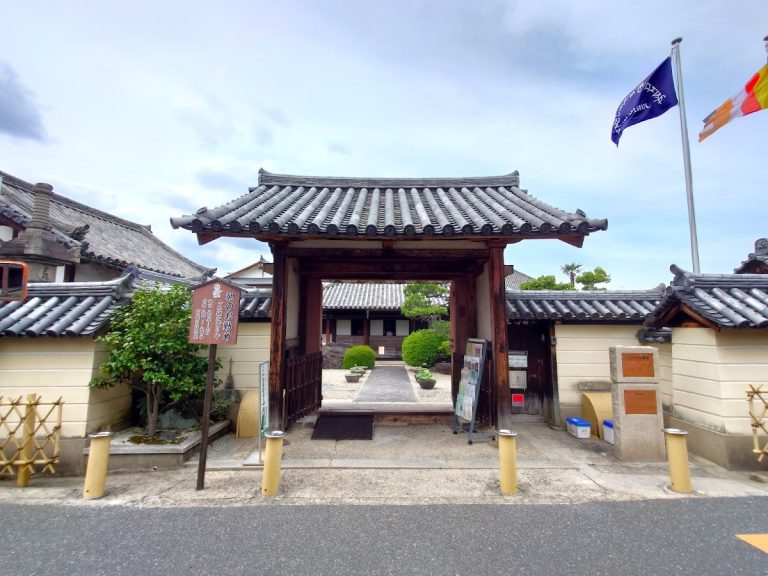
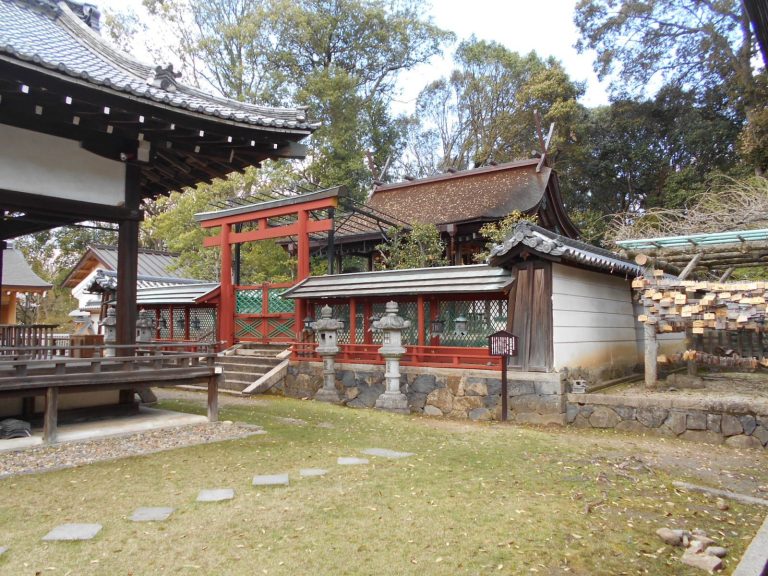
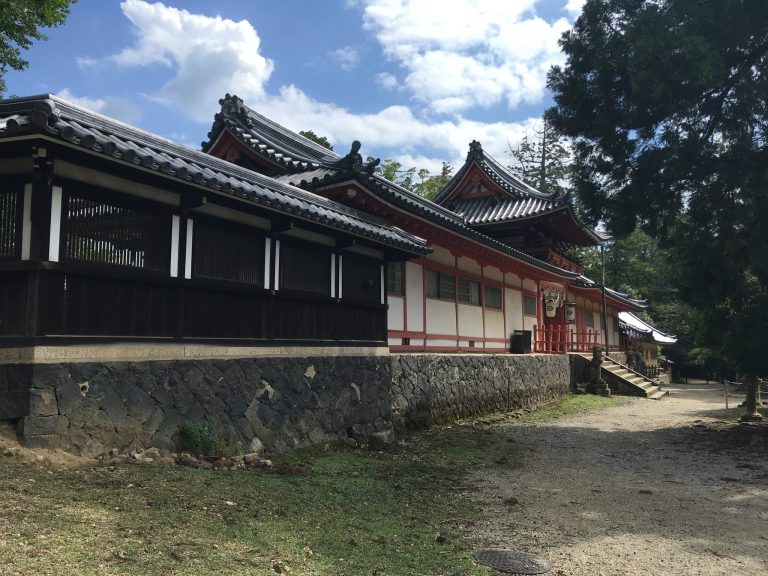
Byakugō-ji occupies the western lower slope of Mount Takamado, south of Mount Kasuga in southeastern Nara. The grounds overlook the Nara Basin and are approached by a path and a flight of steps. Within the precinct are the main hall, a Portrait Hall dedicated to Kukei, a treasure repository used as a small museum, the Stone-Buddha Path, the former Tahōtō site, the temple kitchen and living quarters, the mountain gate, and a staircase lined with bush clover.
Buildings and precinct features
Main hall
The main hall is the principal surviving worship hall. It was damaged during the Sengoku period, an era of prolonged civil conflict, and rebuilt in the early Edo period. The building is a tangible cultural property designated by Nara City.
Former Tahōtō site
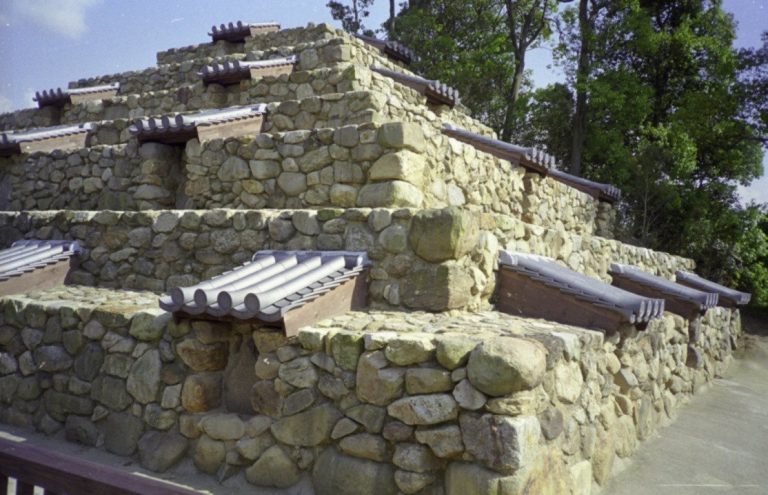
Only the foundation stones of the former Tahōtō remain within the temple grounds. The pagoda was built during the Muromachi period and relocated in 1917. After its identification at a villa in Takarazuka, it was destroyed by a forest fire in 2002.
Other precinct features
The grounds also contain Kukei’s Portrait Hall, a treasure repository that functions as a small museum, the Stone-Buddha Path, the kitchen and living quarters, and the mountain gate. A staircase lined with bush clover forms part of the approach through the grounds. A stone monument carries a poem attributed to Prince Shiki: “On the fields of Takamado, do the autumn bush clover bloom and scatter in vain, with no one to see them?”
Buddhist sculptures
Amida Nyorai
The principal Amida Nyorai is a seated wooden sculpture made from joined blocks of Japanese cypress. This joined-block method fits multiple pieces of wood together and is known in Japanese as yosegi-zukuri. The image is generally dated to the late Heian period or approximately the Kamakura period.
Manjushri
A seated wooden bodhisattva traditionally identified as Manjushri, the Buddhist figure associated with wisdom, is regarded as the temple’s oldest Buddhist image and is thought to date from the ninth century. Its high topknot, substantial treatment of the legs, and vigorously carved drapery retain characteristics of early Heian sculpture.
The sculpture was formerly regarded as the principal image of the Tahōtō. Its earlier transmission and original identity remain unknown, and both hands include partly later replacement parts. The original hand gesture therefore cannot be determined.
Jizo
The standing wooden image of Jizo dates from the late Kamakura period. Jizo is a bodhisattva widely associated with the protection of beings and travelers. The sculpture retains vividly colored polychromy.
Eison
A seated wooden portrait of Eison represents the monk who restored Byakugō-ji. The portrait resembles the image of Eison in the Aizendo at Saidai-ji, a hall dedicated to the Buddhist deity Aizen Myōō, and presents him in his later-life appearance.
Images from Enma Hall
Enma-ō
The seated wooden statue of Enma-ō was formerly the principal image of Enma Hall. Enma-ō is the Buddhist judge of the dead and ruler of the underworld. The Kamakura-period sculpture has a strongly expressive and severe face.
Taizan-ō
The seated wooden statue of Taizan-ō represents one of the judges of the underworld. Ink writing preserved inside the sculpture identifies Kōen, a grandson of Unkei, as its maker and dates its creation to 1259. The crown, sleeves, and legs contain later replacement parts, while an internal inscription records repairs made in 1498 after the fire damage.
Shimei and Shiroku
The half-seated wooden figures of Shimei and Shiroku are attendants of Enma-ō and were made by members of the Kōen school. Together with the Enma-ō and Taizan-ō sculptures, they were formerly enshrined in Enma Hall.
Five-Color Camellia
The grounds contain an old Five-Color Camellia reputedly transplanted from Kitain, a sub-temple of Kōfuku-ji, during the Kan’ei era, from 1624 to 1645. It is recognized as one of Nara’s three famous camellias and is described as approximately 400 years old. The tree is designated a natural monument of Nara Prefecture.