Daianji-Hachiman Shrine (Nara): Guardian Shrine of Daianji Temple


Site at a Glance
- Rating
- 4.4
- Popularity
- Very Low
- Country
- Japan
- Primary era
- Medieval
- External website
- Open
- Eras represented
- Medieval, Early Modern, Modern
- Civilizations
- Ashikaga shogunate, Japanese, Tokugawa
- Site type
- Religious
- Remains
- Sanctuary
On this page15 sections
History
Daianji-Hachiman Shrine (Nara) is a Shinto shrine in Nara, Japan, founded as the guardian shrine of Daianji Temple. Its foundation is traditionally placed in 807, and its principal sanctuary represents the flowing-style nagare-zukuri form of shrine architecture. The shrine developed within the former Daianji precinct and remained closely connected with the temple until the upheavals of the late sixteenth century.
Foundation and Daianji
The shrine was originally called Daianji Hachimangu. It is also known as Moto-Iwashimizu Hachimangu because of a tradition that it was the original shrine of Iwashimizu Hachimangu on Mount Otokoyama. Hachiman, a Japanese deity associated with warfare, protection, and the imperial line, is commonly identified in shrine worship with Emperor Ojin. The shrine was also called Tatsuichi Hachimangu because it served as the tutelary shrine of the four Tatsuichi districts. Before the modern period, it held the status of a village shrine.
The principal foundation tradition appears in the Record of the Enshrinement of Daianji Hachimangu, dated May 11, 962. It says that the Daianji monk Gyōkyō, returning from Tang China, stopped at Usa Hachimangu in Buzen Province and received a sacred image. On August 7, 807, he enshrined the image at the Iwashimizu cell in the seventh cloister of Daianji’s Eastern Residence. A shrine was later built, and the deity was moved there as Iwashimizu Hachimangu, the temple’s guardian.
According to the same tradition, a divine oracle led to the deity’s transfer to Mount Otokoyama in 859. Emperor Heizei then ordered a new shrine to be established at the former location. A separate account from 1140 gives a different date, attributing the foundation to Gyōkyō’s ritual enshrinement of the deity in 855. These traditions also lie behind the shrine’s claim to have been the parent shrine of Iwashimizu Hachimangu.
The claim was disputed by the shrine on Mount Otokoyama, which maintained that the Daianji deity had instead been invited from Otokoyama. Rikyū Hachimangu at Oyamazaki preserved another tradition, stating that it was founded in 859 and that its deity was moved across the Yodo River to Mount Otokoyama in 860. The competing traditions leave the origins of the Mount Otokoyama shrine uncertain.
Medieval patronage and worship
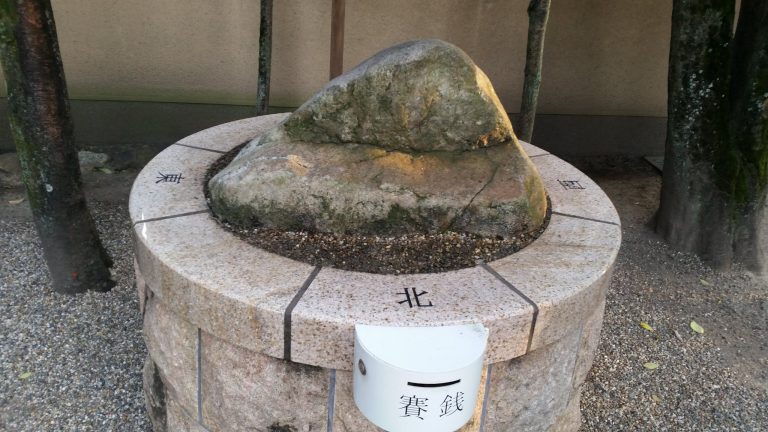
Daianji-Hachiman Shrine once stood inside Daianji’s precinct, north of the temple’s Eastern Pagoda. The temple’s Seven-Story Pagoda and Eastern Pagoda were to its south, while the Iwashimizu cell mentioned in the foundation story lay between the present shrine and Daianji. A medieval description places a line of monk cells about 120 meters from north to south east of the temple’s main hall. It identifies the fourth cell from the north as Gyōkyō’s residence, and the Iwashimizu well near the present Goryo Shrine is regarded as preserving the name associated with that residence.
During the medieval period, the shrine was widely known as Tatsuichi Hachimangu and served the four Tatsuichi districts. A person appointed chief ritual deputy of Kasuga Taisha, a major Shinto shrine in Nara, was expected to serve at Daianji-Hachiman at least once as ritual leader. The shrine’s principal festival was then held on August 17 and was called the Daianji Festival. It attracted large crowds and included sarugaku, a medieval performance tradition that contributed to the development of Noh theatre. A 1478 record states that a planned performance was cancelled after Hachijo and Higashikujo disputed the distribution of mats for the dance pavilion, creating a threat of violence.
The shrine is also called Koyasu Hachimangu because worshippers associated it with protection in childbirth. Its principal deities are Emperor Ojin, Empress Jingu, and Emperor Chuai. The present principal festival takes place on October 10.
Destruction, independence, and modern classification
The honden, or main sanctuary, was rebuilt in 1385 under Ashikaga Yoshimitsu, the third shogun of the Muromachi shogunate, the era of samurai rule centered on the Ashikaga government. Fire destroyed it in 1504, after which it was rebuilt, although the details of that reconstruction are uncertain.
The shrine declined along with Daianji during the warfare of the sixteenth century. Matsunaga Hisahide, a military leader whose campaigns affected the Nara region, attacked Tatsuichi in 1571. The Keicho Fushimi Earthquake then damaged the shrine on July 13, 1596. Daianji became effectively abandoned for a time, while the shrine became independent and was restored by local villagers as their ujigami, or community tutelary deity.
A major repair is traditionally said to have taken place in 1863. During the Meiji period, the shrine was classified as a village shrine. In 1913, painted decoration was applied to the honden and all subsidiary shrines. The middle gate and wing corridors are now designated as tangible cultural properties of Nara City.
Ritual associations and community organization
The Daianji district historically maintained two privileged miyaza, hereditary ritual associations responsible for shrine worship and festivals. Known as the Kannon-do Group Left Seat and the Seat Group Right Seat, they together included about 50 households. The Left Seat claimed descent from the Naka family, said to have accompanied the deity from Usa in 807. The Right Seat traced its origin to the Sakai family, said to have welcomed the deity locally. Both groups therefore operated as closed hereditary associations rather than open village organizations.
The Left Seat held precedence over the Right Seat. A senior elder elected from the Left Seat supervised both groups, while each seat chose five senior members. These ten people formed the Ten Senior Members and assisted the elder. Admission was controlled through the Name-Change Rite, which the elder and the Ten Senior Members decided upon roughly every eleven years. New members entered at the lowest rank, and the ceremony formerly involved changing from a childhood name to an adult name.
Hereditary eligibility could be lost if a branch family failed to serve as the ritual household, or toya, within three years, or if it moved outside the town. A returning member could regain eligibility by greeting the Ten Senior Members, but would then occupy the lowest position. If a seat member died without a male successor, the family’s hereditary eligibility remained with the bereaved household.
The Kannon-do Group appears in the surviving evidence by 1483. It had 21 members in 1712 but declined to 15 before the middle of the eighteenth century, apparently because family lines ended and economic difficulties increased. The group struggled to pay for festival entertainments. The Sakai family donated fields to the shrine in 1732, followed by the Onishi family in 1740. These gifts appear to have supported the formation of the Right Seat. Records from 1754 show the Left and Right Seats together, and their founding traditions were probably formalized at that time.
Higashikujo and Karasumo also maintained miyaza. In Higashikujo, land-tax reform in 1873 made the hereditary system difficult to preserve. Admission was opened to other families, transforming the association into a village organization, while about 30 former hereditary families continued separately as the Tenjin Association.
The secondary shrine at Higashikujo
A second Hachiman Shrine stands about one kilometer south of the main shrine, near the Higashikujo community center. Parishioners established it in 1954 as a nearby place from which they could worship in the direction of their more distant tutelary shrine. It enshrines a divided spirit of the main shrine’s deity, a ritual transfer known as kanjo. The building was raised on October 31, 1954, with the cooperation of Higashikujo parishioners.
Remains
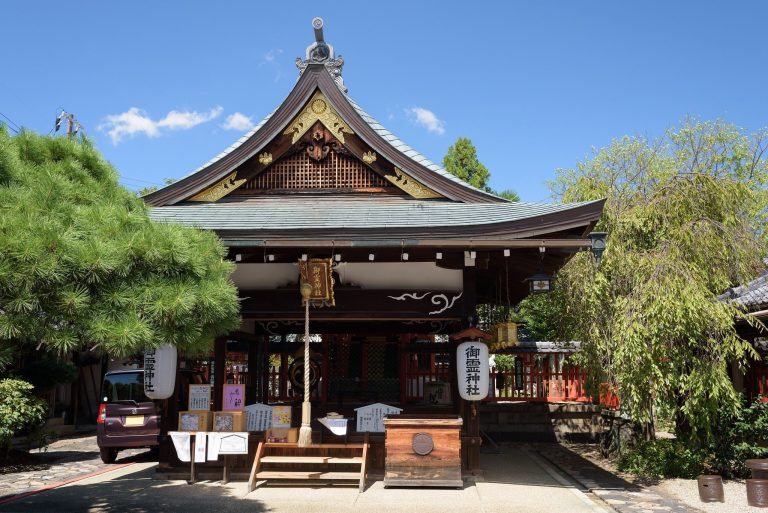
The surviving compound centers on a square, three-bay honden with a cypress-bark roof. Its nagare-zukuri design uses a roof whose front slope extends forward to create a covered entrance. The worship hall, or haiden, stands within the main precinct, while the middle gate, wing corridors, front gate, and shrine office form the other principal buildings of the compound.
Main shrine buildings
Honden
The honden is the square, three-bay sanctuary that houses the shrine’s principal deities, Emperor Ojin, Empress Jingu, and Emperor Chuai. Its cypress-bark roof and forward-projecting entrance slope define its flowing-style construction. Wakamiya Shrine and Takeuchi Shrine stand in front of it, to the left and right. Wakamiya Shrine is dedicated to Emperor Nintoku, while Takeuchi Shrine honors Takeuchi no Sukune, a legendary court figure associated with service to several early emperors.
Middle gate and wing corridors
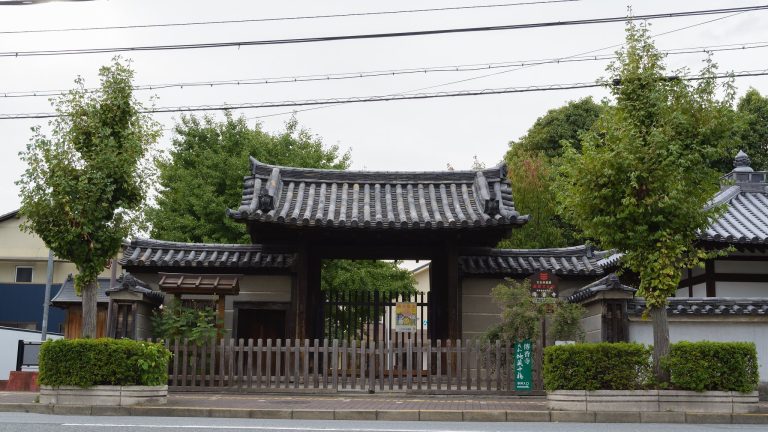
The chumon, or middle gate, was built during the Muromachi period and remodeled in the early Edo period, the era of Tokugawa rule that followed Ashikaga government. It is a four-legged gate with a tiled roof. Wing corridors extend from both sides, giving the combined structure the appearance of a divided worship hall. The gate and corridors are separately identified parts of the precinct and are designated as Nara City tangible cultural properties.
Worship hall and compound buildings
The haiden provides the worship space within the main precinct. The front gate and shrine office are also part of the principal compound. Together with the honden, middle gate, and corridors, these buildings define the surviving arrangement of the main shrine.
Subsidiary shrines and ritual objects
Shrines before and around the honden
Several subsidiary shrines are arranged around three sides of the honden. They include Sugawara Shrine, dedicated to Sugawara no Michizane, the Heian-period scholar and court official later venerated as Tenjin; Itsukushima Shrine, dedicated to Ichikishimahime; two Inari Shrines, dedicated to Ukemochi; and Sarutahiko Shrine, dedicated to Sarutahiko and Amaterasu.
The group also includes Kotohira Shrine, dedicated to the Kotohira deity; Kasuga Shrine, dedicated to Ame-no-Koyane and Ōmononushi; Myōbu Shrine, dedicated to Toyotamabime and Tamayoribime; and Miyatama Shrine, dedicated to Miyatama. Kamo Shrine was transferred into the precinct and merged with it in 1910. A survey from 1891 identifies its deity as Izanagi, while a 1907 record made shortly before the merger identifies Takemikazuchi.
Ceramic komainu and clay pigeons
The precinct contains what is described as the largest ceramic komainu in Nara Prefecture. These guardian figures traditionally stand at Shinto shrine entrances. Numerous clay pigeons are arranged beneath the honden. Worshippers offered them when praying for safe childbirth, linking the physical objects with the shrine’s identity as Koyasu Hachimangu.
Secondary Hachiman Shrine
The secondary shrine south of the main compound has its own honden. A roof-raising tablet preserved there gives October 31, 1954, as the date associated with the building’s construction. The sanctuary houses the divided spirit transferred from the main shrine and represents the continuation of Daianji-Hachiman’s local worship at a separate Higashikujo site.