Itosaki Shrine: A Historic Hachiman Shrine in Mihara, Japan


Site at a Glance
- Rating
- 4.2
- Popularity
- Low
- Country
- Japan
- Primary era
- Early Modern
- External website
- Open
- Eras represented
- Early Modern, Modern
- Civilizations
- Japanese, Tokugawa
- Site type
- Religious
- Remains
- Sanctuary
On this page16 sections
History
Itosaki Shrine is a historic Hachiman shrine in Mihara, Japan, traditionally founded in 729 and associated with the coastal community of Itosaki on the Seto Inland Sea. Formerly called Itosaki Hachimangu, it is said to have begun when the sacred birth hair of Emperor Ojin was brought from Usa Hachimangu and enshrined there. Hachiman is a Japanese religious tradition centered on the deified Emperor Ojin, with associations including protection, warfare, and broad popular worship.
Foundation and maritime setting
The shrine enshrines Emperor Chuai, Emperor Ojin, and Empress Jingu, figures of early Japanese imperial tradition. Empress Jingu is presented in legend as a military ruler and regent, while Emperor Ojin is traditionally regarded as Japan’s fifteenth emperor. Itosaki attracted both courtly and popular devotion and was once regarded as a special shrine with a status comparable to that of an Ichinomiya, the highest-ranking shrine in a historical province. It was also known by a title meaning “Great Clan Shrine.”
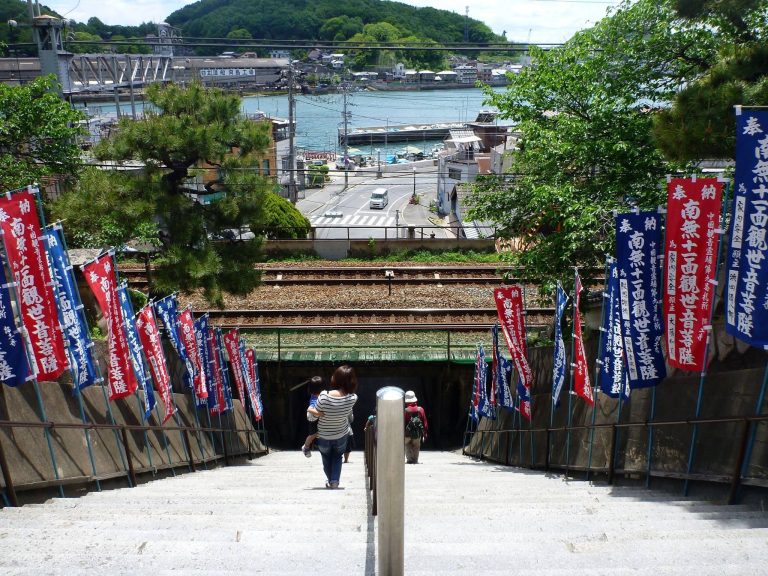
The surrounding port was historically called Nagai-no-ura. Ships waited there for favorable winds before continuing across the Seto Inland Sea. The port appears in three poems in volume 15 of the Man’yoshu, Japan’s oldest surviving major poetry anthology, traditionally compiled in the eighth century. The poems were composed while ships lay moored at Nagai-no-ura in Mitsugi District of Bingo Province.
Shrine tradition connects the port with Empress Jingu, who is said to have moored her ship there and drawn water from the shrine’s well. The place was also called Idosaki, a name regarded as the origin of Itosaki. The district name Mitsugi was likewise traditionally connected with the well.
Patronage and rebuilding
During the medieval period, the Kobayakawa, Mori, and Fukushima families protected the shrine. In the early modern period, the Kobayakawa family donated an estate yielding 330 koku, a historical measure of rice-based agricultural production, together with 150 kan, a traditional monetary unit.
The main sanctuary burned in 1612. It was rebuilt in 1642 under Asano Nagaakira, lord of the Hiroshima domain. A second fire damaged the shrine in 1752, and the present main sanctuary was rebuilt in 1759.
Modern status and continuing observances
Itosaki Shrine received the prewar designation of prefectural shrine in 1924 and is now classified as a former prefectural shrine. Its historical role also continued through a local maritime custom: newly built ships first underwent purification at Itosaki Shrine before proceeding to Oyamazumi Shrine.
Religious observances include New Year rites, the Yakujin Festival, Setsubun, and the Nagoshi purification rite, during which participants pass through a chinowa ring. The annual grand festival features children’s sumo, while a kagura performance of ritual dance and music for the kami is held on the preceding evening.
Remains
The precincts preserve shrine buildings, a historically associated gate, a well connected with local tradition, a large sacred camphor tree, and commemorative features. The principal buildings use the irimoya roof form, which combines a hipped roof with gabled sections. Their copper-covered roofs and decorated gables give the surviving complex a clearly defined traditional appearance.
Principal shrine buildings
Main sanctuary
The main sanctuary, rebuilt in 1759, is three bays wide and two bays deep, meaning that its structure is divided into three units across the front and two units in depth. It has an irimoya roof covered with copper sheets, a front-facing chidori hafu gable, and a one-bay projecting worship porch. The porch has a kara-hafu, a gable with a curved profile.
Worship hall
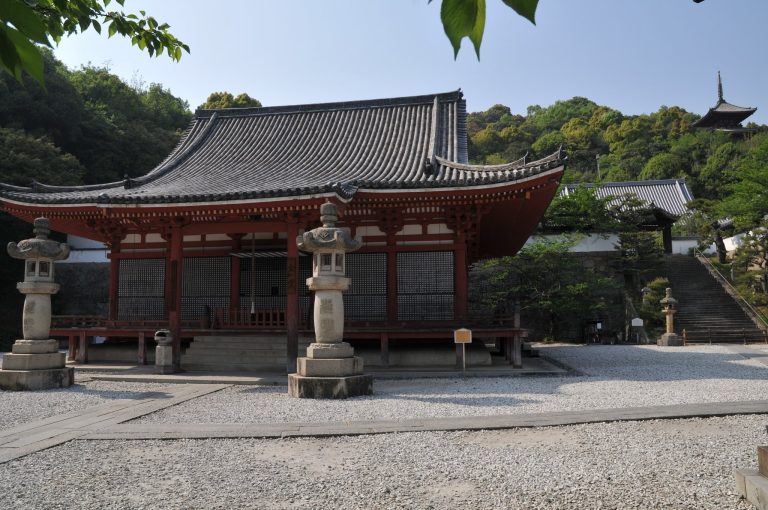
The worship hall is three bays wide and three bays deep. Like the main sanctuary, it has an irimoya roof clad in copper sheets, a front-facing chidori hafu gable, and a one-bay projecting porch with a curved kara-hafu gable.
Main gate
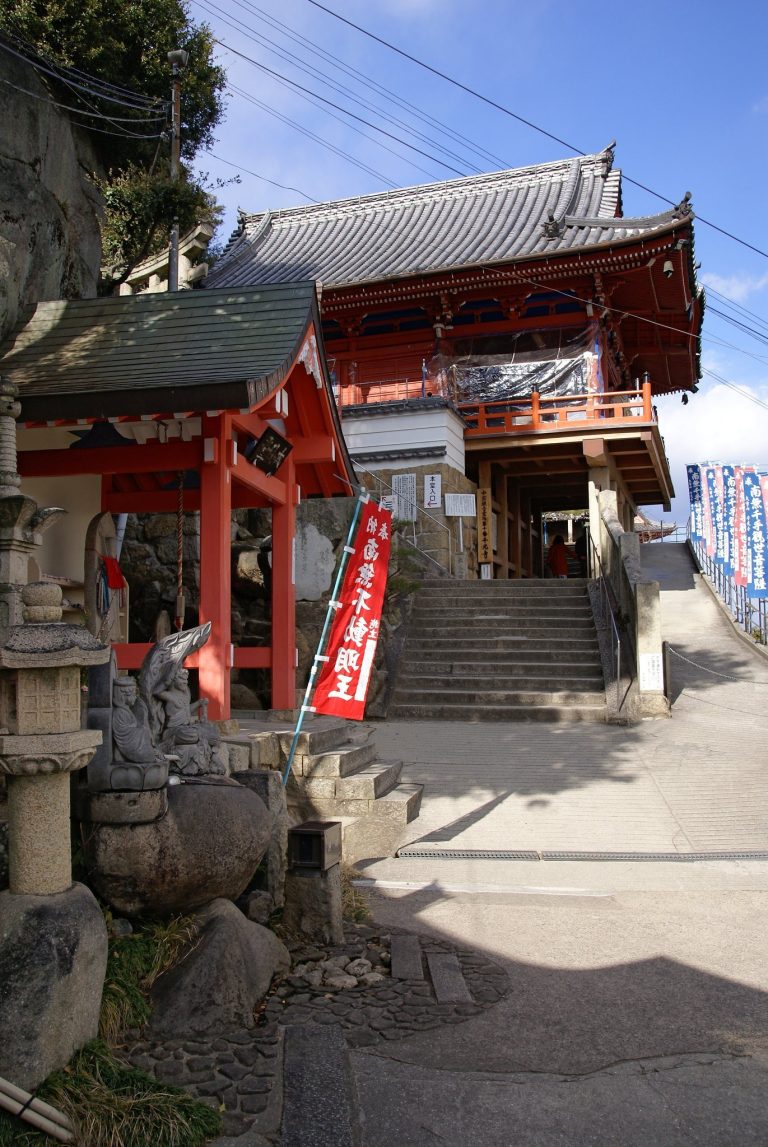
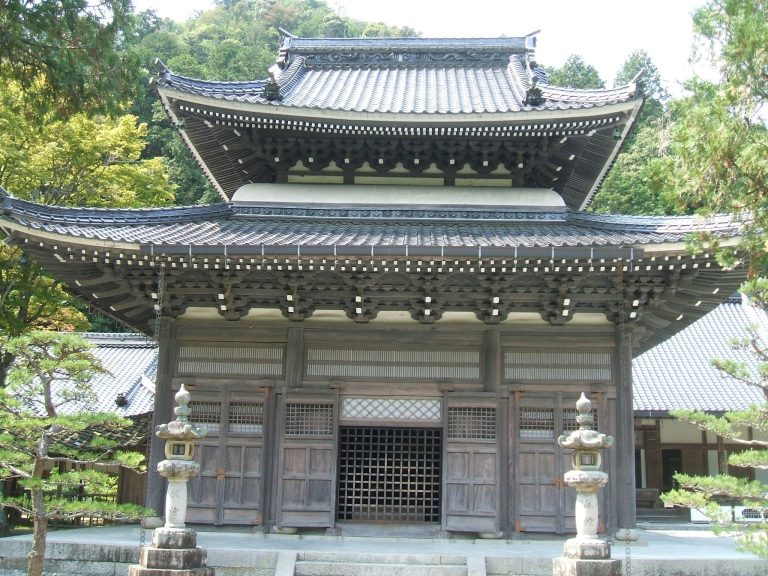
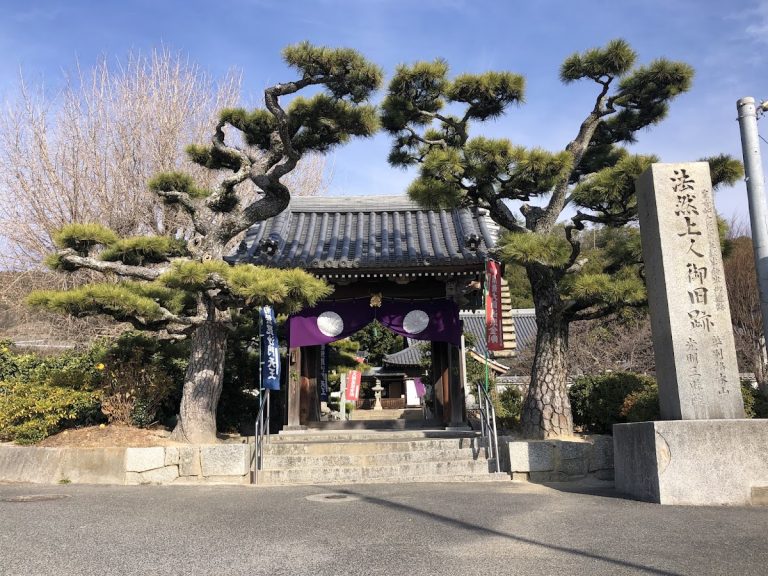
The main gate is a three-bay, four-legged gate with a single entrance, a gabled roof, and traditional fired-tile roofing. It was moved to the shrine in 1875 from a gate that had belonged to a samurai residence within Mihara Castle. The gate is among the few surviving structures associated with the castle.
Well and sacred tree
Mitsugi Well
The Mitsugi Well stands on the eastern side of the precincts. Also known as the Well of Tribute, it is associated with the tradition that Empress Jingu drew water there after mooring at Nagai-no-ura. The well’s name is also linked with the traditional explanation of the district name Mitsugi.
Sacred camphor tree
A sacred camphor tree rises to 30 meters and has a trunk circumference of 13 meters at breast height. Its estimated age was 500 years in 1962. At that time it was described as the largest camphor tree in Hiroshima Prefecture and the third largest in the Chugoku–Shikoku region. The tree is designated a municipal natural monument.
Commemorative features and records
Night-Crying Pine tradition
A giant pine formerly stood within the precincts and was known as the Night-Crying Pine. Its bark was traditionally boiled and given to children who cried at night, and it was also believed to cure many illnesses. The tree was widely known during the Edo period and appears in the classical Kamigata rakugo piece Soothing Night Crying.
Honinbo Shusaku monument
An Edo-period stone monument commemorates Honinbo Shusaku, a nineteenth-century Japanese Go master counted among the traditional Go sages, an honorific for especially distinguished historical players.
Historical documents
The shrine’s associated documentary collection contains 11 historical documents concerning its landholdings, stipends, and the reconstruction of the main sanctuary during the Kan’ei era. The collection became Mihara City Important Cultural Properties in 1975. The shrine gate received the same municipal designation in 1979.