Musashi Kokubun-ji Remains: A Provincial Buddhist Monastery and Convent in Japan


Site at a Glance
- Rating
- 4.1
- Popularity
- Low
- Country
- Japan
- Primary era
- Medieval
- External website
- Open
- Eras represented
- Medieval
- Civilizations
- Yamato
- Site type
- Religious
- Remains
- Monastery
On this page14 sections
History
Musashi Kokubun-ji Remains preserves a former provincial Buddhist monastery and convent in Kokubunji, Tokyo, Japan, established in Musashi Province under Emperor Shomu’s eighth-century program of officially sponsored Buddhist institutions. A provincial monastery, or Kokubun-ji, served as the Buddhist institution for a historical province, while its companion convent served a community of Buddhist nuns. The former complex was founded sometime from the late 750s to the early 760s, although its exact date remains uncertain.
Foundation in Musashi Province
Two main dating proposals have been advanced for the foundation. One places it approximately between 741 and 758, based on the absence of the name of Shinra District from inscribed roof tiles. Another places it approximately between 756 and 764, based on the decoration of excavated tiles. These proposals reflect different archaeological readings, and neither fixes a single year for the establishment of the monastery and convent.
The religious complex was divided by the Tosan-do Musashi Road, the route through Musashi Province of an ancient road linking the central government with the eastern provinces. The monastery stood to the east and the convent to the west. A north-south road connected the complex with the Musashi provincial capital, the administrative center of the province, and its main government office.
Destruction and Later Buddhist Use
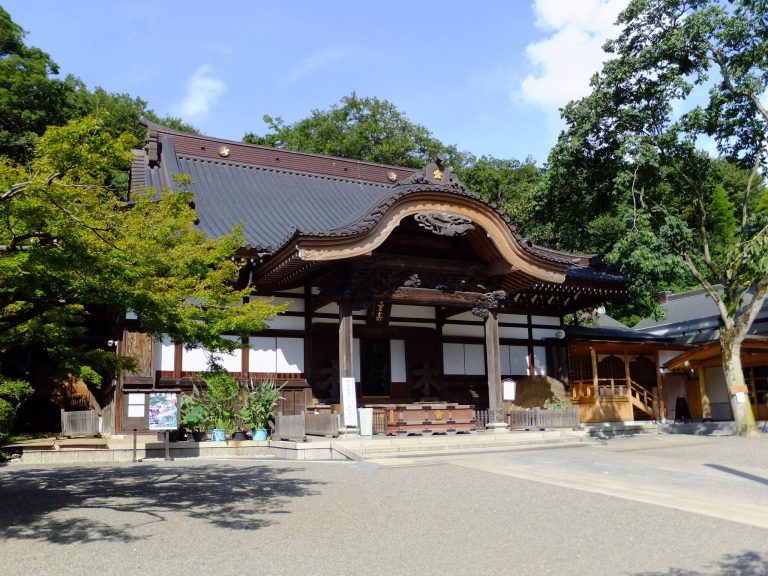
The former Musashi Kokubun-ji was destroyed by fire during the Battle of Bubaigawara at the end of the Kamakura period, the medieval era conventionally dated from 1185 to 1333. A later Musashi Kokubun-ji was rebuilt through a donation by Nitta Yoshisada. That surviving religious institution belongs to the Buzan branch of Shingon Buddhism, a Japanese form of esoteric Buddhism.
The convent’s location was debated for many years. Discoveries of ancient roof tiles during the Edo period, the era of Tokugawa rule from 1603 to 1868, and an illustrated gazetteer published in 1823 supported identifying the Kurogane valley as the convent site. An alternative theory placed it in the Kyozu area, but later research largely rejected that proposal, and Kurogane is now established as the convent’s location.
Investigation and Preservation
Field surveys during the Meiji period, which began with the imperial restoration in 1868 and lasted until 1912, fixed the location of the monastery. After the remains received national historic-site designation in 1922, the arrangement of foundation stones was used to reconstruct the probable temple plan. The first excavation of the monastery area followed in 1956.
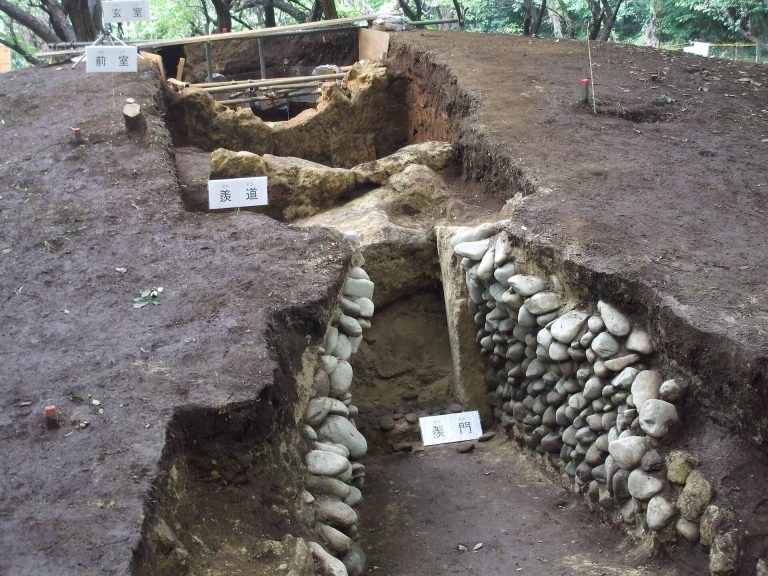
Unauthorized large-scale housing development in the convent area in 1964 destroyed the zone then thought to contain the lecture hall before it could be investigated. In response, the city carried out eight emergency investigations between 1964 and 1971. These revealed a probable rammed-earth platform for the main hall and the remains of the middle gate. Rammed-earth construction creates a raised platform by compacting successive layers of earth.
A preservation campaign began in 1973 after a plan was announced to build a municipal junior high school within the estimated temple precinct. The city established an archaeological investigation committee and excavated in cooperation with Tokyo and national cultural authorities. The campaign’s leading figure was not a researcher, but made a substantial contribution to the investigation and preservation of provincial monasteries and convents across Japan.
Further discoveries came during public-housing reconstruction in Fuchu in 1999. Excavation uncovered a road running north from the former provincial government office toward the Tosan-do Musashi Road, together with another road leading from it toward the monastery’s south gate. Pillar remains at the entrance to this latter road led to its designation as the Musashi Kokubun-ji approach entrance in 2004.
The protected area was expanded in stages, first in 1976 to include the eastern monks’ quarters, then in 1979 to include part of the convent area identified through additional excavation. The approach entrance was added in 2004, and the remains of the Tosan-do Musashi Road were included in 2010. The designated area covers about 11 hectares, excluding the road remains. A high-rise apartment project beside the designated area led to a lawsuit with local residents in 2001, settled through reconciliation in 2005.
The convent area was completed as a historical park in 2003, while archaeological investigation and phased site development have continued in the monastery area. The city also established the Musashi Kokubun-ji Remains Museum beside the current temple and has published a museum newsletter since 2010.
Remains
The former monastery and convent occupied an extensive complex about 1,500 metres from east to west and 1,000 metres from north to south, centered on the monastery’s main hall. The monastery precinct itself is estimated at eight cho east to west and five and a half cho north to south. A cho was a historical Japanese unit of length used for land and temple precincts, although its precise value varied by period and context. The monastery remains include foundations and areas associated with a seven-story pagoda, main hall, lecture hall, northern precinct, western precinct, eastern monks’ quarters, middle gate, south gate, and approach. A second pagoda foundation was identified in 2004.
Monastery Precinct
Pagodas
The monastery’s remains include the site of a seven-story pagoda, as well as a second pagoda foundation identified through excavation in 2004. Together, these foundations form part of the surviving evidence for the religious and spatial organization of the eastern precinct.
Main and Lecture Halls
The main hall had a façade more than 36 metres wide and extended seven bays across. Excavation in the convent area also identified a probable rammed-earth platform associated with the main hall. The monastery precinct includes the site of a lecture hall, while investigations have addressed the principal hall area and the surrounding temple plan.
Gates and Approach
The middle gate and the area of the south gate have been investigated as parts of the monastery’s entrance sequence. A separate road led toward the south gate from the road running north from the former provincial government office. Pillar remains at that road’s entrance define the feature called the Musashi Kokubun-ji approach entrance.
Monks’ Quarters and Other Precincts
The eastern monks’ quarters form part of the protected monastery area, alongside the northern and western precincts. Their inclusion in the designated area reflects the continuing reconstruction of the former temple’s layout from foundations, excavated surfaces, and related archaeological evidence.
Convent Precinct
Central Convent Buildings
The convent stood west of the Tosan-do Musashi Road. Its excavated remains include a middle gate, main hall, nuns’ quarters, facilities attached to the nuns’ quarters, and earthen boundary walls. In the central area, the buildings were enclosed by those walls, with the middle gate, main hall, and nuns’ quarters arranged in a straight line. The five nuns’ quarters were large enough to accommodate an estimated total of about ten nuns.
Hill and Medieval Temple Remains
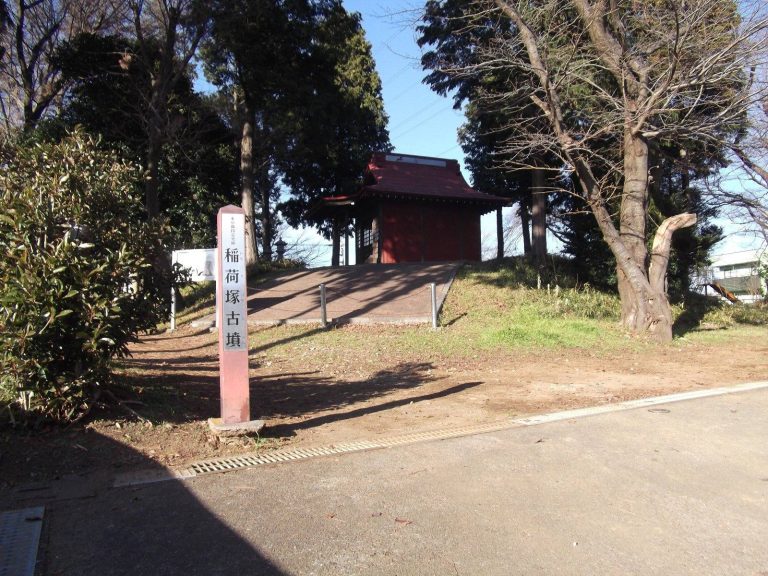
Behind the central convent area, a low hill forms part of the Kokubunji Escarpment, a natural elevated terrace in the local landscape. Local tradition associated convent facilities with the hill, but excavation found the remains of a medieval temple there. The hill also contains a cut-through traditionally associated with the remains of the Upper Route of the Kamakura Highway.
Roads, Landscape, and Preservation
The site lies immediately south of the Kokubunji Escarpment. The Fuchu Road and the JR Musashino Line now cross between the former monastery and convent areas. The convent has been developed as a historical park, while the monastery remains continue to undergo archaeological investigation and phased development. Excavated materials connected with the complex are displayed and preserved at the Musashi Kokubun-ji Remains Museum and a local-history display room.