Xenophontos Monastery: An Orthodox Monastic Centre on Mount Athos


Site at a Glance
- Rating
- 4.9
- Popularity
- Medium
- Country
- Greece
- Primary era
- Modern
- External website
- Open
- Eras represented
- Medieval, Early Modern, Modern
- Civilizations
- Ottoman
- Site type
- Religious
- Remains
- Monastery
On this page13 sections
History
Xenophontos Monastery is an Orthodox Christian monastery in Greece, standing on the western shore of the Athos peninsula. Dedicated to Saint George, it is one of the twenty principal monasteries of Mount Athos, an autonomous monastic territory, and holds sixteenth place in the Athonite hierarchy. Its formal status is that of a Holy Patriarchal and Stavropegic Monastery, meaning that it is placed directly under the authority of a patriarch rather than an ordinary local bishop. The monastery is traditionally said to have been founded shortly before 998 and is broadly associated with the tenth or eleventh century.
Early Christian and Byzantine foundations
A small Christian community dedicated to Saint Demetrios is said to have occupied the site in the sixth century. The monastery’s traditional founder is Saint Xenophon the Senator, a Byzantine Christian saint associated with its early history and also described as its abbot. The monastery first enters documentary records in the late tenth century, providing an early written indication of its place within the developing monastic landscape of Mount Athos.
An act of 1083 records a major period of renewal. The naval commander Nikephoros Stephanos entered the monastery as a monk under the name Simon, became its abbot, and financed the restoration and decoration from his own resources with imperial assistance. The Byzantine emperor Alexios I Komnenos, who ruled from 1081 to 1118, was also an important benefactor. He presented the monastery with mosaic icons of Saints George and Demetrios.
Xenophontos acquired houses that produced income both on Mount Athos and beyond the peninsula. It flourished before the Ottoman capture of Constantinople and the final Byzantine conquest. Piracy and brigandage later destroyed monastic buildings, while Byzantine emperors undertook major restorations. From the sixteenth century, rulers of the Danubian principalities and other benefactors supported the monastery through gifts, endowments, and financial assistance.
Communal reform and nineteenth-century rebuilding
In 1784, a patriarchal decree issued by Gabriel IV changed Xenophontos from an idiorrhythmic community into a cenobitic one. An idiorrhythmic monastery allowed monks greater individual control over economic and domestic life, whereas a cenobitic monastery followed communal ownership, discipline, and shared monastic practice. Paisios of Kafsokalyvia, a hieromonk, became the first abbot after the change and led an extensive programme of expansion and restoration. Archimandrite Zachariah helped raise funds through journeys to various countries.
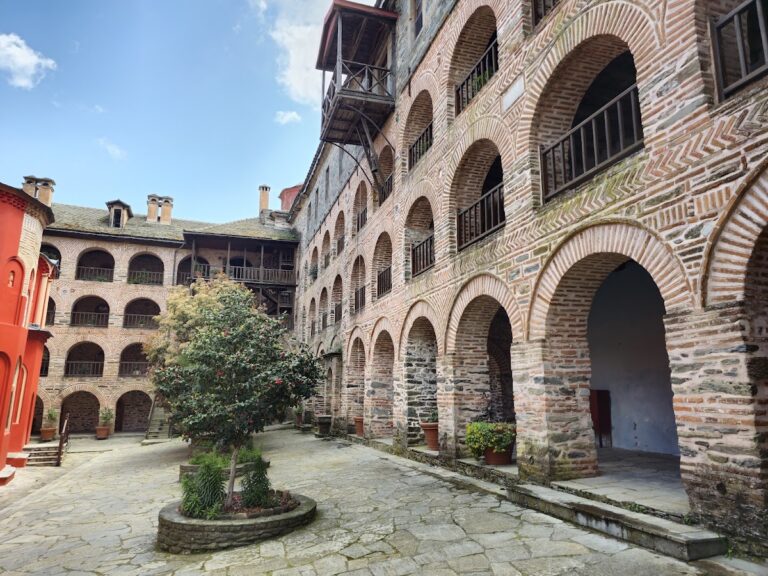
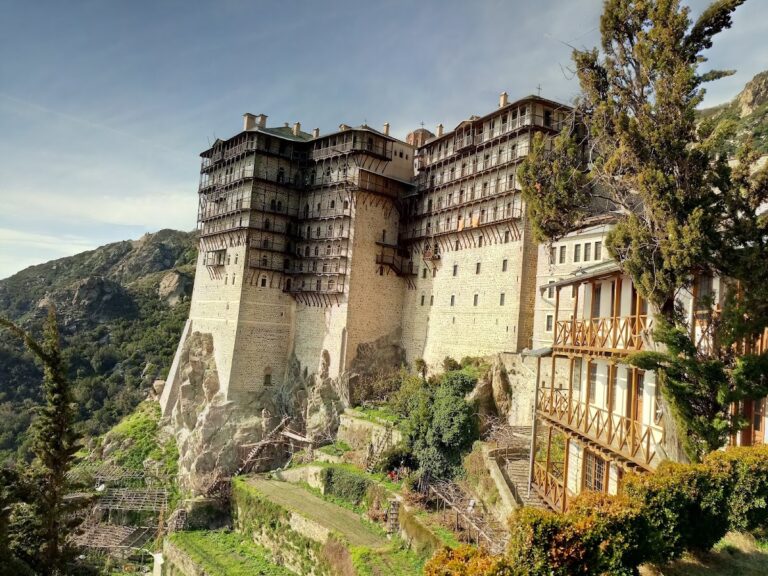
A substantial part of the complex burned in the early nineteenth century, destroying many documents. The monastery was soon restored and enlarged at the expense of Theophilos, formerly Metropolitan of Samak, who had resigned his episcopal office and spent his final years at Xenophontos. The abbot Nikephoros continued the work. This rebuilding phase produced much of the architectural form associated with the monastery today.
Dependencies and modern life
The monastery’s dependent establishments include the Skete of the Annunciation, founded in 1760 by the hieromonk Sylvester and the monks Ephraim and Agapi. It also possesses the cells of Saint Tryphon and Saint Nectarios, four kathismata, or small dependent monastic dwellings, and the representation of Saint Andrew at Karyes. Outside Mount Athos, its dependencies include the Holy Hermitage of the Forerunner in Akritochori, the Church of the Holy Athonite Fathers in Nea Ionia, the Church of the Virgin of the Tearful Stream in Nikaia, and the Monastery of the Transfiguration in Skopelos.
In 1976, Abbot Alexios arrived from the Monastery of Great Meteoron with seventeen monks. He had led Great Meteoron from 1973 to 1976 and continued to lead Xenophontos as of 2025. Under his direction, the community has worked to restore the complex, provide spiritual services, and maintain traditional icon painting and woodcarving. Extensive renovation has also been undertaken with support from the Greek government and the European Commission. A patriarchal and synodal tome granting autocephalous status to the Orthodox Church of Ukraine was crafted at Xenophontos, continuing the monastery’s historical association with the production and preservation of religious works.
Remains
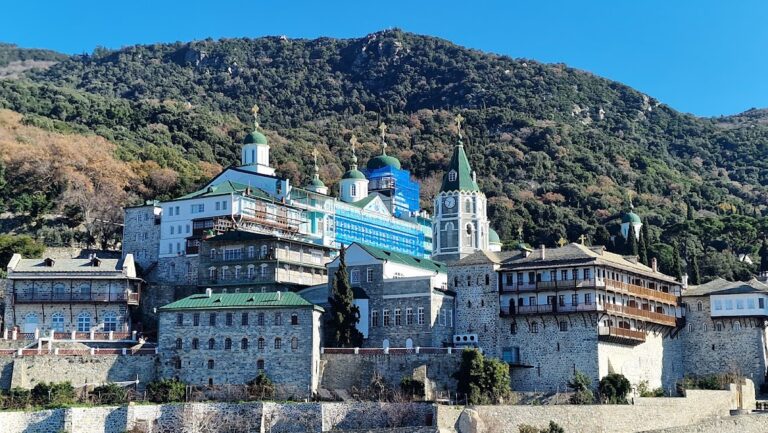
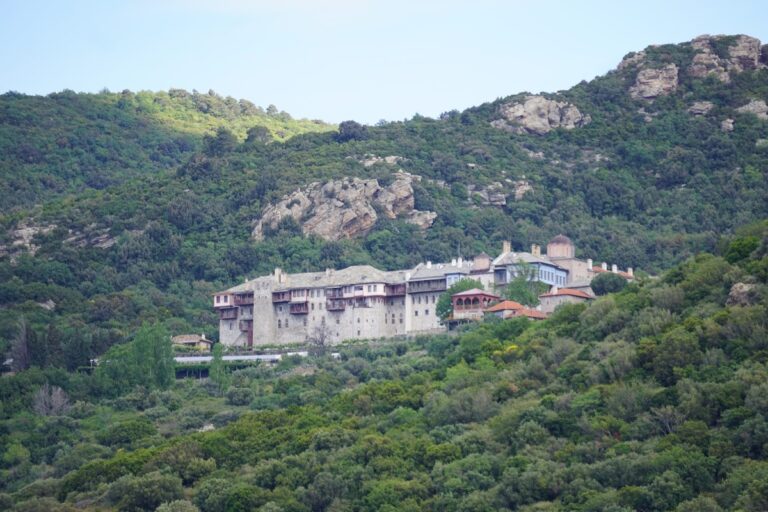
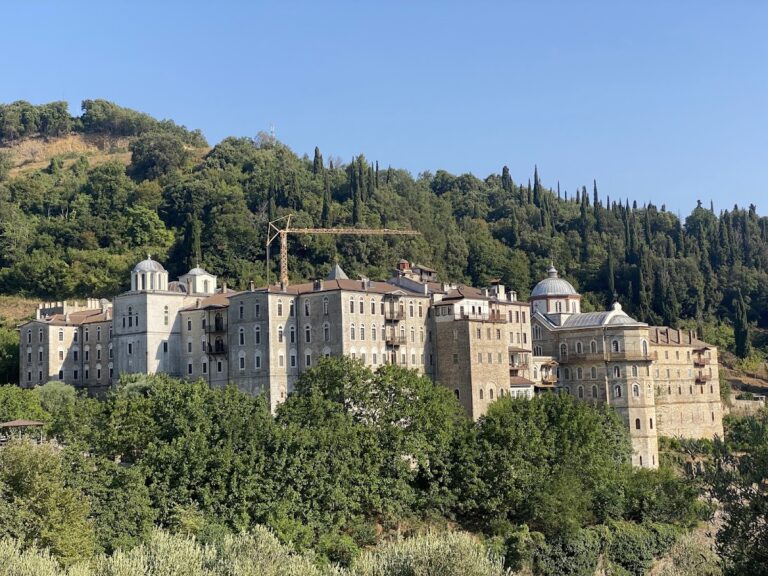
Xenophontos occupies a steep seashore site on the western side of the Athos peninsula, between the monasteries of Docheiariou and Saint Panteleimon. The complex contains two principal churches, eleven chapels within the monastery, and six chapels outside it. Its buildings, sacred objects, library, museum, and working areas form a monastic centre that has developed through successive periods of construction, fire, restoration, and enlargement.
Churches and chapels
Older katholikon
The older katholikon, the principal church of an Orthodox monastery, stands lower down the slope and nearer the sea than the newer church. It is among the smallest katholika on Mount Athos. Its narthex, the entrance or transitional area of a church, is attached to the eastern side of the refectory and is also connected with a monastic cell. The church contains wall paintings by the Cretan painter Antonios, dated to around 1544, while the exterior narthex beside the refectory has frescoes dated to 1475.
Chapel of Saint Demetrios
The chapel of Saint Demetrios is identified as the oldest monastic building. Its date remains uncertain. It is associated with the early Christian community said to have occupied the site and is traditionally attributed to Saint Xenophon, but it is also described as a seventeenth-century chapel distinguished by rich and refined decoration.
Great Katholikon
The newer Great Katholikon was built beside the monastery’s main tower between 1817 and 1839. It has eight domes, a Neo-Classical character, and notably good acoustics. Its main sanctuary contains a richly coloured marble iconostasis, the screen separating the sanctuary from the main worship space, as well as another iconostasis at the altar. Antonios Litra of Tinos sculpted the marble work, and a large cross hangs above the inner sanctuary.
The Great Katholikon contains later frescoes and large mosaic icons of Saints George and Demetrios in the right choir. A chapel there preserves twelve icons of the Apostles, probably made at the end of the sixteenth century and possibly once installed in the iconostasis of another chapel. The main church also houses a ninth-century icon of Saint George. Monastic tradition holds that the icon was kept in Constantinople during the period of Byzantine iconoclasm, when imperial and ecclesiastical authorities opposed the veneration of religious images, and survived attempts to destroy it with fire and sword before being thrown into the sea and reaching Xenophontos around the tenth century.
The monastery also preserves the miracle-working icon of the Virgin Hodegetria, an Orthodox image type showing the Virgin Mary as the guide who presents Christ. It began to be housed at Xenophontos in 1730 after a tradition that it repeatedly returned there from Vatopedi despite attempts to take it back. The nineteenth-century katholikon contains the thirteenth-century icon of the Virgin Kecharitomene.
Other sacred objects include a rare small steatite icon of the Transfiguration, a fragment of the True Cross, reliquaries containing saints’ remains, and ecclesiastical vestments. The preserved relics are associated with Saints Demetrios, George, Stephen, Tryphon, and Theodore of Tyre, as well as with the right hand of Saint Marina. The monastery’s chapels are dedicated to Saint Euthymius, the Holy Unmercenaries, the Dormition of the Virgin, Saint John the Theologian, Saint Lazarus, Saint Demetrios, Saint Stephen, the Presentation of the Virgin, the Apostles, Saint Nectarios, and the Holy Trinity.
Monastic buildings and collections
Bell tower and workshops
The bell tower was built in 1864 and now contains workshops used by the monks. These workshops continue the traditional arts of icon painting and woodcarving. A 2016 icon of the Virgin of Xerokrene, painted by the monk Luke of Xenophontos, is kept in the Church of All Saints in Thessaloniki.
Library and museum
The library occupies a secure building and contains about 600 manuscripts, including eight parchment manuscripts and two liturgical parchment scrolls. It also holds approximately 10,000 printed books and includes a museum. The early nineteenth-century fire destroyed many documents, giving the surviving collection particular value for the monastery’s continuing religious and historical identity.
Annunciation Skete and surrounding features
The Annunciation Skete is a smaller monastic settlement dependent on Xenophontos. It lies on a green mountain slope beside the Gulf of Singitic, approximately an hour from the monastery, and consists of a main church and twenty-two cells. Most of the cells are currently empty, while the skete’s library contains printed books.
A spring on the left side of the monastery’s beach was described in the eighteenth century as miraculous healing water emerging from the sand. Together with the churches, chapels, dependent establishments, collections, and craft workshops, it forms part of the physical and religious environment through which Xenophontos has continued its monastic life.