Konstamonitou Monastery: A Greek Orthodox Monastery on Mount Athos


Site at a Glance
- Rating
- 4.9
- Popularity
- Low
- Country
- Greece
- Primary era
- Modern
- Eras represented
- Medieval, Early Modern, Modern
- Civilizations
- Byzantine, Ottoman
- Site type
- Religious
- Remains
- Monastery
On this page15 sections
History
Konstamonitou Monastery is a Greek Orthodox monastery in Greece, located in the wooded interior of the Mount Athos peninsula and traditionally dated to the 11th century. Dedicated to Saint Stephen the Protomartyr, it holds twentieth place in the hierarchical order of the twenty monasteries of Mount Athos, an autonomous monastic territory containing Orthodox monasteries and smaller religious establishments. The monastery is patriarchal and stavropegic, meaning that it depends directly on the Ecumenical Patriarch rather than on a local diocesan bishop.
Foundation and Early Traditions
The origins of Konstamonitou remain uncertain. One tradition attributes its foundation to Constantine the Great, the Roman emperor who legalized Christianity and established Constantinople as an imperial capital, or to his son Constans. Another tradition places the monastery in the 11th century, while others connect its establishment with a monk from Paphlagonia, a wealthy Constantinopolitan family, or a court noble serving the Komnenian emperors. The last account would place the foundation no earlier than the 13th or 14th century. The name is also linked with the chestnut grove surrounding the monastery.
Destruction and Byzantine Restoration
In 1276, supporters of the unionist policy of Emperor Michael VIII Palaiologos destroyed the monastery. The policy sought ecclesiastical agreement between the Byzantine and Latin churches, and provoked opposition in parts of the Orthodox world. Konstamonitou later received substantial assistance from the Byzantine emperors John V Palaiologos and Manuel II Palaiologos, as well as from George Brankovic, the Serbian despot, a title used by rulers of medieval Serbia. Their support enabled the monastery to be restored after the destruction.
Ottoman Rule and Nineteenth-Century Reconstruction
Konstamonitou faced severe difficulties during Ottoman rule and recovered substantially only in the 19th century. A patriarchal sigillion, a formal decree or charter issued by the Ecumenical Patriarchate, made the monastery coenobitic. In a coenobitic monastery, monks live under communal discipline and share property and resources.
Major reconstruction began in 1818 during the abbacy of Chrysanthos of Epirus. Ali Pasha, the Ottoman governor of Ioannina in Epirus, financed the work through the mediation of Kyra Vasiliki, his influential consort. The eastern wing was rebuilt during this phase. Reconstruction continued under the hieromonks Simeon Stagirites and Joseph. With the assistance of Archimandrite Meletius, they raised funds in Russia, paid the monastery’s debts, and rebuilt the principal church and the northern wing. The present katholikon, the principal church of an Orthodox monastery, was constructed on the site of its predecessor between 1867 and 1869.
Continuing Monastic Life
Konstamonitou remains an active male monastery. Its community comprises approximately 30 monks, while the total monastic strength, including members of its dependencies, is approximately 45 people. In 1988, the monastery formed part of the Mount Athos property registered as a UNESCO World Heritage site.
Remains
Setting and Courtyard
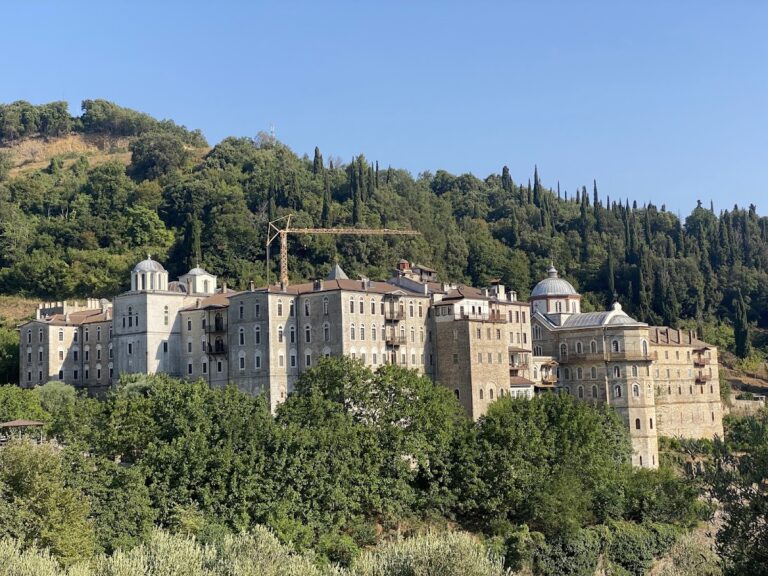
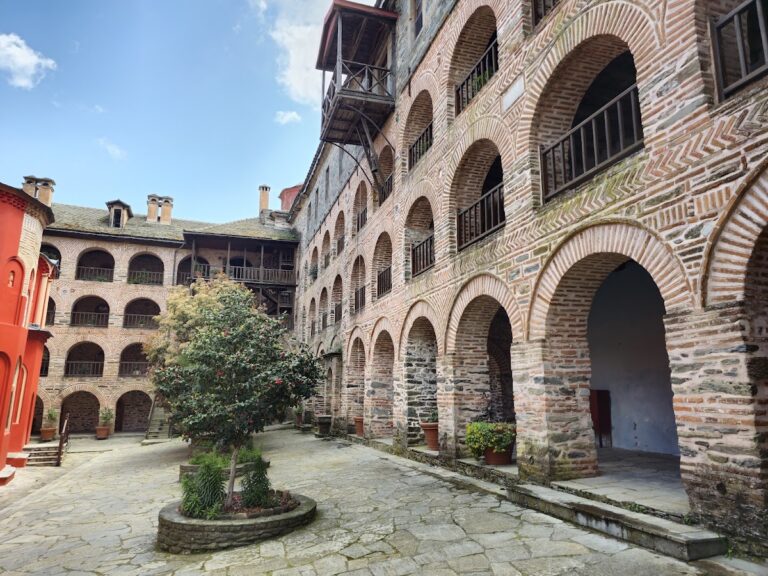
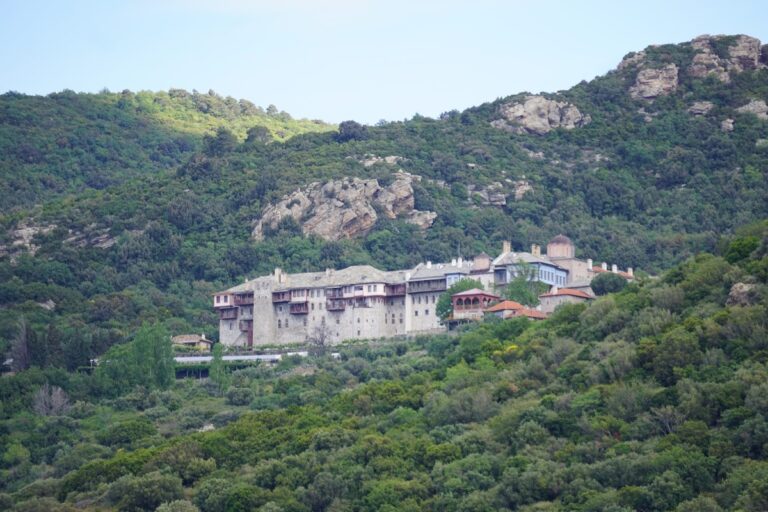
Konstamonitou stands approximately in the center of the Athonite peninsula, within the forest of Kreiovouni. The monastery is set inland in dense woodland dominated by chestnut trees, and difficult paths separate it from other monasteries. Its buildings form an enclosed complex with the katholikon at the center of the courtyard, while chapels and monastic dependencies occupy the surrounding area.
The Katholikon
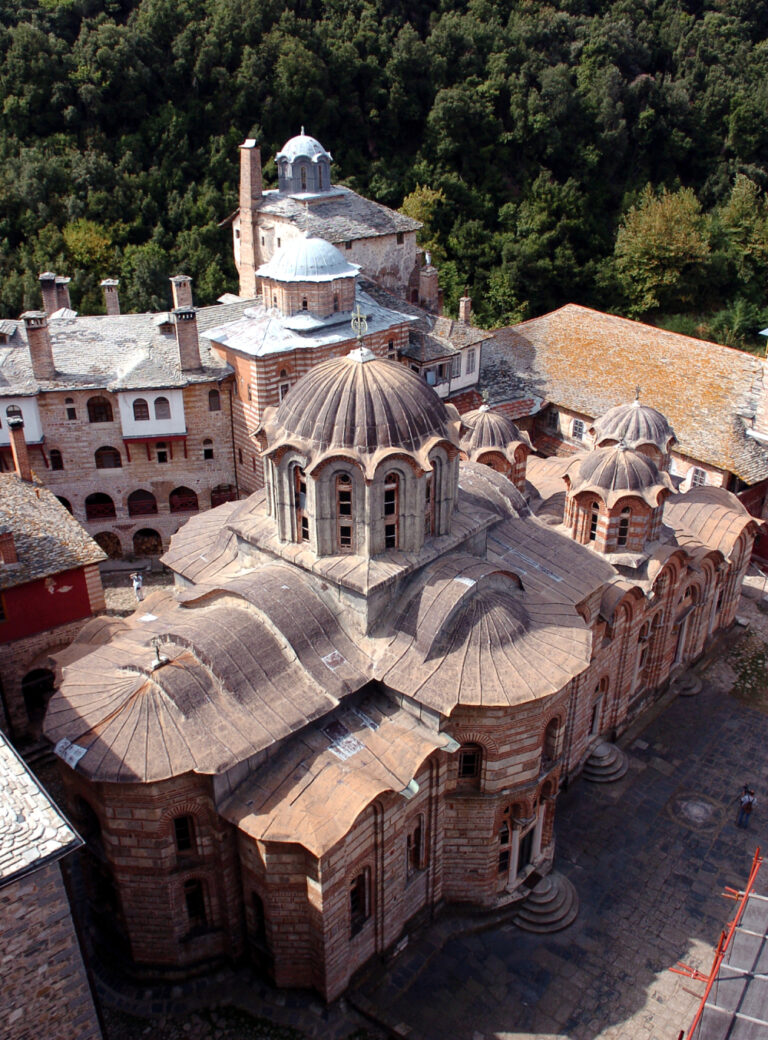
Dedicated to Saint Stephen, the katholikon follows the general Athonite church type and was built in 1867 on the ruins of the earlier church, with construction continuing until 1869. It has eight externally visible domes covered with lead, including a central dome that is the largest. Carefully laid stone forms the church walls. The interior is largely undecorated, with limited painting in the central dome.
The walls display numerous portable icons. Among them is the Hodegetria icon of the Virgin, an ancient image traditionally associated with the Blachernae Church in Constantinople. The Serbian princess Anna gave it to the monastery after receiving it from Emperor Manuel II Palaiologos and his son John Palaiologos. It stands beside the northeastern column supporting the dome.
The church also preserves another icon of the Virgin traditionally said to have performed a miracle at the monastery in 1020, along with an 11th-century miraculous icon of the Virgin and a miraculous icon of Saint Stephen. Other treasures include a finely made Byzantine cross, a fragment of the True Cross, and reliquaries, containers made to preserve and display relics. These hold relics associated with Saint Stephen, the Apostle Andrew, the Evangelist Luke, Constantine the Great, Saint Tryphon, Saints Cosmas and Damian, Saint Modestus, and Saint John Chrysostom. They also include part of Saint Blaise’s head, part of Saint Constantine’s shoulder, and Saint Tryphon’s hand.
A Gospel book with silver-gilt covers made in Epirus in 1820 was presented by Kyra Vasiliki. It is preserved in the katholikon with other liturgical objects.
Chapels and Cemetery Church
The monastery has nine chapels, four within the enclosure and five outside it. The internal chapels are dedicated to the Portaitissa icon, All Saints, Saint Constantine, and Saint Nicholas.
Chapel of the Portaitissa
Built above the entrance in the southern wing, the Chapel of the Portaitissa dates to 1871. Its carved wooden iconostasis, the screen separating the sanctuary from the main body of an Orthodox church, houses a miraculous icon of the Portaitissa Virgin.
Other Enclosure Chapels
The Chapel of All Saints occupies a floor of the southeastern wing. The larger Chapel of Saint Constantine occupies another floor and served as the monastery’s katholikon while the present principal church was being built in the mid-19th century. The Chapel of Saint Nicholas stands on the northern side of the enclosure.
External Chapels
Outside the monastery are the Chapel of Panagouda, the Chapel of Saint Anthony on the site of the earlier monastery, the Chapel of the Holy Trinity, the Chapel of Saint Nicholas at the monastery’s harbor installation, and the cemetery chapel. Panagouda contains Byzantine wall paintings, while Saint Anthony has a fine wooden iconostasis dated to 1670. The cemetery church lies a short distance southeast of the monastery and is dedicated to the Archangels Michael and Gabriel.
Dependencies and Collections
Karyes Cell and Kathismata
Konstamonitou maintains a cell at Karyes dedicated to the Athonite Fathers, which serves as its representative office. It also has two kathismata, smaller monastic dependencies that generally combine a chapel with residential space, in the wider monastery area.
The Holy Trinity kathisma lies west of the monastery in a position overlooking the sea. Built in 1894, it has finely cut stone masonry. Its chapel is clearly separated from the residential spaces, which occupy the western part of the building. Age-related deterioration has left the dependency uninhabited. The second kathisma, known as the old mill, stands opposite the monastery entrance, with habitable rooms on its upper floor.
Library
The monastery library preserves 110 manuscripts and approximately 5,000 printed books, extending the material record of Konstamonitou beyond its buildings, icons, relics, and liturgical objects.
Nearby sites