Agiou Panteleimonos Monastery: A Russian Orthodox Monastic Center on Mount Athos


Site at a Glance
- Rating
- 4.9
- Popularity
- Low
- Country
- Greece
- Primary era
- Modern
- Eras represented
- Early Modern, Modern
- Civilizations
- Ottoman
- Site type
- Religious
- Remains
- Monastery
On this page18 sections
History
Agiou Panteleimonos monastery is an Orthodox patriarchal stavropegic monastery in Greece, on the Mount Athos peninsula, whose history developed from a Russian monastic settlement established by the eleventh century. A stavropegic monastery stands directly under a patriarch rather than ordinary diocesan authority. Known also as the Russian Monastery, Rossikon, or New Russik, it is one of the twenty ruling monasteries of Mount Athos, ranks nineteenth in the Athonite hierarchy, and remains under the canonical jurisdiction of the Ecumenical Patriarchate of Constantinople.
Medieval foundations and changing communities
The earliest Russian settlement on Mount Athos was established at Xylourgu. At the request of Abbot Lavrentios, the community later moved to the abandoned Monastery of the Thessalonian, while Xylourgu became a smaller dependent settlement, or skete. The mountain monastery that developed at the former Thessalonian site is now called Old or Mountain Russik. The Monastery of the Thessalonian was recognized as a separate monastery in 1169.
The early history of the monastery is difficult to reconstruct because a fire in the thirteenth century destroyed its archives and library. Catalan pirates burned it in 1307. Serbian rulers and nobles subsequently protected the community and gave it donations and properties that produced revenue. During the period of Mongol rule in Russia, the brotherhood was predominantly Greek. Russian pilgrims began returning to Mount Athos from 1497, while the monastery became predominantly Serbian in the late fifteenth and sixteenth centuries, as its correspondence with authorities in Moscow indicates.
The monastery declined during the seventeenth and eighteenth centuries. It became impoverished and indebted, and many of its properties passed away. In 1726, its community consisted of two Russian and two Bulgarian monks under a Bulgarian abbot. The monastery was declared Greek in 1735.
Transfer to the coast
A Greek brotherhood moved from the mountain site to a coastal dependency around 1770. A small Church of the Ascension had been built there in 1667 by Christopher, Bishop of Ierissos. The present coastal monastery was established at the site in 1765 with support from Balkan rulers and Danubian princes, especially Scarlat Callimachi, ruler of Moldavia and Wallachia.
Callimachi’s patronage supported a rebuilding campaign in the early nineteenth century. Patriarch Callinicus confirmed the monastery’s charter in 1806, and the principal church was built between 1812 and 1821. The Greek War of Independence caused the monastery to be deserted. A prolonged boundary dispute with Xenophontos monastery further weakened it. After Ottoman military occupation ended and normal life on Mount Athos was restored in 1830, the monastery did not regain its former properties, which had passed to other monasteries in settlement of debts. The Protaton later attempted to remove it from the list of monasteries, but Patriarch Constantine I rejected the proposal.
Russian revival and expansion
Russian monastic life began to revive in the 1830s with the arrival of Hieromonk Anikita, formerly Prince Shirinsky-Shikhmatov, and Hieromonk Jerome, born Ivan Solomentsov. After the death of the Russian spiritual elder Arseny on 24 March 1846, Jerome became an influential spiritual successor among Russian, Greek, Bulgarian, Serbian, and other Athonite monks.
Russian monks returned to the monastery in 1840 and soon formed the majority. Archimandrite Makary Sushkin became its first Russian abbot in 1875. Under his leadership, Agiou Panteleimonos increasingly became a Russian monastic center. The Russian imperial family supported the monastery, which expanded substantially during the second half of the nineteenth century.
Its growth produced disputes over administration and jurisdiction. Russian monks sought formal recognition of Russian jurisdiction, while the Russian Holy Synod and government treated the monastery and its Russian monks as subject to Russian jurisdiction during the early twentieth century, alongside their status within the Ottoman Empire. The 1924 Charter of the Holy Mountain expressly prohibited this practice. Later claims by Soviet authorities and the Russian Orthodox Church that the monastery belonged to them had no ecclesiastical or civil legal basis.
In 1861, the monastery’s council of elders sent Hieromonk Arseny Minin to Russia to collect voluntary donations. In August 1867, he brought relics from the monastery to Moscow’s Epiphany Monastery. Donations later funded a chapel for the relics, which was closed and demolished in 1929.
By the end of the nineteenth century, Agiou Panteleimonos was the largest monastery on Mount Athos by both area and number of monks. More than 1,000 monks lived there during that period, including Greeks and southern Slavs. The community numbered 1,446 in 1903 and approximately 2,000 in 1913.
The imyaslavie crisis and the modern brotherhood
In the 1910s, the monastery became a center of intense Russian theological disputes over imyaslavie, or “Name-Glorification,” a movement that treated the name of God as more than a merely verbal designation. In 1913, Russian troops intervened by force. Supporters of the movement were arrested and transported to Russia, including 418 monks from Agiou Panteleimonos.
The monastery suffered a severe library fire in 1959 and a major fire in 1968. In 1966, for the first time since 1914, four monks arrived from Russia or the Soviet Union to replenish the brotherhood. One was Hieromonk Hippolytus, who later became the monastery’s steward. Hieromonk Abel became abbot in 1975.
The brotherhood fell to thirteen monks in the early 1970s because new arrivals from the Soviet Union were scarce and Soviet citizens faced restrictions on entering Mount Athos. After Patriarch Pimen visited Mount Athos in 1972 and the Soviet government provided assistance, recruitment improved somewhat. The monastery had about 70 resident monks in 2014, approximately 80 to 90 in 2016, and 104 in the main community in 2020, with a further 26 monks in its dependencies.
Saint Silouan the Athonite, the monastery’s best-known modern elder, died there in 1938. Other monks associated with its traditions include Basil Ploshchansky, John the Russian, and Job of Ugolsk. Saint Daniel of Smyrna was tonsured at the monastery in 1866. The abbot since 2 October 2016 has been Archimandrite Eulogius Ivanov. In 2005, the monastery received a special diploma from the Union of Russian Writers for publishing a book about Saint Silouan.
Agiou Panteleimonos has dependencies in Moscow, Saint Petersburg, and Istanbul, while a dependency in Kiev opened in 2012. A skete of Saint Silouan the Athonite in Zhytomyr Oblast was attached to the Kiev dependency in 2014, and its activity was suspended in 2017. The monastery’s principal dependent settlements include the sketes of the Dormition of the Mother of God at Xylourgu, Old Russik, New Thebaid, and Kromnitsa. It also owns five cells. The former Andreyevsky Skete passed to Vatopedi after the death of its last Russian monk, while the Ilyinsky Skete, founded by Paisius Velichkovsky, is now attached to Pantokrator.
Remains
Coastal complex and principal churches
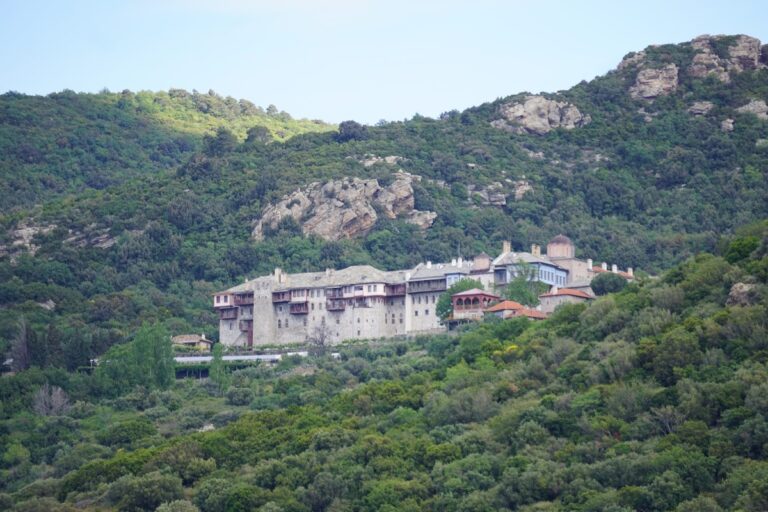
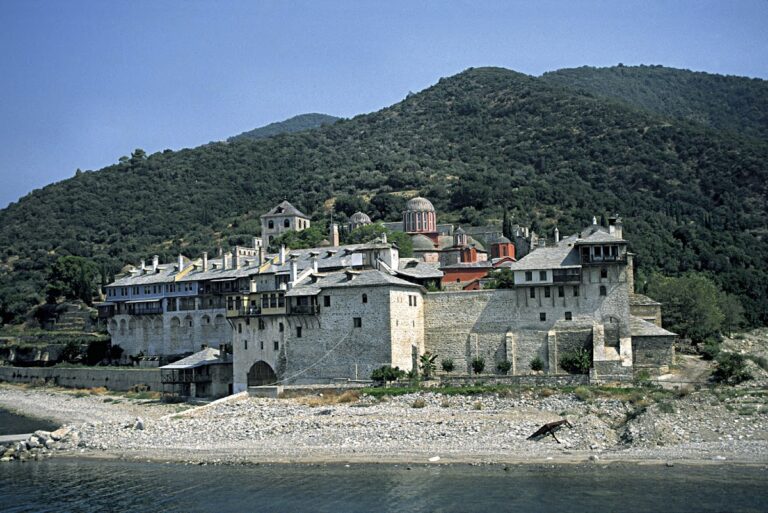
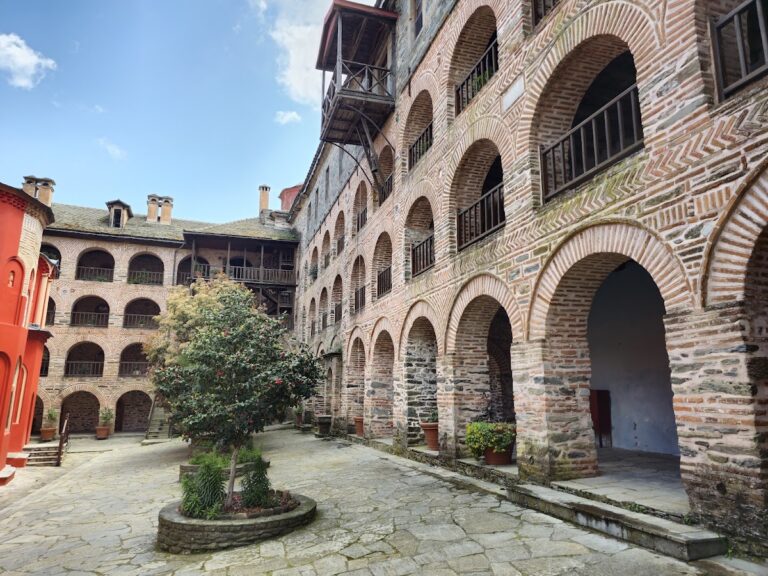
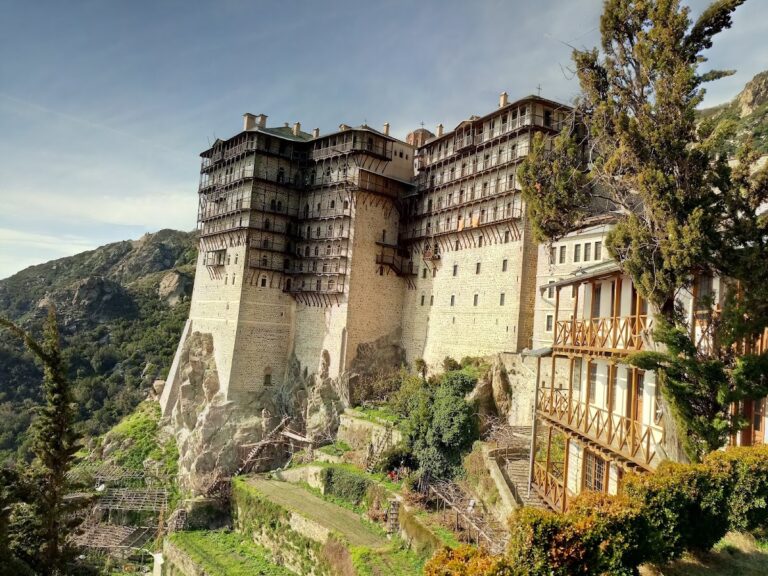
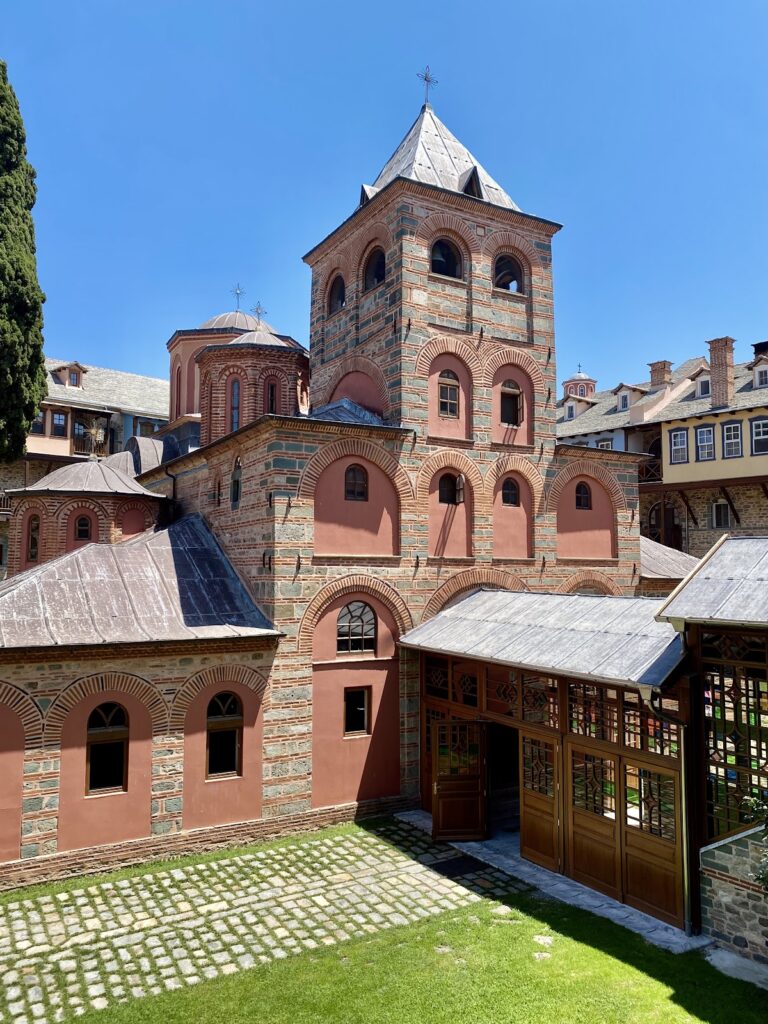
The present monastery stands on the western coast of the Mount Athos peninsula, between Xenophontos monastery and the port of Daphne. Its large complex consists of multistory buildings grouped around numerous churches, chapels, and communal structures. High church domes contribute to its appearance as a small town.
Church of Saint Panteleimon
The principal church, or katholikon, is dedicated to Saint Panteleimon, traditionally venerated in Eastern Christianity as a physician and martyr. It was built between 1812 and 1821, according to the inscription at the entrance. The church follows the general plan of Athonite monasteries and has eight domes crowned with crosses. Its walls are made from rectangular dressed stone slabs. Services are conducted in Greek and Church Slavonic, and Russian craftsmen made its richly decorated iconostasis, the screen separating the sanctuary from the main body of the church.
Church of the Protection of the Mother of God
A second principal church is dedicated to the Protection of the Mother of God. It contains the relics of Saint Silouan and several revered icons, including the Jerusalem icon of the Mother of God, an icon of Saint John the Baptist, an ancient icon of Saint Panteleimon, and an icon of Saint Charalambos. The Jerusalem icon and other revered icons are particularly associated with this church.
Other churches and chapels
Other churches within the monastery are dedicated to Saint Mitrophan of Voronezh; the Dormition of the Mother of God; Saints Vladimir and Alexander Nevsky; the Ascension; Saint Sergius; Saint Demetrius; the Archangels; Saint Gerasimus; Saints Constantine and Helena; and Saints Vladimir and Olga. The church interiors contain nineteenth-century wall paintings. The Alexander Nevsky church is richly decorated, with icons arranged in a gilded icon case and a gilded iconostasis.
The monastery has thirty-five chapels. Among those named are chapels dedicated to the Dormition, Saint Mitrophan, the Ascension, Saint Sergius, Saint Demetrius, Saint Alexander Nevsky, the Protection of the Mother of God, Saint Sabbas, Saint Nicholas, and Saint John the Baptist.
Cemetery churches and southern buildings
Cemetery churches
The cemetery churches are the old Church of Saints Peter and Paul, built in 1820, and a two-storey church built in 1896. The upper floor of the later building contains a church dedicated to the Archangels, while the lower floor contains a church dedicated to Saints Seraphim of Sarov and Theodosius. The building also includes two cells.
Southern churches
Eight churches formerly stood in the southern part of the monastery. The 1968 fire left the churches of Saint Sabbas and Saint Nicholas as the surviving members of this group. Two additional churches stand outside the monastery walls.
Refectory, bells, and library
Refectory and bell tower
The refectory stands directly opposite the entrance. Built in 1890 and painted in 1897, it can accommodate approximately 800 people. A bell tower rises above it, while a holy-water basin stands opposite the tower, to the left of the entrance.
The bell tower was built in 1893. Its largest bell has a circumference of 8.71 metres, a diameter of 2.71 metres, and a weight of 13 tonnes. Thirty-two additional bells are also recorded. During the nineteenth century, the monastery’s bells were regarded as the largest in Greece.
Library
The library occupies a separate two-storey building. Its holdings include approximately 1,320 Greek manuscripts and 600 Slavonic manuscripts, together with more than 20,000 printed Greek, Slavonic, and Russian books. Notable items include a richly illuminated Gospel book and sixteen homilies of Gregory the Theologian. The 1959 fire severely damaged the library.
Relics, icons, and associated establishments
The monastery preserves the head of Saint Panteleimon, relics of the True Cross, and relics or remains associated with numerous apostles and saints. Its collections also include parts of the relics of Saint John the Baptist, Saint Silouan, and other holy figures. The Church of the Dormition houses a refined chalice and a Gospel with a precious repoussé cover, donated by Grand Duke Constantine Nikolaevich, who visited the monastery in 1845.
Cells and sketes
The five cells belonging to the monastery are dedicated to Saint Euthymius, the Unmercenary Saints Cosmas and Damian, the Life-Giving Spring, the Protomartyr Archdeacon Stephen, and Saint George the Victorious. The cells dedicated to Stephen and George are located in Karyes.
The monastery’s associated establishments include the sketes of Xylourgu, Old Russik, New Thebaid, and Kromnitsa. A skete is a smaller monastic settlement subordinate to a principal monastery. Old Russik occupies the site of the former mountain monastery of the Thessalonian. Xylourgu is one of the oldest Russian Orthodox establishments on Mount Athos and marked the millennium of Russian Orthodoxy on Mount Athos in 2016.
Kromnitsa lies near Ouranoupoli amid the monastery’s vineyards. It formerly served as a monastic health retreat and survived the large Athonite fire of August 2013 while surrounding vegetation burned and the vineyards remained untouched. The monastery also historically possessed additional dependent properties, including the Kromnitsa metochion, a monastery-owned dependent property, near Ouranoupoli.