Château de Bonnefontaine: A Fortified Renaissance Residence in France


Site at a Glance
- Rating
- 4.4
- Popularity
- Low
- Country
- France
- Primary era
- Early Modern
- External website
- Open
- Eras represented
- Early Modern
- Civilizations
- French
- Site type
- Domestic
- Remains
- Castle
On this page9 sections
History
Château de Bonnefontaine is a fortified residence in France, near Antrain in the former province of Brittany, principally constructed during the sixteenth century in the regional Breton Renaissance style. This architectural movement combined Renaissance forms with the traditions of fortified residences. The estate’s history reaches back to the late eleventh century and includes connections with prominent Breton families, the French monarchy, and the political upheavals of the eighteenth and nineteenth centuries.
Medieval Foundations and the Saint-Brice Inheritance
Bonnefontaine first enters the historical record in the late eleventh century, when Geoffroy Chaussebœuf donated the estate to Saint-Florent Abbey of Saumur, a Benedictine monastery and important medieval religious institution. At the end of the thirteenth century, the property passed into the Saint-Brice family, which held it for three generations.
In 1370, Jeanne de Saint-Brice, the sole heiress of Bonnefontaine, married Guillaume de Porcon. Guillaume was the son of Olivier de Porcon and had been a companion of Bertrand du Guesclin, the Breton commander who became constable of France during the Hundred Years’ War. Through this marriage, Bonnefontaine entered the Porcon family, which originated in Saint-Méloir-des-Ondes near Cancale and retained the estate for approximately two centuries.
The Porcon and Giffard Families
Arthur de Porcon held important responsibilities in late fifteenth-century Brittany. He served as chamberlain to Anne, Duchess of Brittany, who later became queen consort of France through her marriages to Charles VIII and Louis XII, and he was captain of Fougères in 1488.
Françoise de Porcon inherited Bonnefontaine in 1533 and married Pierre Giffard de La Marzelière. Pierre had been raised at the court of Francis I and served as a gentleman of the king’s household. He received the Order of Saint Michael, a prestigious French chivalric order founded by Louis XI in 1469, for his conduct at the siege of Renty in Boulonnais in 1556.
On 5 July 1547, Pierre obtained permission from King Henry II to transform Bonnefontaine into a fortified stronghold. The authorization led to the construction of the southern part of the château, including its large tower with machicolations. These projecting openings or parapets allowed defenders to observe and attack enemies below the walls or tower. The work established the principal fortified character associated with the sixteenth-century residence.
The Coëtquen Period
In 1604, Bonnefontaine was inherited by the daughter of François Giffard de La Marzelière. In 1631, she married Malo de Coëtquen. He was the son of a woman from the illegitimate Orléans-Rothelin branch of the Capetian family and the grandson of a member of the Rohan-Guéméné family.
The Coëtquen family were also lords of Combourg and governors of Saint-Malo. They often lived at Combourg, linking Bonnefontaine to a family whose later traditions became associated with François-René de Chateaubriand, the major French Romantic writer. The wooden-legged ghost connected with Chateaubriand’s Combourg is identified with Malo III de Coëtquen, Baron of Bonnefontaine and son of Charlotte de Rohan-Chabot.
Revolutionary and Nineteenth-Century Ownership
In 1754, Louise-Maclovie de Coëtquen, the wife of Emmanuel-Félicité de Durfort, Duke of Duras and Marshal of France, sold Bonnefontaine to Jean de La Motte, lord of Lesnage. After Jean de La Motte’s wife died and her heir emigrated, the estate was sold as national property in the seventh year of the French Revolutionary calendar.
Bonnefontaine changed owners several times before Guy Aubert de Trégomain acquired it in 1806 with the consent of the legitimate heirs, whom he compensated for the property. Later a deputy of Ille-et-Vilaine under King Charles X, he was a committed Legitimist, a supporter of the senior Bourbon line who opposed the regime of Louis-Philippe. During the Western Plot, a Legitimist conspiracy associated with the Duchess of Berry’s attempt to promote her son’s claim to the throne, he was entrusted with command of the army of Ille-et-Vilaine.
François de Guiton purchased the château in 1858 at the age of twenty-six. He was married to Françoise Hay des Nétumières, and roughly two decades later he undertook major works that gave the château and park their present appearance. During the later nineteenth century, the park was designed and laid out by Denis Bühler and Édouard André as part of the romantic landscape-garden movement.
Inheritance and Protection
The Vicomtesse de Guiton died without issue in 1910 and left the property to her nephew, Jacques Le Cardinal de Kernier, Marquis of Kernier. His daughter, Béatrix Le Cardinal de Kernier, inherited Bonnefontaine. Through her marriage to Count Léonor de Rohan-Chabot, the château entered the Rohan-Chabot family, which has retained it since then.
The façades, roofs, and well have been protected as a French historic monument since 16 September 1943. The château remains owned by the Rohan-Chabot family.
Remains
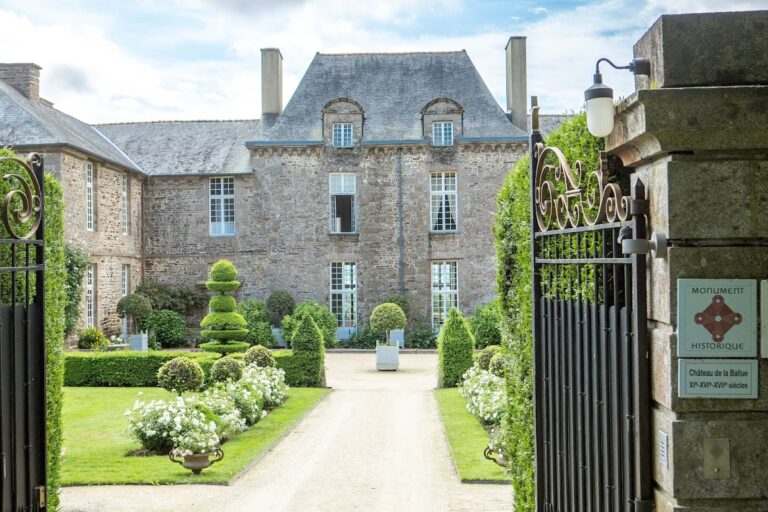
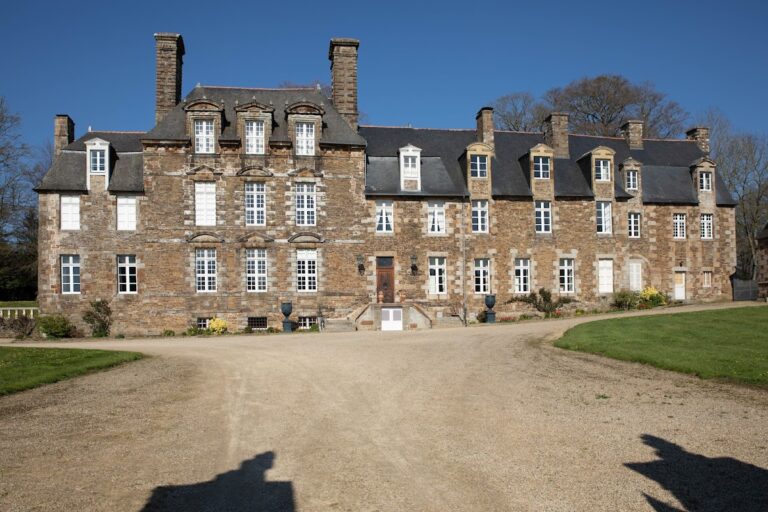
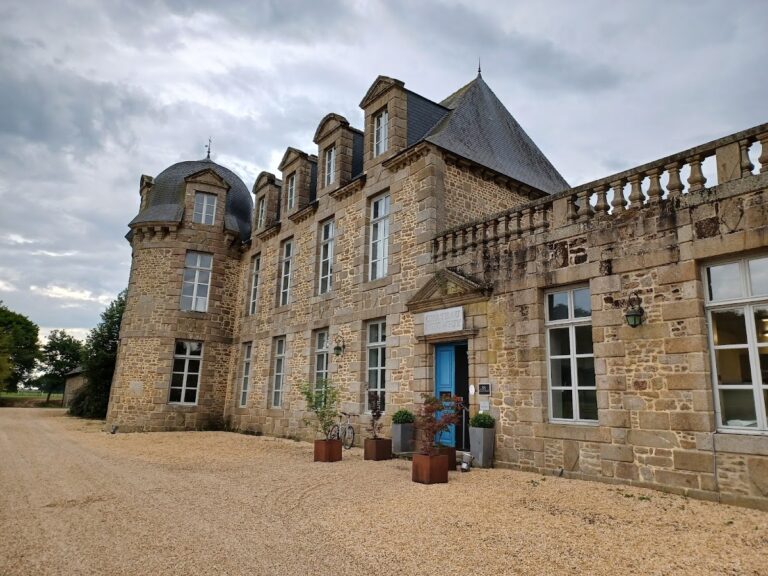
Château de Bonnefontaine combines a substantial residential building with elegant turrets, tall windows, carved dormer windows, and squat towers capped by pepper-pot roofs. Its defensive character is expressed most clearly by the machicolations on the towers. The result is a residence in which refined Renaissance details coexist with the forms of a fortified Breton manor.
The Château
The southern part of the building belongs to the fortification campaign directed by Pierre Giffard de La Marzelière after the royal authorization of 1547. Its large machicolated tower is the principal surviving feature of that work. The château’s façades, roofs, and associated well form part of the protected historic fabric.
The Park
The park is an English-style landscaped garden organized around broad natural spaces, wide vistas, successive plantings, and groves. Many of the trees planted when the grounds were created remain, including giant sequoias, bald cypresses, Chinese yews, magnolias, cedars, palms, and purple beeches.
A chestnut beside the main avenue is known as the “Duchess Anne’s Tree.” A sign relates a local tradition that Anne of Brittany sat beneath it after a storm in 1987 overturned the tree. The tradition preserves the tree’s association with one of Brittany’s most prominent historical rulers.