Wat Ratchaburana: A Royal Ayutthaya Buddhist Temple Complex
Site at a Glance
- Rating
- 4.7
- Popularity
- Medium
- Country
- Thailand
- Primary era
- Medieval
- Eras represented
- Medieval, Early Modern
- Civilizations
- Unclassified
- Site type
- Religious
- Remains
- Temple
On this page11 sections
History
Wat Ratchaburana is a Theravada Buddhist temple complex in Ayutthaya Historical Park, Thailand. The Ayutthaya Kingdom founded and constructed it in 1424 under King Borommarachathirat II, also known as Prince Chao Sam Phraya, during the early Ayutthaya period. Its central prang and associated buildings formed a royal religious foundation, while its underground crypt later became one of the most important archaeological discoveries in the historic city.
Foundation under Borommarachathirat II
One Thai historical tradition states that Borommarachathirat II established Wat Ratchaburana after the death of his father, King Intharacha. The temple was built at the place where Intharacha’s cremation took place and served as a royal act of merit-making. Its name, Wat Ratchaburana, means “Royal Fulfillment.” Borommarachathirat II ruled from 1424 to 1448, and his reign belonged to a period when Ayutthaya was expanding as a centre of administration, commerce, and Buddhist culture.
Official Thai historiography instead connects the temple with the cremation of Borommarachathirat II’s elder brothers, Chao Ai Phraya and Chao Yi Phraya. After Intharacha’s death, the brothers fought for succession and killed each other in an elephant duel. Borommarachathirat II is said to have built two chedis for them near the area between Wat Ratchaburana and Wat Mahathat, while establishing the temple over their cremation site.
Historical traditions and Ayutthaya’s expansion
The foundation traditions do not agree on every detail. One chronicle places the brothers’ duel and the temple’s foundation in 1430 rather than 1424, and connects the two chedis with that conflict. Another tradition attributes the foundation to King Ekathotsarot, who ruled approximately from 1605 to 1610. A further tradition assigns the foundation of a monastery called Wat Ratchaburana to King Borommakot, who ruled from 1733 to 1758. Rebuilding and the addition of another stupa have also been associated with Borommarachathirat III, who is likewise given a reign from 1733 to 1758 and had previously spent many years as a monk.
The temple’s early setting was linked to Ayutthaya’s development as a port and commercial intermediary with China. During the reign of Intharacha, trade with China expanded with the support of the Ming emperor. The Ming dynasty ruled China from 1368 to 1644, and this commercial relationship contributed to Ayutthaya’s rapid growth.
Discovery, looting, and conservation
The crypt was discovered in 1956 and quickly attracted nationwide attention. In 1957, a large group of thieves illegally excavated it, removing gold artifacts, royal regalia, jewelry, Buddha images, and other objects. The thieves were arrested, although only part of the stolen material was recovered. Excavations by Thailand’s Fine Arts Department subsequently revealed three crypt chambers, more than 2,000 offerings or artifacts, over 100,000 votive tablets, and more than 100 kilograms of gold.
Restoration followed the looting and archaeological investigation in 1957 and 1958. Wat Ratchaburana was registered as an archaeological monument by the Fine Arts Department in 1935. It forms part of the Historic City of Ayutthaya, which UNESCO inscribed as a World Heritage cultural site in 1991 under criterion (iii). The temple was severely affected by the 2011 floods, when water stood at about one metre across large parts of Ayutthaya Historical Park for several weeks. In 2012 and 2013, the Fine Arts Department and the German Wat Ratchaburana Safeguarding Project carried out conservation and emergency stabilization, concentrating on delicate stucco and plaster decoration, the entrance building, the southeast side of the central prang, and the foundations.
Remains
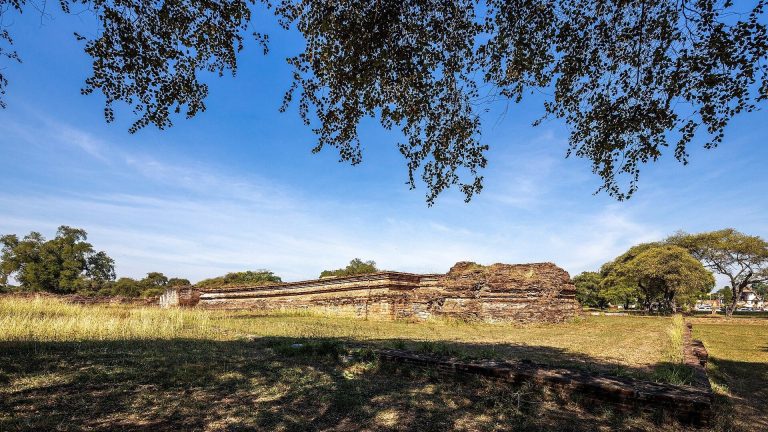
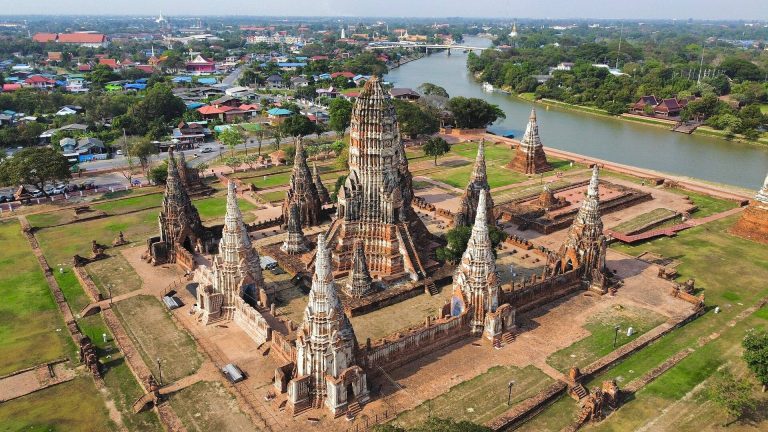
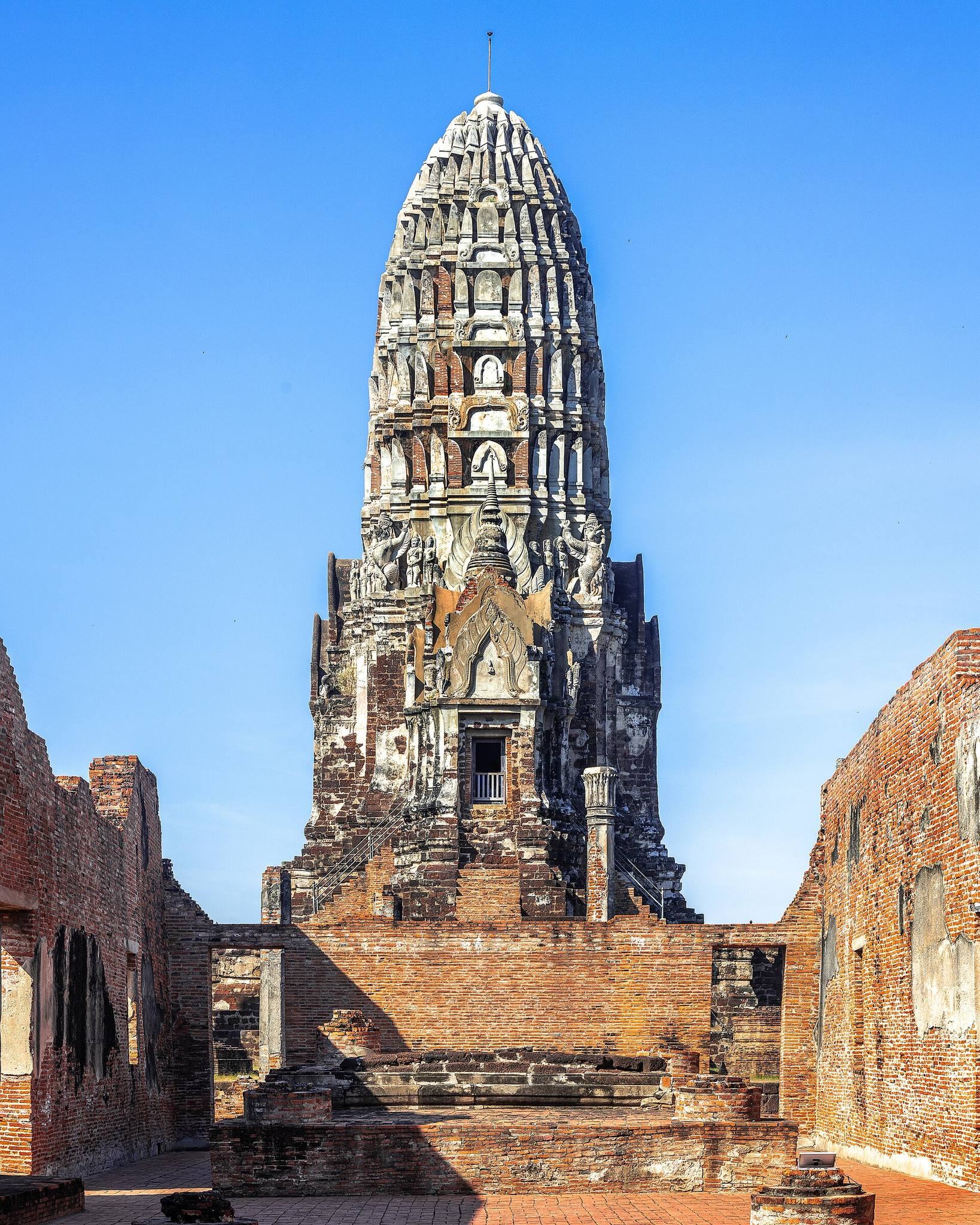
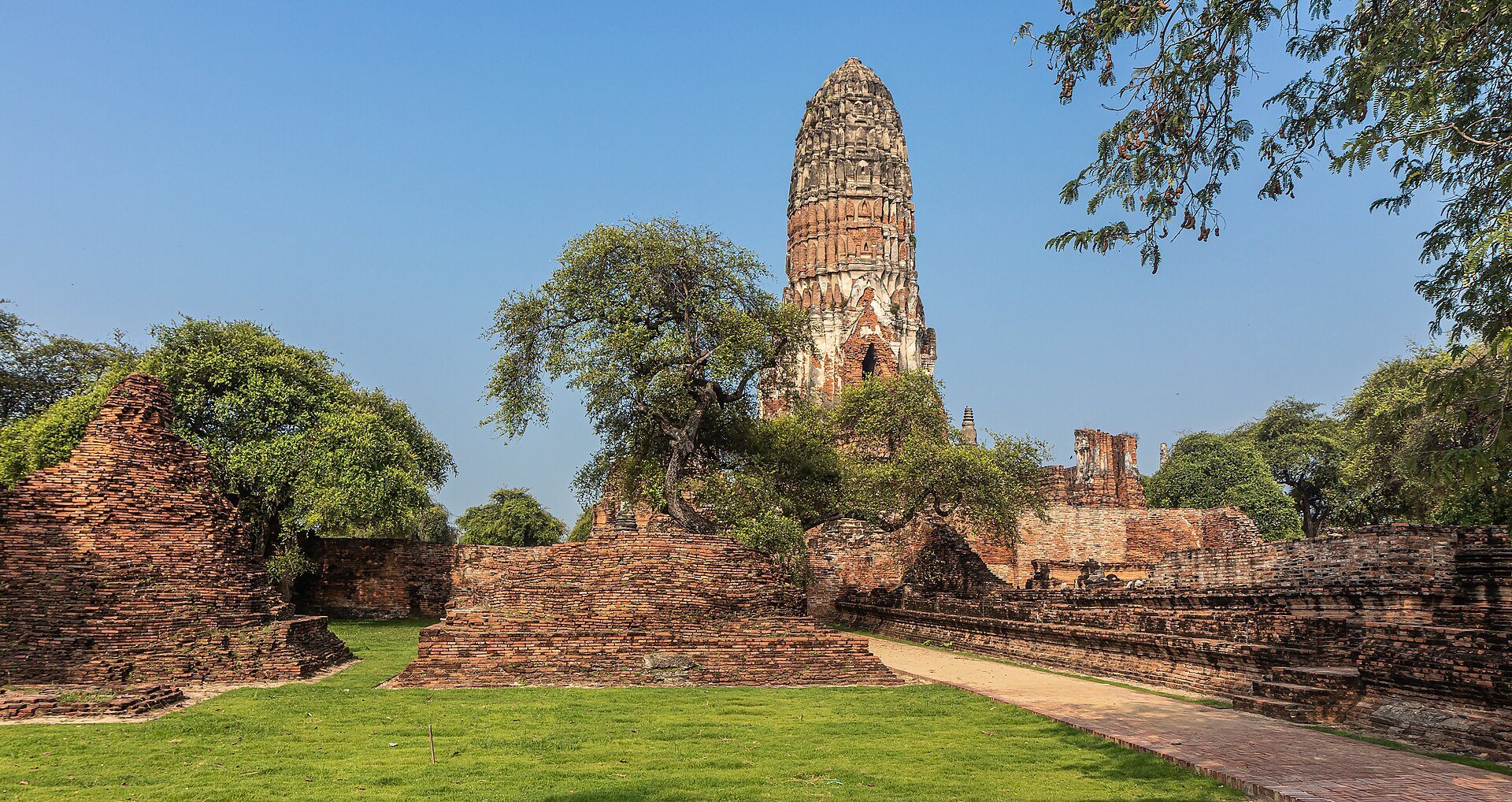
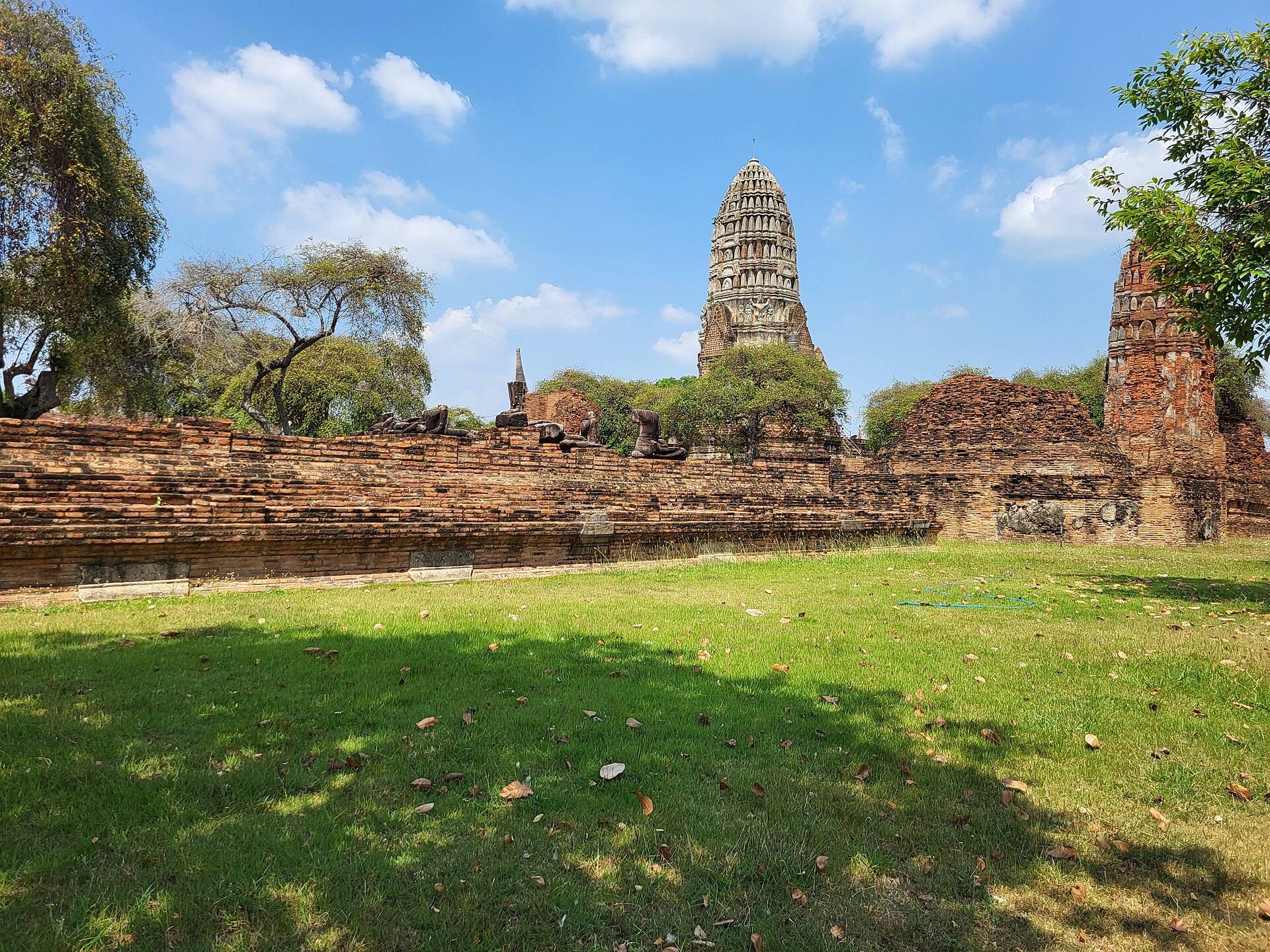
Wat Ratchaburana occupies approximately 38,400 square metres and measures about 98 metres from north to south and 65 metres from east to west. The surviving complex consists principally of brick and wood ruins on the island section of Ayutthaya, west of the Lopburi River and immediately north of Wat Mahathat. It stands at the foot of Pa Than Bridge, near the former royal palace. The central prang, estimated at about 32 to 35 metres high, rises within a ruined cloister and is surrounded by four surviving corner chedis.
Central sacred structures
Central prang
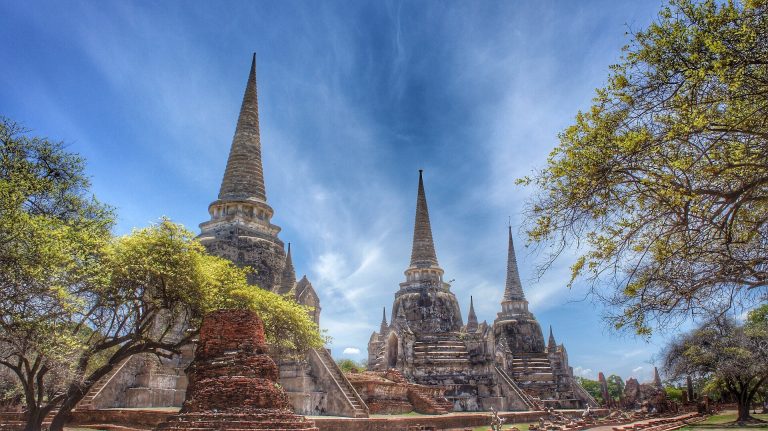
The central prang is a tall tower derived from the earlier Khmer prasat, a Khmer temple or sanctuary tower used as a central sacred structure. Its high base and elongated vertical form give it a strong upward emphasis. Four tapering chedis anchor its corners, and together the prang and chedis represent Mount Meru, the world-mountain at the centre of the Buddhist cosmos. Some scholars date the present arrangement of the surrounding stupas to the seventeenth century.
Stucco decoration covers the prang in a Khmer-influenced style. The surviving imagery includes Garudas, bird-like divine beings, nagas, serpent-like supernatural beings, other mythical creatures and animals, and lotus motifs. One original scene shows a Garuda swooping upon a naga, while niches contain Buddha images. The prang also contains a deep crypt reached by steep stairs. Its faded wall paintings include scenes from the Buddha’s former lives and other Buddhist imagery, making them rare surviving examples associated with the early Ayutthaya period.
Cloister and halls
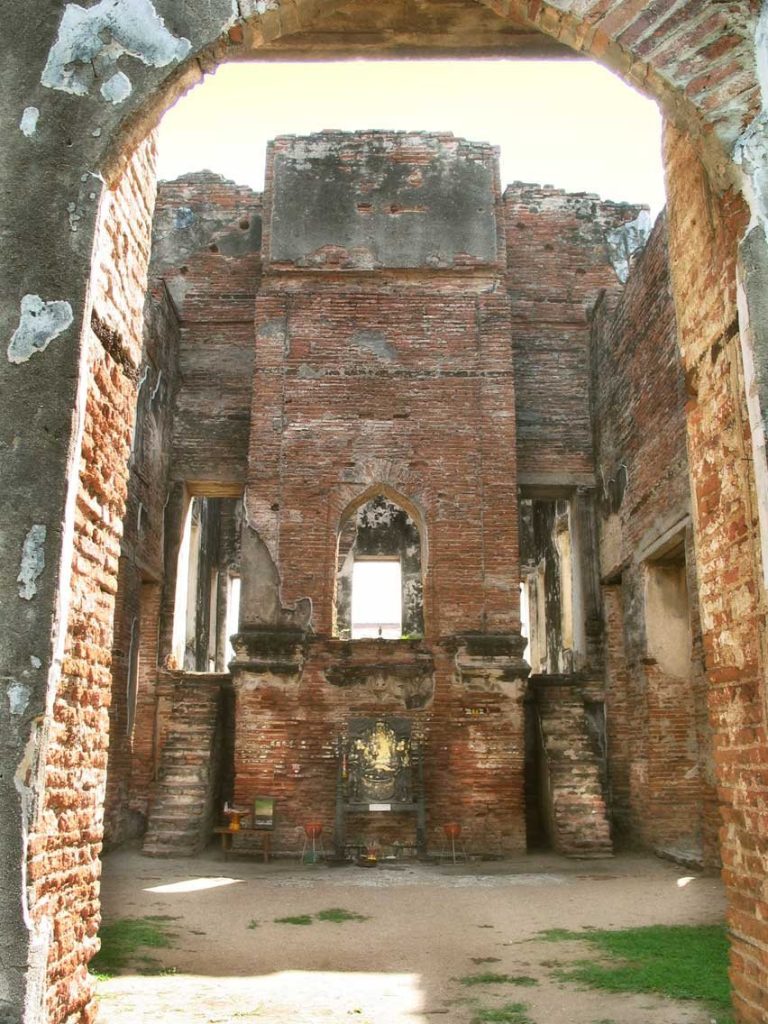
A ruined cloister encircles the central prang and the four corner chedis. To the east stands a long, narrow viharn, a Buddhist assembly or preaching hall. The corresponding building to the west served as the monastery’s ubosot, the ordination hall used for formal monastic rites. Additional satellite chedis and smaller viharns are distributed across the grounds in various states of ruin.
The crypt and excavated material
Three underground chambers
The crypt consists of three chambers arranged vertically, with the lowest chamber approximately at ground level. The upper chamber was enclosed by walls decorated with figures, including Chinese figures and assemblies of deities. Small recesses behind the walls held votive tablets and Buddha images. Thieves reportedly found three or four gold Buddha images there, each approximately one cubit in lap width.
The middle chamber contained three gold trays filled with gold objects. Its murals showed scenes from the Buddha’s former lives in rectangular panels, and most niches held small bronze tables for gold objects and gold cloth. Part of the floor was removed, creating a connection between the middle and lower chambers. The lowest chamber was regarded as the most important because it contained Buddhist relics in a gold reliquary or gold chedi, surrounded by additional Buddha images.
Murals, tablets, and objects
Archaeological investigation revealed murals in all three chambers and thousands of carefully stacked votive tablets. These small devotional offerings bear Buddha images from Thailand, India, Burma, Indonesia, Nepal, and other regions. Three tablets carry Chinese inscriptions, and a gold plaque bears Chinese characters.
Other finds included gold royal regalia, jewel-decorated garments, antique jewelry, numerous Buddha images, coins, two gold objects from Kashmir, three Buddha images from Sri Lanka, a stone Buddha from India, and another stone Buddha from Nepal. A ceremonial gold sword associated with King Intharacha was also reportedly found and was probably made for his funeral ceremony. The Buddha images show Khmer and Sukhothai influences.
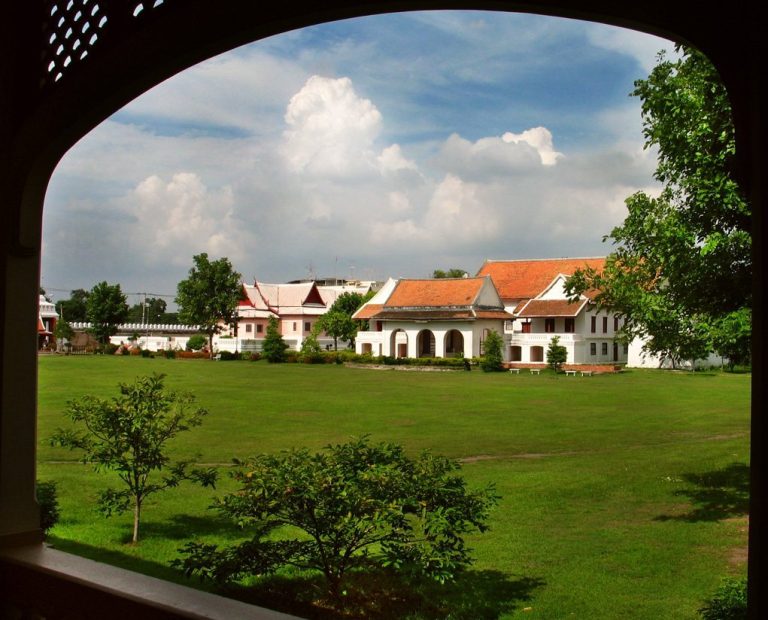
The excavated objects are housed principally in the Chao Sam Phraya National Museum, including its Ratchaburana Room. The collection contains the gold objects, jewelry, coins, votive tablets, Buddha images, and other material recovered from the crypt. In 2005, a claim emerged that a gold helmet had been found in a museum in the United States, but its authenticity and possible connection with Wat Ratchaburana remain unresolved.