Trincheras Hill: An Archaeological Settlement in Sonora
Site at a Glance
- Rating
- 4.9
- Popularity
- Very Low
- Country
- Mexico
- Primary era
- Medieval
- Eras represented
- Medieval
- Civilizations
- Unclassified
- Site type
- City
On this page8 sections
History
Trincheras Hill is an archaeological settlement in Trincheras, Sonora, Mexico, associated with the Trincheras culture and occupied during the Trincheras IV phase, approximately from AD 1300 to 1450. The wider culture extended across northwestern Sonora from about the eighth to the fourteenth centuries. The settlement developed as a complex regional center, combining farming, craft production, residential areas, ceremonial activity, and observation of the sky.
The Trincheras IV Settlement
The inhabitants cultivated maize, beans, cotton, and agave while continuing to depend partly on gathering and hunting. The settlement contained agricultural infrastructure, artisan quarters, residences for elites, ceremonial structures, astronomical observatories, ritual enclosures, and plazas. Its population exceeded 1,000 people, giving Trincheras Hill an important regional role within the agricultural communities of the surrounding area.
Regional Connections and Abandonment
Archaeological interpretations place Trincheras Hill among the major centers of the region, with an importance comparable to Paquimé, also known as Casas Grandes, in western Chihuahua. The Trincheras region had stronger connections with the Paquimé culture than with the Hohokam tradition of the Sonoran Desert.
The settlement had been abandoned by the seventeenth century. Juan Mateo Mange, a seventeenth-century European explorer and chronicler, was among the first Europeans to encounter the hill after its abandonment. He called the walls on its slopes “trenches” because he mistakenly understood them as military works. At that time, Pima and Papago communities inhabited the Magdalena Valley region. The hill and its archaeological zone are administered by Mexico’s National Institute of Anthropology and History, the federal institution responsible for archaeological research, conservation, and heritage management.
Remains
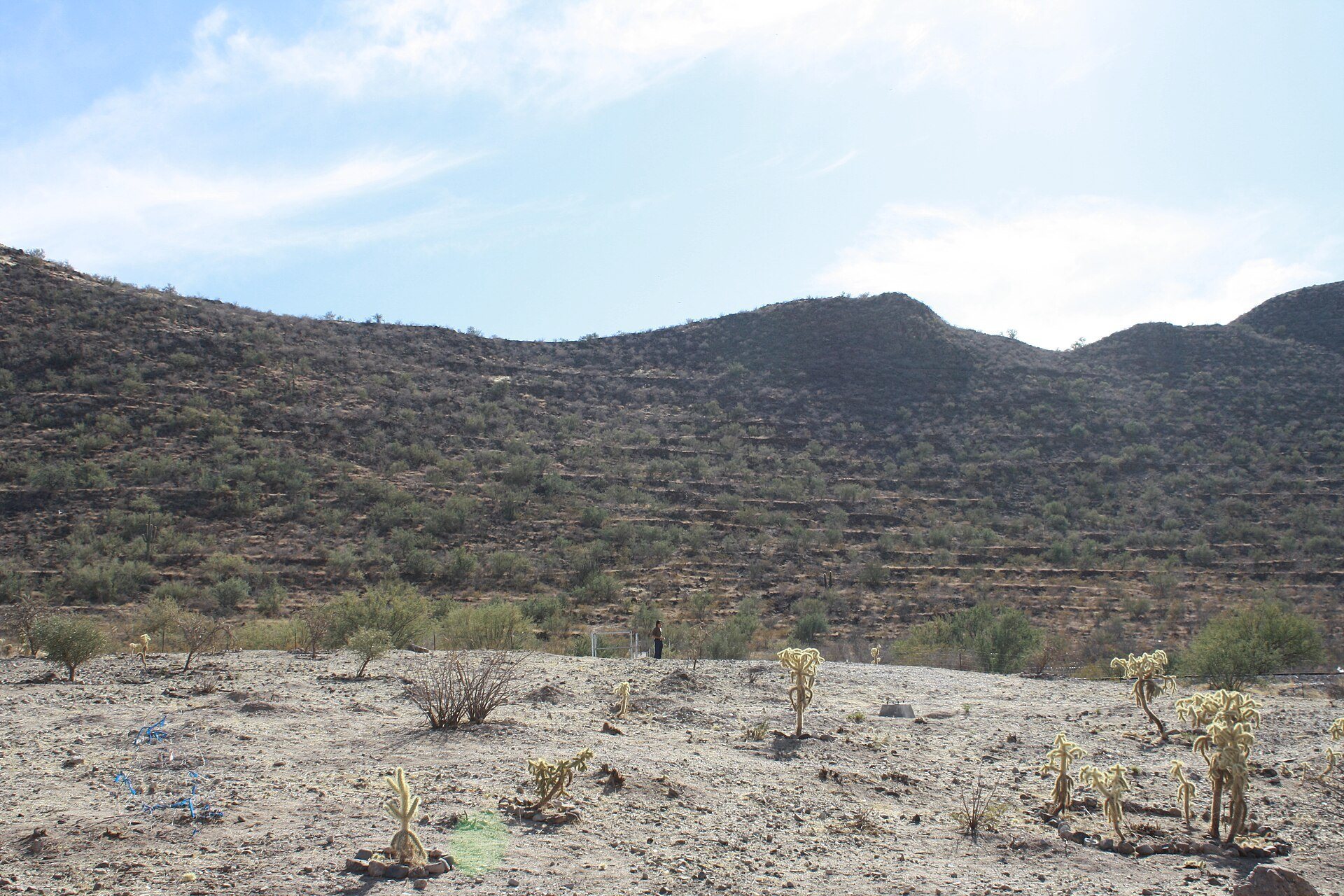
Trincheras Hill is a natural elevation immediately south of the municipal seat of Trincheras. It rises 170 meters above the surrounding desert, and the archaeological zone covers more than 120 hectares. More than 900 terraces extend across the slopes, incorporating square and circular stone structures that reach up to one meter in height. Together, these constructed surfaces and buildings give the settlement a monumental character and a commanding position among the contemporary agricultural communities of the Magdalena Valley and its surroundings.
Terraced Slopes
Most of the terraces measure between 13 and 30 meters in length, although some extend beyond 300 meters. Their stone structures form part of the settlement’s agricultural and built landscape, linking the cultivated slopes with the residential, ceremonial, and communal areas of the hill.
Ceremonial Areas
La Cancha
La Cancha is a rectangular enclosure at the northern base of the hill, measuring 51 by 13 meters. Stacked stones define its edges and create rounded corners. Its form and setting suggest a communal ritual purpose, with interpretations that include use as a ballcourt or as an open-air theater.
El Caracol
El Caracol occupies the summit plaza on the eastern side of the hill. Its walls follow an open spiral resembling a snail shell, and circular stone structures approximately 1.5 meters high surround it. The feature’s position and difficult access suggest that it was reserved for a very small group and probably served ceremonial purposes.