Schloss Gschwendt: A Historic Castle and Care Centre in Austria

Site at a Glance
- Rating
- 4.8
- Popularity
- Very Low
- Country
- Austria
- Primary era
- Medieval
- External website
- Open
- Eras represented
- Medieval, Modern
- Civilizations
- Holy Roman Empire
- Site type
- Domestic
- Remains
- Castle
On this page8 sections
History
Schloss Gschwendt is a historic castle and present-day care centre in Neuhofen an der Krems, Austria. First documented in 1308 as a fief of Passau, an ecclesiastical principality whose authority extended into the region, it was held by Heinrich Gschwendtner, also known as Heinrich of Volkenstorff. The estate later became a centre of local lordship and judicial authority.
From Passau fief to Losensteiner lordship
In 1369, Gschwendt passed to the Losensteiner family. The lordship included a regional court, a territorial court with authority over the surrounding area. By the end of the sixteenth century, the water castle was listed among places intended to provide refuge and defence during wartime. This designation reflects the defensive role attributed to the complex at that time.
A battle took place near the castle in 1626 during a later period of peasant revolt in the Habsburg lands. Peasants led by Achaz Wiellinger confronted imperial troops commanded by Colonel Hans Christoph Löbl. The poorly equipped peasant forces reportedly suffered more than 1,000 deaths.
Auersperg ownership and the nineteenth century
The male line of the Losensteiner family ended in 1692 with the death of Franz Anton von Losenstein, a canon of Passau Cathedral who had been raised to the rank of imperial prince in 1690. His heir was his sister Maria Katharina, who was married to Prince Johann Weikhard von Auersperg. Gschwendt consequently remained in Auersperg possession until 1851.
In that year, Prince Karl von Auersperg sold the castle to Franz Leuck, the owner of the court tavern. The land associated with the estate was later divided and sold to farmers. The lordship had comprised 502 subjects around 1750. A report from 1843 alleged that torture was still being used at the castle, although the practice had already been abolished in the Habsburg Monarchy during the eighteenth century.
Psychiatric institution and Nazi crimes
Overcrowding at Linz’s psychiatric institution led the Upper Austrian parliament to establish an agricultural psychiatric custodial institution for male and female patients. The purchase of Schloss Gschwendt for this purpose was approved in February 1894. The first patients arrived at the turn of 1894 and 1895, and the institution housed 100 people by 1897. It operated as a branch of the Niedernhart state psychiatric hospital, with nursing care provided by religious sisters of the Order of Saint Vincent de Paul, a Catholic congregation associated with nursing and charitable work.
During the Nazi period, Gschwendt became involved in Nazi euthanasia, the organized murder of people whom the regime classified as having mental or physical disabilities. Its director was Rudolf Lonauer, a physician involved in the program. The institution served as an intermediate station for patients awaiting transfer to Hartheim, a Nazi killing facility, including people sent from other institutions in the Nazi-era Ostmark, the designation used for Austria after its annexation into Nazi Germany in 1938.
An unknown number of patients were also murdered at Gschwendt itself. Lonauer and members of the nursing staff killed patients through medication and deliberate undernourishment. As Allied bombing of Linz intensified, Lonauer moved with his family to Neuhofen an der Krems. Shortly before the arrival of the US Army at the end of the war, he poisoned his wife, then his two daughters, and finally shot himself. The family was buried in the cemetery of Neuhofen an der Krems.
After the Second World War, investigations were opened against 61 principal perpetrators connected with mass crimes in psychiatric institutions in Upper Austria. Only three trials took place. Anton Schrottmayer, who had headed Gschwendt’s women’s department, died by suicide in Ybbs prison on 4 August 1946, while most proceedings were discontinued.
Later use
Schloss Gschwendt is now used as the Upper Austrian State Care and Support Centre for people with mental illnesses. The castle was extensively renovated and enlarged with additional buildings for this purpose. A column erected in front of the castle in 1976 commemorates the battle fought nearby in 1626.
Remains
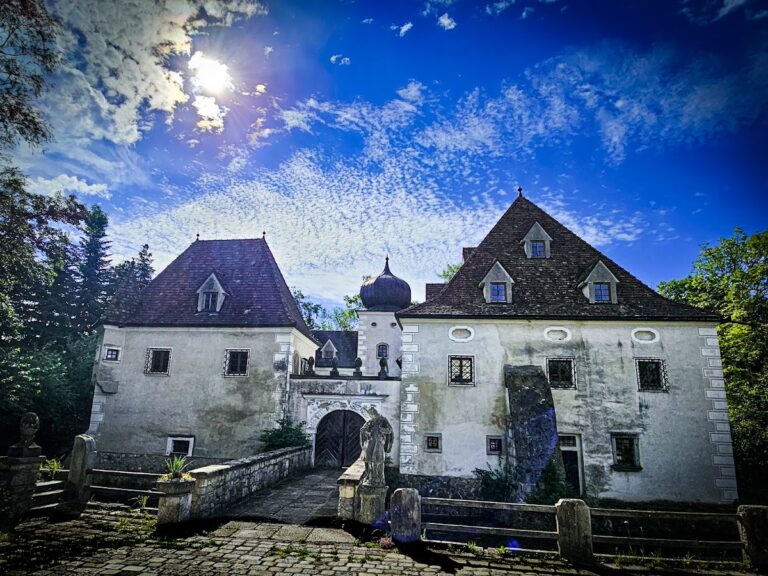
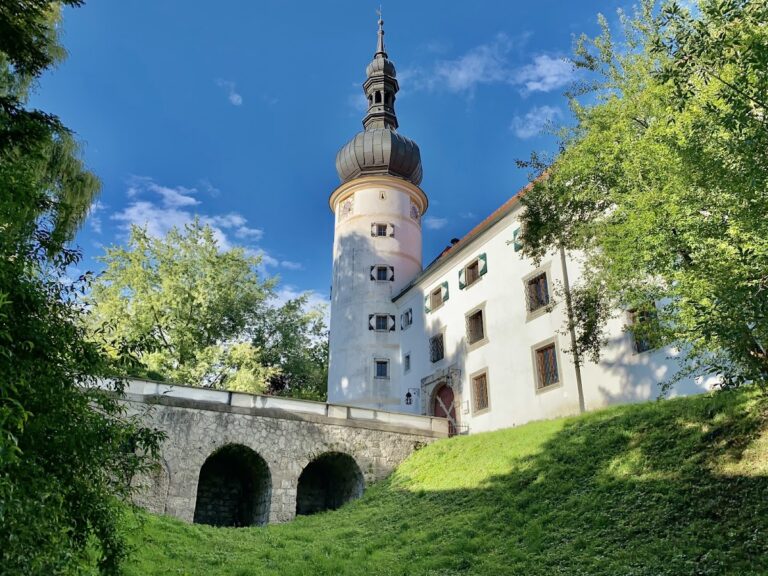
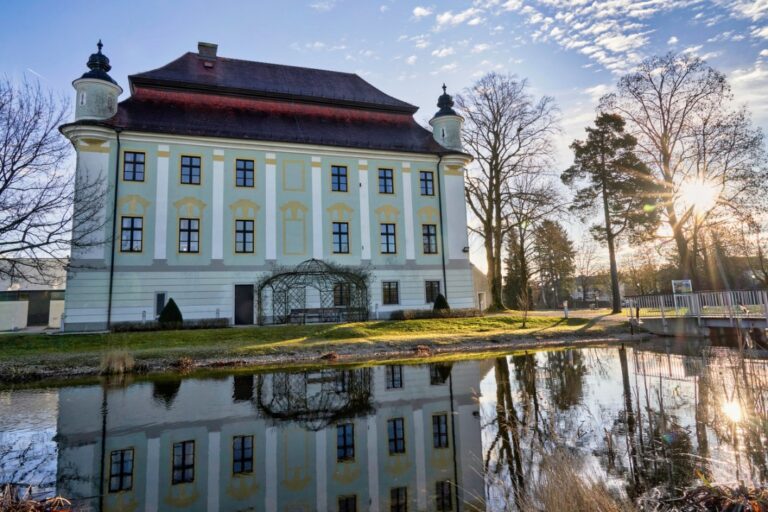
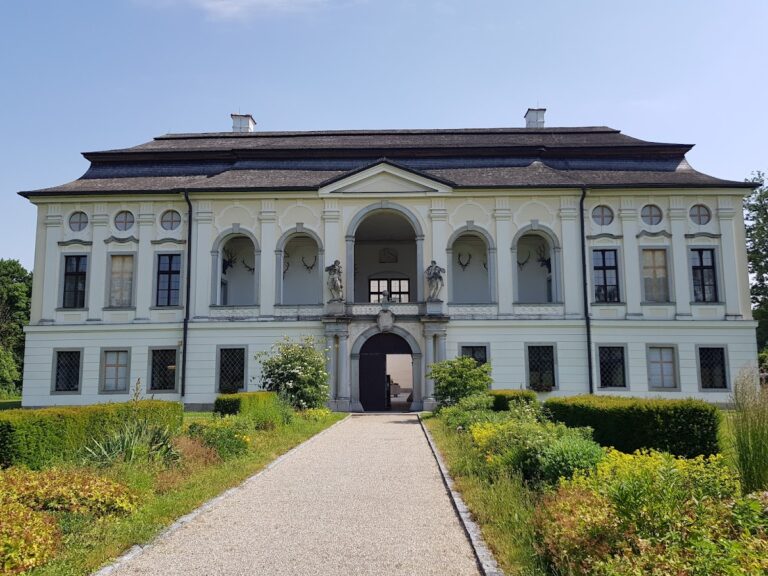
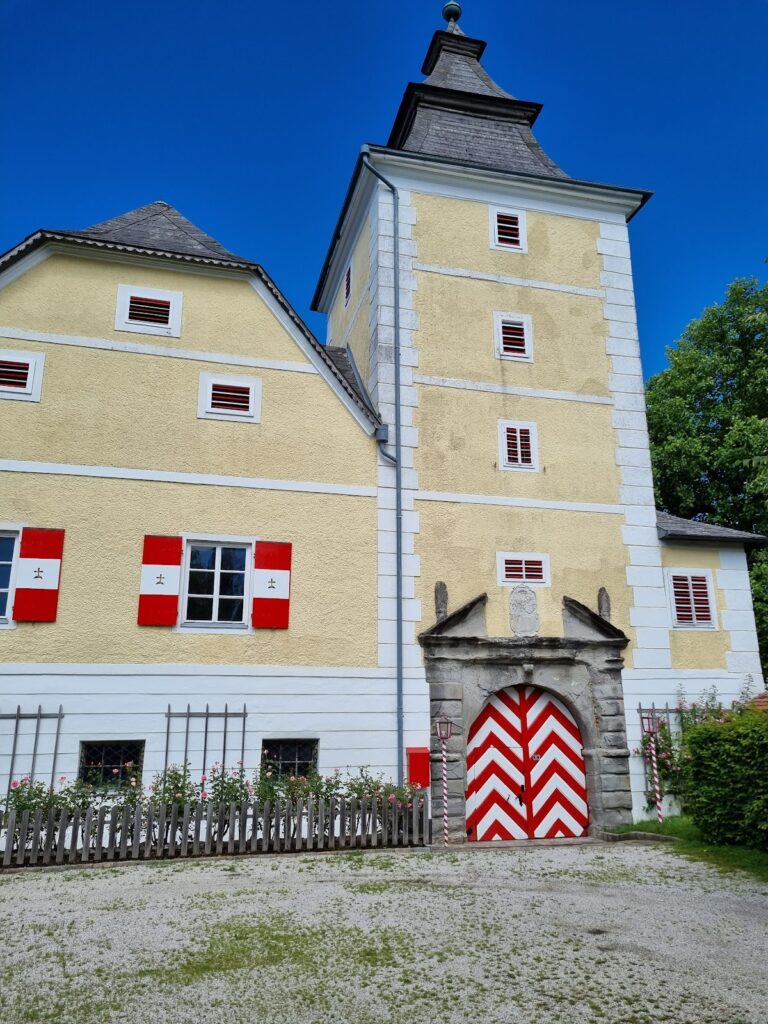
Schloss Gschwendt stands in the Gries district of Neuhofen an der Krems, east of the Krems River. The historic complex was originally a water castle, a fortified residence protected by surrounding water. Its arrangement included a double wall strengthened by towers, three cross wings linking the front and rear sections, and ponds around the castle. The surviving historic building is the ten-axis main tract, formerly the manor house.
Approach and surviving main tract
A metal-and-glass bridge now crosses a newly created water area to the castle, replacing the former stone bridge. A snail-like metal sculpture rises from the water beside the approach. The main tract preserves the historic core of the complex, while additional buildings reflect its later use as a care institution.
Portal decoration and surroundings
The portal carries a crowned medallion containing the coat of arms of Upper Austria. Two angels appear above it, with the figure on the left holding a palm branch and the figure on the right holding a cross. Schloss-Gschwendt-Straße runs northward from the castle.
Nearby sites