Waldeck Castle: A Medieval Spur Castle and Cultural Centre in Germany


Site at a Glance
- Rating
- 4.5
- Popularity
- Very Low
- Country
- Germany
- Primary era
- Early Modern
- Eras represented
- Medieval, Early Modern, Modern
- Civilizations
- Electoral Palatinate, Holy Roman Empire
- Site type
- Military
- Remains
- Castle
On this page14 sections
History
Waldeck Castle is a medieval hill and spur castle in Germany, overlooking the Baybach valley near Dommershausen, with its first secure association with the Waldeck family dating to 1189. A fortified residence probably stood here by that time, although a tradition attributing construction around 1150 to William I of Heinzenberg remains uncertain. The castle occupies a strategically placed spur at about 248 metres above sea level in the Dorweiler district of Rhineland-Palatinate.
Waldeck family and feudal rule
The castle itself first appears in a record from 1243, when Heribert, Udo, Bosso, and Winand of Waldeck transferred it as a fief to Konrad von Hochstaden, Elector and Archbishop of Cologne. The transaction formed part of a settlement and exchange of property between the archbishops of Cologne and the Counts Palatine. Waldeck had probably previously belonged to, or stood within the political sphere of, the Palatinate, a major principality of the Holy Roman Empire ruled by the Counts Palatine.
Waldeck became the ancestral seat of several Hunsrück ministerial families, particularly the Boos von Waldeck line. Ministeriales were service nobles who held administrative, military, and court offices for more powerful lords. The castle operated as a Ganerbenburg, meaning that several coheirs jointly owned or occupied it, with separate residential areas and negotiated rights of use.
The Boos von Waldeck family later expanded its political influence and secured imperial immediacy for the surrounding Lordship of Waldeck. This status placed the lordship directly under the emperor rather than beneath an intervening territorial lord. The lordship survived until the French occupation of the left bank of the Rhine at the end of the eighteenth century. The Electors of Cologne remained Waldeck’s principal feudal lords for more than two centuries, with the last recorded renewal of the Cologne fief taking place in 1469. Other rights were held by the Electors of Trier, the Counts of Sponheim, and the Counts Palatine.
Expansion and Palatine control
A lower castle probably developed toward the valley during the following decades, perhaps around 1250 under Rudolf, also known as Udo, of Waldeck. The upper and lower parts are recorded together in 1285. During the Eltz Feud of 1331 to 1336, the coheirs of Waldeck, Schöneck, Ehrenburg, and Eltz opposed the territorial policy of Balduin, Archbishop and Elector of Trier. Their defeat and the subsequent peace settlement made the coheirs dependent on Trier as feudal tenants, although Waldeck’s dependence lasted only a short time beyond Balduin’s death.
By the 1360s, the castle had returned to the Palatinate’s sphere of influence. In 1398, Ruprecht of the Palatinate, later King of the Romans, besieged and captured Waldeck, probably after disputes and attacks by the coheirs against Palatine property. Ruprecht then became one of the coheirs himself. He acquired several buildings, erected a new tower, and secured a right of first refusal over the remaining parts of the castle.
Ruprecht’s intervention produced a three-part complex. The new upper castle stood above the two earlier wards, while the former upper castle became known as the lower castle, and the earlier lower castle lay farther toward the valley. Several family branches and other coheirs continued to share the property. By 1557, the Boos von Waldeck family lived there alongside the von Metz family and a Palatine official or family.
Residence, administration, and destruction
The Boos von Waldeck family served as hereditary officials of the Palatine administrative district of Obergondershausen. Waldeck also helped administer mills and offices and served as a summer residence for members of the baronial and comital family and for visiting nobles. These functions continued the castle’s importance beyond its role as a fortified residence.
French troops burned and destroyed the medieval castle in 1689 during the Nine Years’ War, also called the War of the Palatine Succession. This European conflict lasted from 1688 to 1697, and French campaigns brought extensive destruction to territories along the Rhine. In the mid-eighteenth century, Baron William Lothar Boos-Waldeck built a hunting and summer residence on the ruins, probably after extensive levelling had removed much medieval archaeological evidence.
During the French period, the Boos von Waldeck family narrowly avoided expropriation. After the family moved to Bohemia, the palace was auctioned in 1833. Parts of the eighteenth-century residence were demolished around 1850, and the remaining buildings gradually decayed. Dressed stones from the palace were reused in a farmstead at Petershausen, in the settlement near Zilshausen, while the removal of structural stones and foundations further accelerated the ruin’s deterioration.
Waldeck and the youth movements
The Wandervogel youth movement began using the castle and its forecourt around 1910. In 1920, Robert and Karl Oelbermann and their associate Kurt Lorenz, known as Nauke, selected the site for the Nerother Wandervogel. Under Robert Oelbermann’s leadership, Waldeck became the organization’s centre for activities and expeditions from 1922. The period also saw plans for a Rhenish Youth Castle, conceived as a youth community based at the historic site.
Waldeck developed an influential song culture and became associated with writers, international visitors, and expeditions to Europe, Africa, South America, and other parts of the world. Werner Helwig composed songs in a hut he built below the medieval ruins and set poems by Bertolt Brecht to music. The French writer Romain Rolland visited, as did Rabindranath Tagore, the Indian poet, philosopher, educator, and Nobel Prize winner, in 1930.
On 18 June 1933, after the Nazi seizure of power, the Hitler Youth, SA, and SS occupied the castle. The Nerother Wandervogel was forced to dissolve at the end of that year. Its supporting association was reorganized in 1934 as the Arbeitsgemeinschaft Burg Waldeck, but this body was dissolved in 1935 and the buildings were confiscated. Robert Oelbermann was murdered in Dachau concentration camp in 1941. His twin brother Karl escaped Nazi persecution by being interned in South Africa.
Post-war cultural development
After the Second World War, survivors returned and re-established the Arbeitsgemeinschaft Burg Waldeck. They sought to make the site a centre for tolerance and international youth exchange rather than continue the earlier project of a romantic medieval youth castle. Karl Oelbermann returned from South Africa in 1950 and later again led the Nerother Wandervogel, which continued to regard Waldeck as its own centre.
Disagreements between the Arbeitsgemeinschaft Burg Waldeck and the Nerother Wandervogel over ownership, house rights, and the site’s direction led to litigation from the late 1950s. After roughly two decades, a court recognized the Arbeitsgemeinschaft Burg Waldeck as the unrestricted legal owner of the forecourt and as the legal successor to the association reorganized under National Socialism. The Nerother Wandervogel retained property on the adjoining ruins.
Construction by the Nerother Wandervogel resumed on a reduced scale in 1954. Later additions included the Diensthaus, whose topping-out ceremony took place in 1970, the Jugendbleibe in 1986, and a chapel completed in 1998. The chapel reflects Robert and Karl Oelbermann’s Christian orientation. From the 1950s onward, organizations connected with the Arbeitsgemeinschaft Burg Waldeck built homes and huts and broadened the site’s cultural work beyond the earlier Wandervogel tradition.
The first Waldeck Festival, Chanson Folklore International, took place in 1964, followed by further festivals through 1969. The gatherings became known as the German Woodstock, helped establish several German-language singer-songwriters, and influenced youth and intellectual culture in West Germany. The Arbeitsgemeinschaft der Liedermacher was founded at Waldeck in April 1974. The site continues to host workshops, rehearsals, discussions, and seminars devoted to dance, theatre, cabaret, songs, and chanson. In the 1990s, a theatre group from the University of Essen used the site for rehearsals, while a colonnaded building and an open-air stage pavilion were added.
Remains
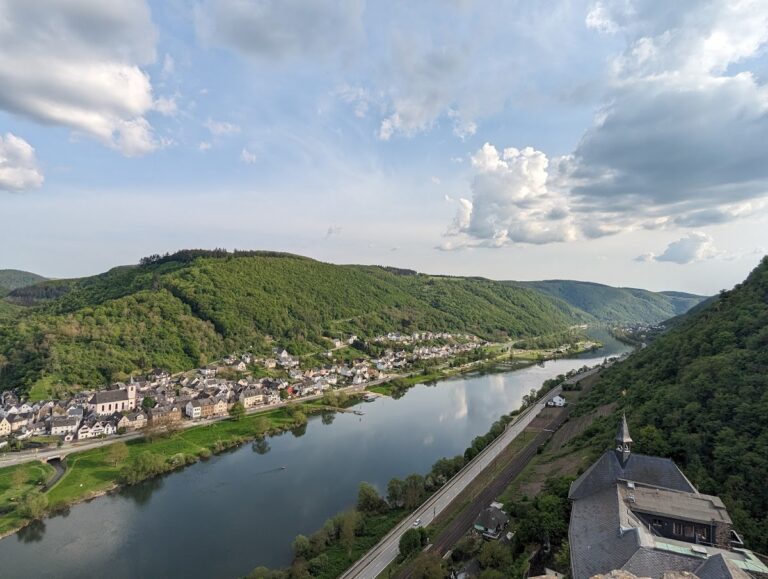
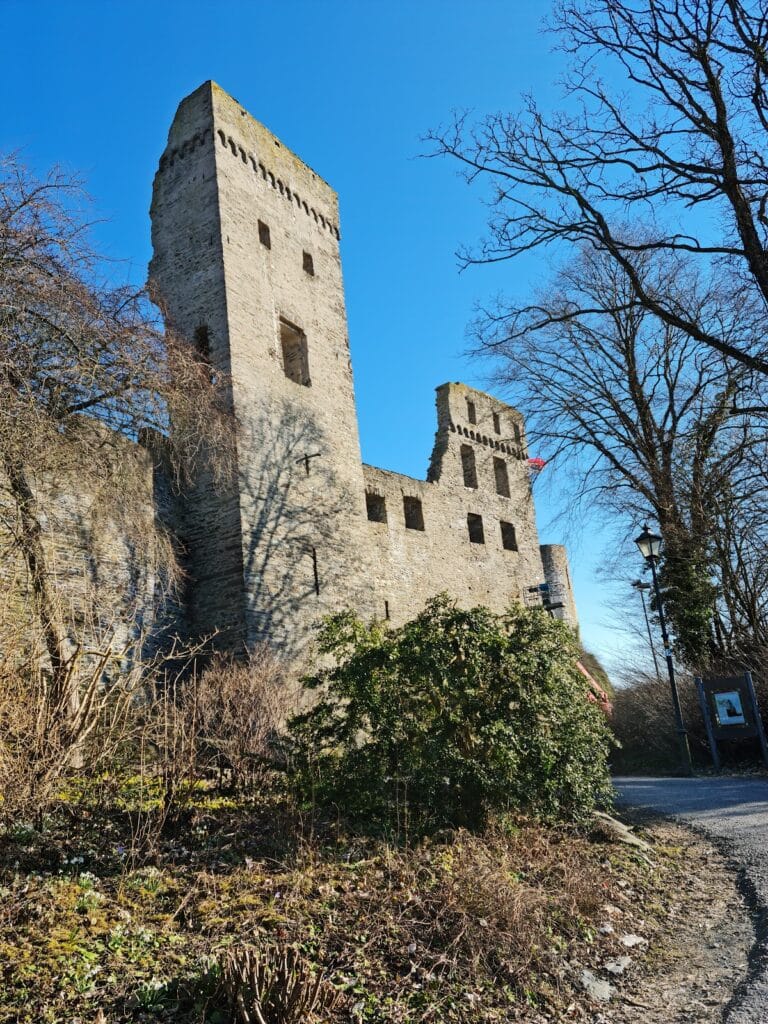
Waldeck survives as a ruined spur castle above the Baybach valley, where the valley narrows into a gorge and oak- and hornbeam-covered slopes descend directly to the stream. The medieval complex was arranged in three principal parts along the spur. A new upper castle, including the tower associated with Ruprecht, stood above the earlier wards. Below it lay the former upper castle, later called the lower castle, followed downhill by the former lower castle. Outer enclosures continued toward the valley, while later buildings occupy parts of the historic site.
Upper castle
Medieval upper ward
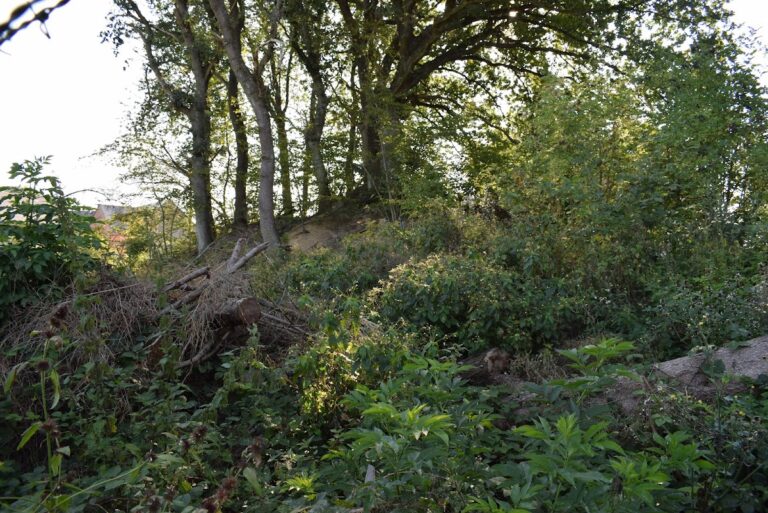
Little medieval fabric remains in the upper castle. Excavations in the 1960s revealed the foundations of a central tower, but the remains were later reburied. The wall leading toward the lower castle and the neck ditch are now the visible medieval elements in this area. A neck ditch is a defensive trench cut across the narrow connection between a spur and the adjoining high ground. At Waldeck, it could be closed toward the valley and used to retain water as a reservoir.
Nerother Wandervogel buildings
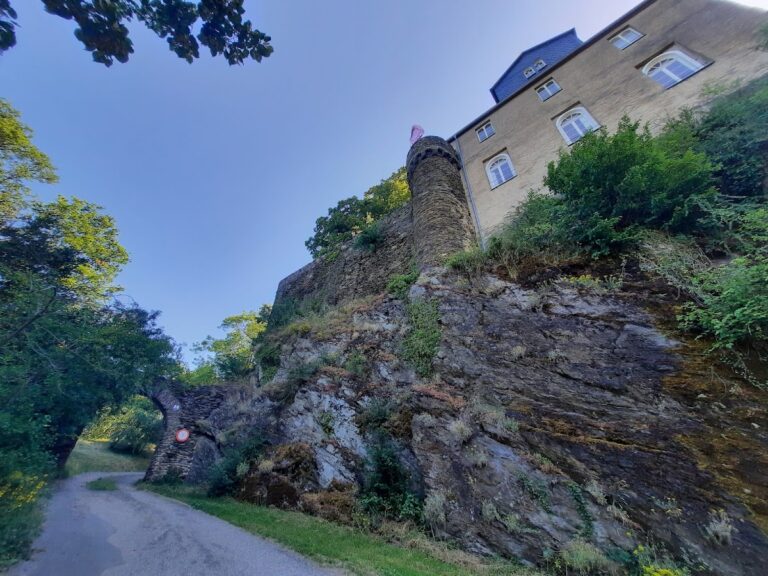
The medieval ruins of the upper castle now contain modern buildings erected by the Nerother Wandervogel in historicizing style. These buildings serve as the organization’s federal centre. Above the ruins, an honorary grove contains memorial stones dedicated to figures associated with the Wandervogel, German youth-movement, and German scouting traditions.
Lower castle and palace ruins
Eighteenth-century palace
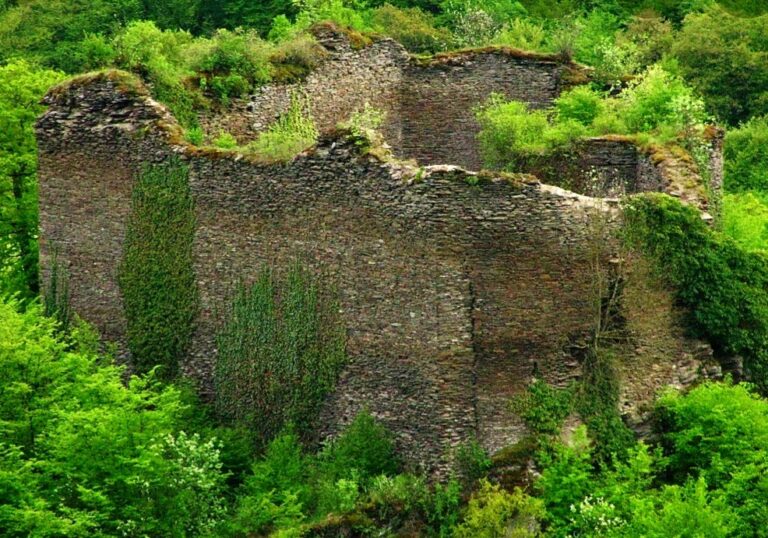
The present lower castle retains more historic fabric, especially the remains of the eighteenth-century palace built on the medieval ruins. The palace had a horseshoe-shaped plan and an attached chapel. Its physical remains were reduced when parts of the building were demolished around 1850 and dressed stones were removed for reuse at Petershausen. The surviving structures subsequently decayed into ruins.
Round tower and Bastion
A round tower standing shortly before the feature known as the Bastion is the only surviving standing remnant of the medieval castle in the lower-castle area. The Bastion was probably constructed with the eighteenth-century palace. Although its form appears defensive, it apparently contained no cannon and was probably used as a garden.
Outer enclosures and present buildings
Additional outer enclosures extend downhill toward the remains of the lowest castle. The former neck ditch lies before the palace ruins on the side facing the upper castle. Its ability to close toward the valley allowed it to retain water as well as serve a defensive purpose.
Buildings above the ruins belonging to the Arbeitsgemeinschaft Burg Waldeck function as a youth-education centre. The open grounds include a campsite and an open-air stage. A colonnaded building and an open-air stage pavilion were added in the twentieth century, complementing the site’s continuing use for cultural work.