Rauschenburg: A Medieval Counter-Castle in Germany


Site at a Glance
- Rating
- 4.4
- Popularity
- Very Low
- Country
- Germany
- Primary era
- Medieval
- Eras represented
- Medieval
- Civilizations
- Electoral Palatinate, Holy Roman Empire
- Site type
- Military
- Remains
- Castle
On this page10 sections
History
Rauschenburg is a medieval hill castle in Germany, above the Ehrbach stream near Mermuth in Rhineland-Palatinate. Baldwin of Luxembourg, Archbishop and Elector of Trier, built it in 1332 during the Eltz Feud, a fourteenth-century conflict in which he sought to enforce his authority over local noble vassals and their castles. Rauschenburg was constructed as a counter-castle against the Lords of Boos of Waldeck, Ehrenberg, and Schöneck, and formed part of Baldwin’s effort to bring the surrounding territory under his control.
The Eltz Feud and Baldwin’s strategy
The castle stood on land belonging to the Palatinate, the feudal lord of Baldwin’s opponents. Its construction followed a repeated strategy used by the archbishop, who established a fortress on territory controlled by an opposing party before attempting to secure wider authority there. At the same time, the Eltz family was being besieged at Trutzeltz, on the opposite side of the Eifel, as the conflict spread among the region’s noble families.
Rauschenburg’s position, almost within sight of Schöneck Castle, gave Baldwin a way to watch his opponents. Schöneck was the administrative seat of the Gallscheid court, and the castle also helped him supervise compliance with the reconciliation reached in 1336. The place-name Rusberge had already appeared in 1285 in connection with an earlier reconciliation between the Lords of Schöneck and Boos of Waldeck. The castle itself was first mentioned in 1340.
Military and administrative use
Rauschenburg served as an arms depot, quarters, and supply store for the archbishop’s troops. It probably also offered secure lodging for Baldwin and his entourage during visitation journeys through the Lower Archbishopric. Konrad of Esch, an administrative official serving the archbishop, was the first recorded Amtmann, an official who exercised territorial authority on behalf of a lord.
In 1340, apparently because Konrad held other offices as well, his nephews Johann and Konrad of Schöneck became hereditary burgraves. A hereditary burgrave held responsibility for a castle and its administration through a hereditary office or tenure. Although the Schönecks had previously opposed Baldwin during the feud, their appointment placed the castle under their long-term responsibility.
Changes of control and decline
Baldwin later tried to recover direct control of Rauschenburg and offered the Schöneck family 1,000 shield guilders for the castle. When he used the money deposited at Koblenz for another purpose, the Schönecks seized his pledge, Baldwin’s share of Thurandt Castle. In the settlement that followed, they agreed to return Rauschenburg without objection once they had received the promised payment.
The Archbishopric of Trier continued to grant the hereditary burgrave title to the Lords of Schöneck into the 1380s. Later, other families from the Lower Archbishopric held Rauschenburg as a feudal fief, sometimes in connection with the enfeoffment of the Beulich bailiwick. The von Eich family and the Waldbott family of Bassenheim were among its later feudal holders.
From the fifteenth century until 1789, the Lords of Boos of Waldeck held Rauschenburg. By the middle of the fifteenth century at the latest, the castle was already described as decaying and militarily insignificant. A feud between the Lords of Waldeck and the Waldbott family of Bassenheim in 1456, as well as the Beilstein War of 1488, has been proposed as a possible cause of its destruction. The precise event that brought about the castle’s ruin remains uncertain.
Remains
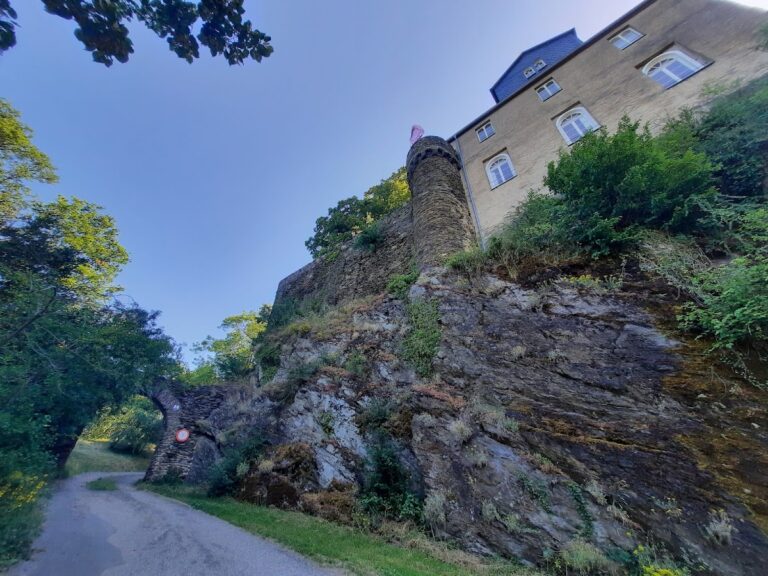
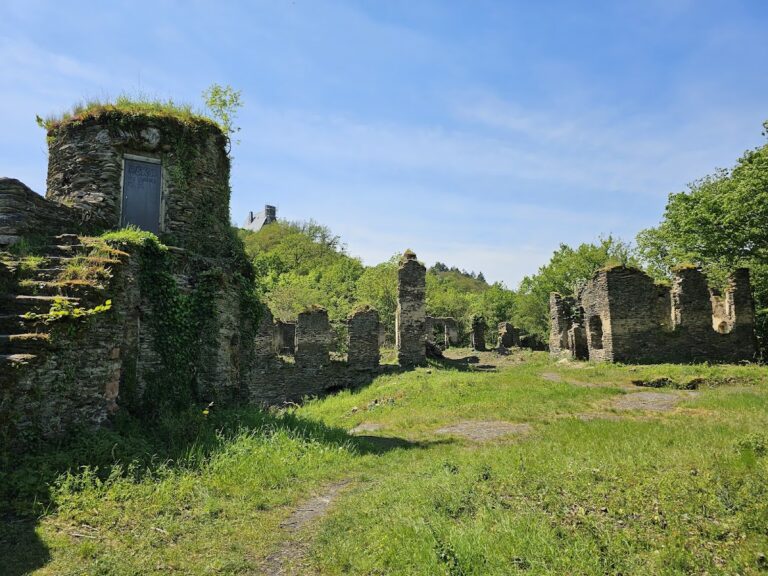
Rauschenburg survives as a ruin on a hill about 250 metres above sea level above the Ehrbach stream. Its main enclosure has a pentagonal plan, and almost the entire complex is surrounded by a second, lower wall. The surviving remains show a compact fortified site organized around an inner bailey, with defensive boundaries and access points adapted to the mountain saddle.
Defensive layout and access
Neck ditch and entrance works
On the southwest side, a neck ditch cuts across the mountain saddle on the uphill approach. This type of ditch obstructed movement across a narrow ridge and formed the castle’s first defensive obstacle. Remains of the gate building and the foundations of a bridge survive in the same area. A path cut into the rock leads toward the entrance and may have been made during the original construction of the castle.
Gates and enclosing walls
Two gates remain accessible within the complex. A third opening in the southeastern part of the ring wall was probably blocked during the Middle Ages. The pentagonal enceinte, or enclosing defensive wall, forms the principal boundary of the castle, while the lower outer wall extends the defensive enclosure around most of the site.
Inner bailey and surviving buildings
The inner bailey contains the ruins of residential buildings. At the centre of the western ring wall stand the remains of a tower that may have been the former bergfried, the principal tower of a medieval German castle, generally used for defence and refuge rather than permanent residence.
Construction and condition
The walls were built from rubble stone gathered in the surrounding area. Processed earth mixed with clay served as mortar. The relatively poor workmanship suggests that the castle may have been intended for use over only a limited period. Today, the site consists of surviving wall remains and other fragmentary structural evidence from its medieval construction.