Bischofstein Castle: A Medieval Stronghold and School Retreat in Germany


Site at a Glance
- Rating
- 4.5
- Popularity
- Low
- Country
- Germany
- Primary era
- Medieval
- External website
- Open
- Eras represented
- Medieval, Modern
- Civilizations
- Holy Roman Empire
- Site type
- Military
- Remains
- Castle
On this page10 sections
History
Bischofstein Castle is a medieval stronghold in Germany, built above the Moselle in the mid-thirteenth century and associated with the Archbishops of Trier and the Trier cathedral chapter. Archbishop Arnold II of Trier is often credited with beginning the work between 1242 and 1259, although both the exact builder and the precise starting date remain uncertain.
Foundation and ecclesiastical lordship
The Trier archdeacon Heinrich von Bolanden, a senior cleric who administered part of the diocese under the archbishop, acquired the half-completed castle. He financed its completion and was living there by 1262. On 11 September 1273, he donated the finished castle to the Trier cathedral chapter. In return, he received lifelong residence and the right for himself and his successors in office to hold Bischofstein as a fief.
The castle’s position gave it a role in the protection and control of movement along the Moselle. In 1303, Heinrich von Bolanden’s successor, Hermann von Weilnau, granted Archbishop Peter of Nassau the right to use Bischofstein during wartime. In 1329, Archdeacon Heinrich von Pfaffendorf undertook to exclude the archbishop’s enemies, protect the Moselle crossings, and admit no vassals or castle guards without the archbishop’s consent.
Later medieval tenure
Subsequent arrangements continued to tie the castle to the archbishop’s authority. Gottfried von Brandenburg was required to use it only with the archbishop’s approval. Friedrich, Count Palatine of the Rhine, was recorded as its holder in 1501, after which no further investiture is known.
A siege by Margrave Albrecht of Brandenburg in 1552 has been reported, but it cannot be confirmed. The Thirty Years’ War, a European conflict from 1618 to 1648, caused extensive destruction in the Moselle region. A detailed visitation record from 1680 nevertheless states that Bischofstein itself had survived that war without damage.
Destruction and changing ownership
French troops destroyed the castle in 1689 during the War of the Grand Alliance, a late-seventeenth-century conflict in which France fought a coalition of European powers. After France annexed the left bank of the Rhine in 1794 and ecclesiastical property was secularized, the ruins belonged to the St. Castor collegiate foundation at Karden.
The ruins were sold at auction on 29 September 1803 to Nicolaus Artz, a winegrower from Burgen, for 330 francs. A house with seven inhabitants stood at the ruins in 1824. Ownership in the following decades is unclear, but Johann Franz Bienen of Rheinberg acquired the castle in 1880.
Rebuilding and educational use
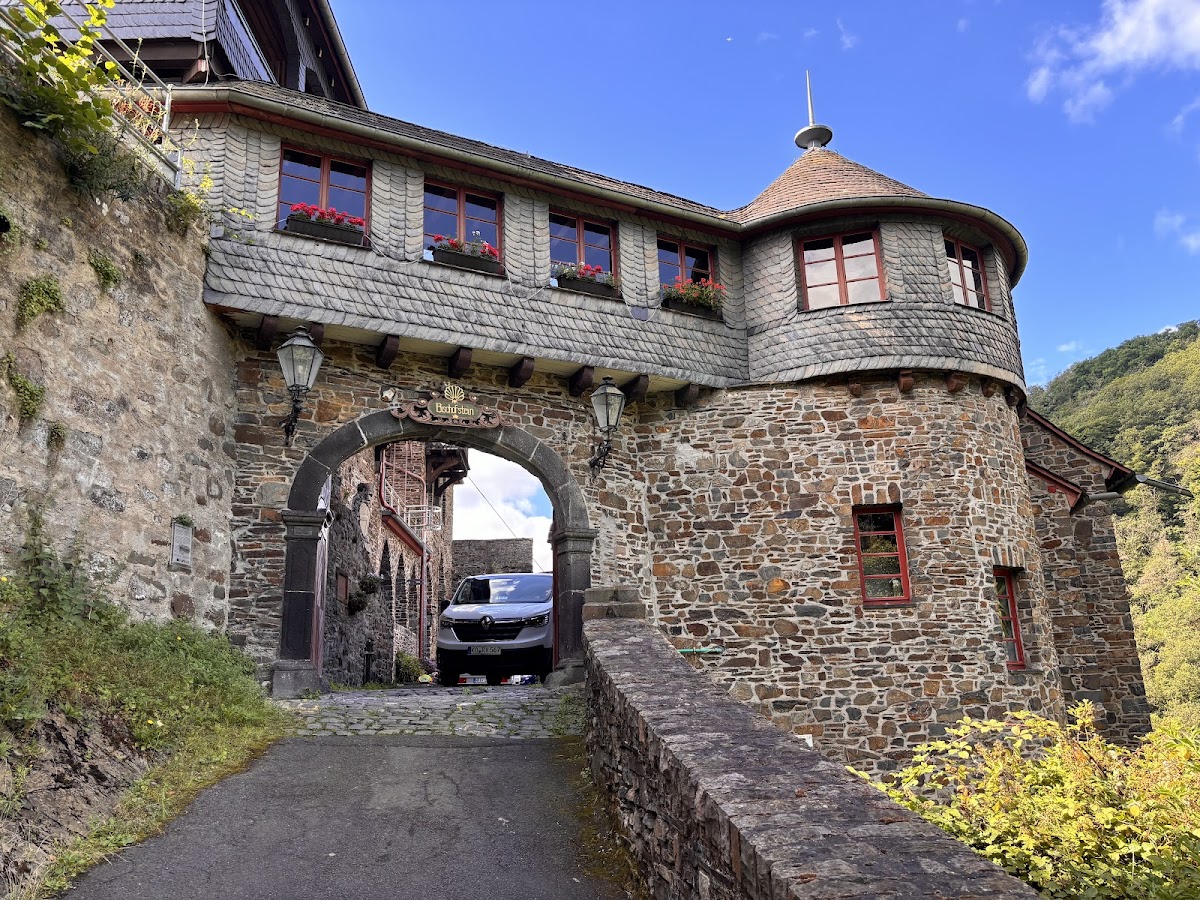
On 11 April 1930, Bienen’s heirs sold Bischofstein to the Darmstadt businessman Erich Deku. He rebuilt it as a holiday residence, using surviving medieval walls in a new construction rather than attempting to reconstruct the medieval castle. After Deku became bankrupt in 1936, Aenny Neuerburg acquired the property at auction. Her family completed its present form in 1937 and 1938.
Under Aenny Neuerburg’s direction, Bischofstein served from 1941 to 1946 as a convalescent home for soldiers, a military hospital, and a refugee home. Her son Raymund Neuerburg and his family later operated it as a guest pension. In 1954, the Schullandheim Fichte-Gymnasium association in Krefeld acquired the property. The purchase contract was concluded on 29 June, and ownership transferred on 1 July.
Bischofstein has since continued as a Schullandheim, a residential school retreat where classes stay for educational programs, group activities, and communal living. Until 1980, it was used only by Fichte Gymnasium; afterward, other schools and groups were also admitted. The castle is legally protected as a monument, particularly as an example of 1930s architectural design and reconstruction rather than as an intact eight-hundred-year-old castle. A house-borer infestation affecting the entire building was identified in 2012, followed by extensive conservation work in 2014.
Remains
Setting and construction
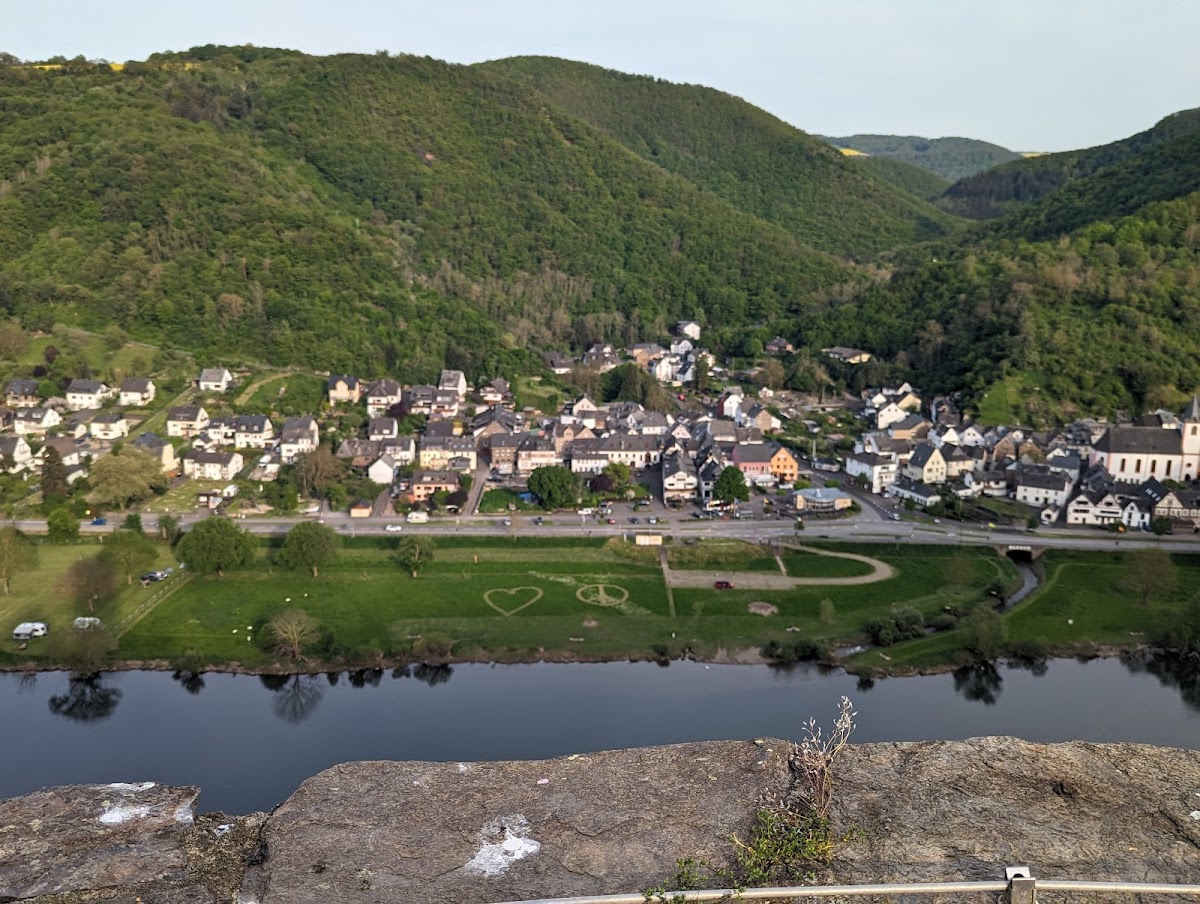
Bischofstein is a spur castle, a fortress built on a projecting ridge or rocky spur that uses steep slopes as part of its defenses. It stands on a rocky projection above the Moselle, on the southern edge of the Maifeld plateau, at about 150 metres above sea level and approximately halfway up the mountainside. The site lies on the western bank between Moselkern and Hatzenport, within Lasserg, a district of Münstermaifeld. The B 416 runs below the castle, while the municipality of Burgen lies across the river. Opposite the castle, the Baybach enters the Moselle, whose nearby landscape also includes the mouths and valleys of the Baybach and Elzbach.
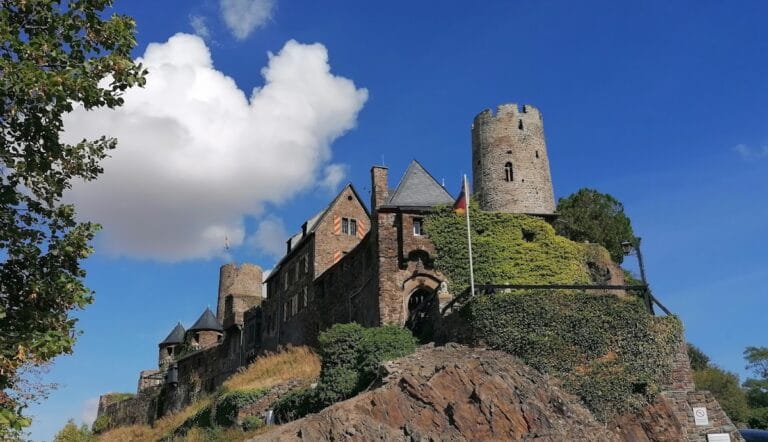
The castle was built in rubble masonry. Its present fabric combines surviving medieval walls with the new construction of the 1930s. The complex also includes a chapel rebuilt during that period, while later work renewed several features and adapted the building for residential educational use.
Keep
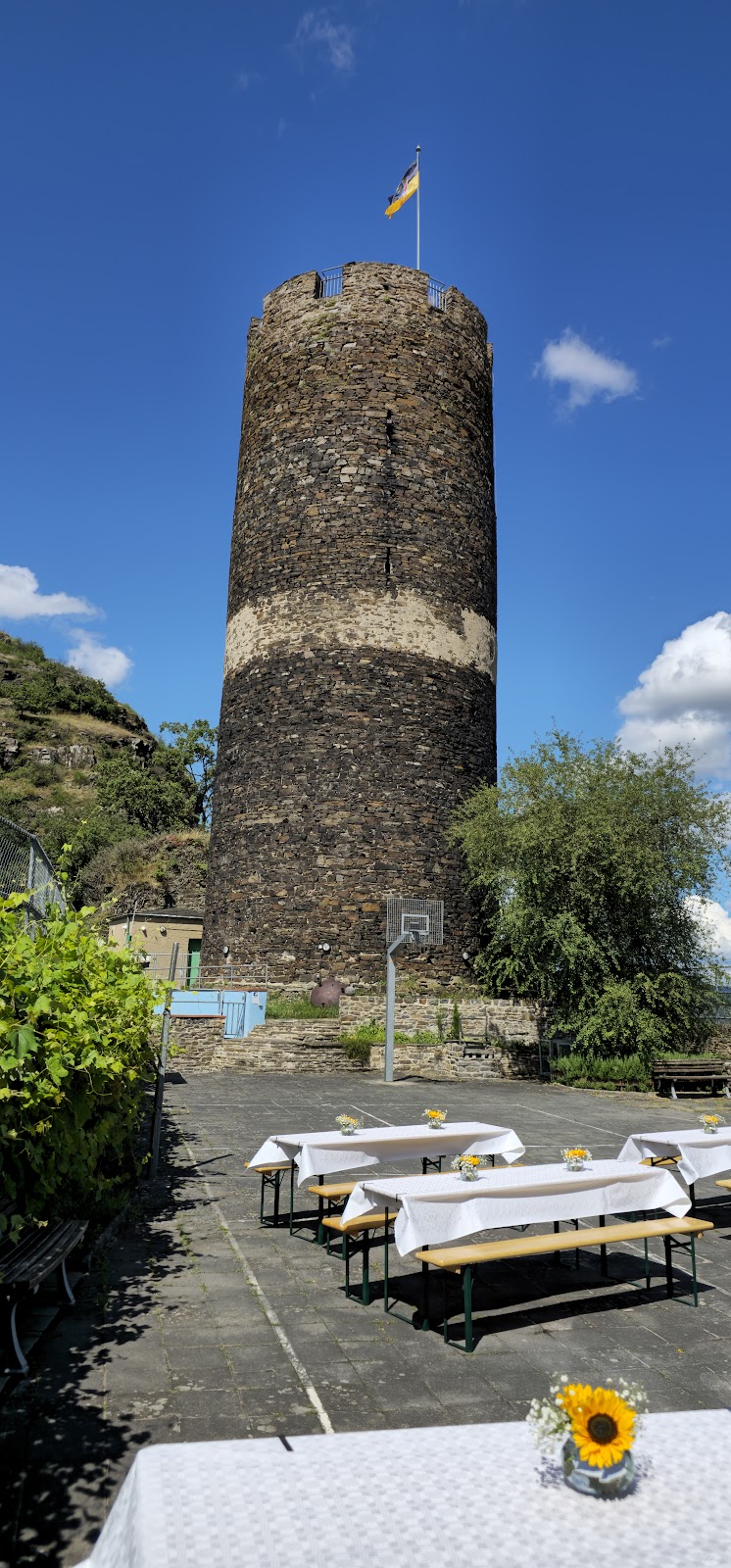
The keep, or donjon, is the castle’s principal fortified tower and rises approximately 25 metres. It is cylindrical and carries a conspicuous white band around its middle. This strip is surviving plaster from the tower’s former continuous coating. Traditions interpret the band as a flood mark, as a place associated with the hanging of captured robbers, or as a symbolic bishop’s ring, but these explanations are legendary rather than established features of the building.
A wooden parapet once stood at the level of the white band and was destroyed in the fire connected with the castle’s destruction in 1689. Most of the tower’s plaster later disappeared through weathering. Renovation in 1997 rebuilt or reinforced the battlements, recast the tower platform, and added an internal wooden staircase in a medieval style.
Chapel
The castle chapel is dedicated to Saint Stephen. It was rebuilt in the 1930s and completely renovated in a medieval style in 1995. Its door incorporates architectural elements from the baroque choir stalls of the Mainz Charterhouse. Produced between 1723 and 1726 under the direction of the Hamburg woodcarver Johann Justus Schacht, the stalls were richly decorated with inlay.
Erich Deku acquired part of the choir-stall material from Adolf von Rath’s collection in 1933, while the door’s inner inlaid panel came from another source. When the castle’s furnishings were auctioned in Frankfurt in 1937, the chapel door was the only part of Deku’s collection to remain in the chapel. The door reflects the wider dispersal of the Mainz Charterhouse stalls after the institution was dissolved. Some were acquired for Trier Cathedral in 1787, eighteen rear panels entered the art trade in 1890, seventeen later went to the Metropolitan Museum of Art, and fourteen returned to Trier Cathedral in 1952. Monument-preservation authorities prevented a proposed sale of the Bischofstein chapel door in 1994.
Retreat facilities
The present interior supports the castle’s continuing educational function. It contains four dormitories with a total of 38 beds, two teachers’ rooms, a common room, a dining and teaching room, a kitchen, and storage rooms. The former knights’ hall contains table-tennis and table-football facilities, linking a surviving historical space with the building’s modern use as a residential school retreat.