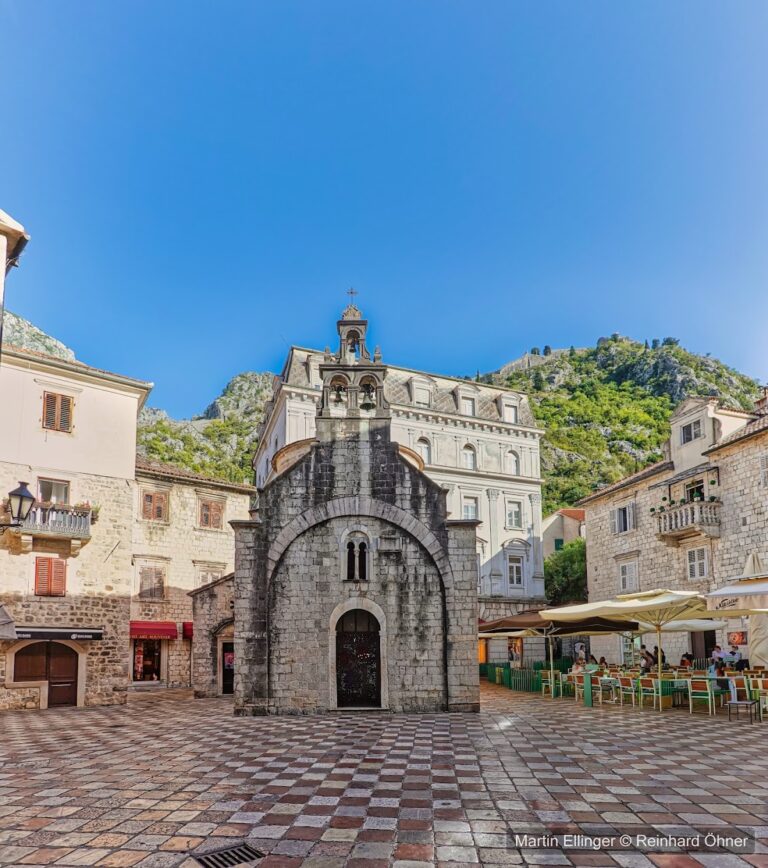
Vlah Church: A Serbian Orthodox Church in Cetinje


Site at a Glance
- Rating
- 4.6
- Popularity
- Very Low
- Country
- Bosnia and Herzegovina
- Primary era
- Modern
- Eras represented
- Medieval, Modern
- Civilizations
- Unclassified
- Site type
- Religious
- Remains
- Church
On this page7 sections
History
Vlah Church is a Serbian Orthodox church in Cetinje, Montenegro, built around 1450 in the area of Donji Kraj on the Cetinje Field, then part of the medieval South Slavic principality of Zeta. It belongs to the Metropolitanate of Montenegro and the Littoral, an Eastern Orthodox jurisdiction of the Serbian Orthodox Church, and is dedicated to the Nativity of the Virgin Mary.
Origins and rebuilding
The church’s name has several traditional explanations. One holds that Vlachs, pastoral communities whose name carried different meanings across periods and regions, guarded the cattle of Ivan Crnojević, the fifteenth-century ruler of Zeta, and built the church. Other traditions connect the name with settlers from Stari Vlah or with the use of “Vlach” as an external designation for Eastern Orthodox communities.
A separate foundation tradition centers on Ivan Borojević, a vojvoda, or military and noble commander, associated with Stari Vlah. He is said to have moved to the area with his family several decades before Ivan Crnojević. After Borojević and his wife Jelica died, their sons reportedly built a small church at their burial place and dedicated it to the Nativity of the Virgin Mary. Tradition also credits the Borojević family with establishing observance of this feast among later settlers.
The building was reconstructed three times. The first reconstruction used stone laid without mortar, while the next used stone bonded with lime mortar. The present church was completed in 1864. A plaque above the entrance commemorates the first construction by the people of Donji Kraj in 1450, the three rebuildings, and the completion of the current form.
Royal ceremonies and the churchyard
Vlah Church hosted the wedding of Prince Nikola I Petrović-Njegoš and Milena Vukotić on 27 October 1860. Nikola I later became Montenegro’s king in 1910, and a royal thanksgiving service was held at the church during his coronation that year.
During the late nineteenth century, burials in front of the church were prohibited so that the grounds could serve as a cultural monument. The preserved graves include those of Metropolitans Ilarion Roganović and Visarion Ljubiša, theological seminary rector Archpriest Stanko Ivanović, Prince Grujica Lopičić, Jovan Pavlović, the first minister of education and ecclesiastical affairs, Ilija Beara, director of the Cetinje Gymnasium, commander Zrno Popović, Captain Tripko Grubačić, Marko J. Bjeladinović, adjutant to Prince Danilo, and Sula Radov Radulović, remembered as a folk sage.
The church and its surrounding remains form part of Cetinje’s historical and archaeological heritage and are treated as a cultural monument.
Remains
Church building and setting
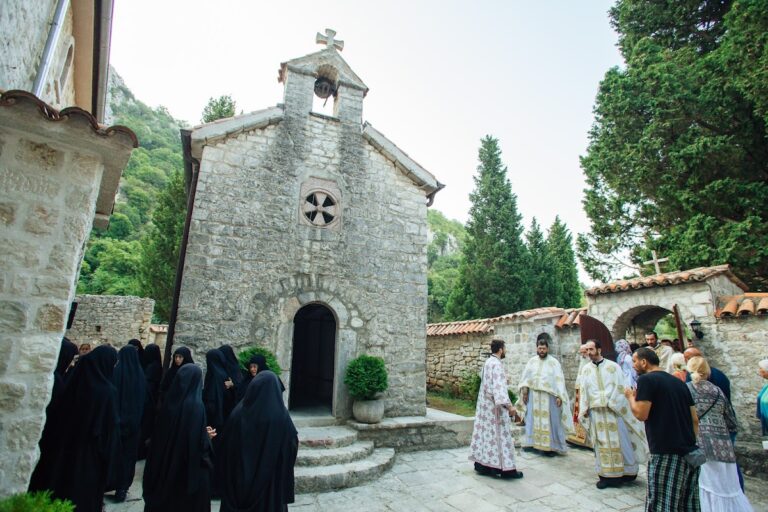
Vlah Church stands at Velja Gomila, a conspicuous location within the Cetinje Field, on ground associated with the former burial place of Ivan Borojević and Jelica. It is a single-nave building with its principal facade facing west, a western entrance portal, and an eastern altar apse. A bell cote, a small structure designed to hold bells, rises as part of the church rather than as a separate bell tower.
The original structure was made from woven branches, sticks, and mud. Later rebuilding replaced this construction with unmortared stone and then with stone set in lime mortar. The present fabric belongs to the 1864 rebuilding, while the plaque above the entrance preserves the sequence of construction and reconstruction.
Stećci and burial remains
The church occupies the site of a Bogomil necropolis. Bogomils belonged to a medieval Christian movement regarded as heterodox by the established Orthodox and Catholic churches. The burial ground contained approximately 150 stećci, decorated monumental tombstones characteristic of the western Balkans.
Two stećci survive. They originally faced one another but were later placed side by side. A tradition first recorded by the nineteenth-century Montenegrin writer Ljubomir Nenadović identifies them as the graves of the seventeenth-century military commander Bajo Pivljanin and his wife. Documentary evidence instead identifies them as the graves of Ivan Borojević and Jelica. Other stećci from the surrounding necropolis were built into the church walls during the nineteenth-century rebuilding.
Interior and churchyard enclosure
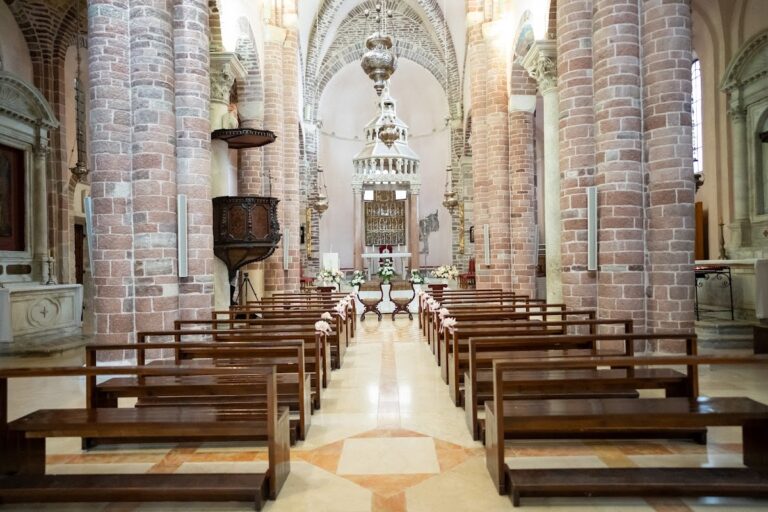
The interior contains an iconostasis, the screen separating the sanctuary from the nave in an Eastern Orthodox church. Vasilije Đinovski, an icon painter from Macedonia who studied painting in Russia, made it in 1878.
The churchyard is enclosed by a fence assembled in 1897 from 1,544 Ottoman rifle barrels. Montenegrins had seized the barrels during the wars of 1858 and 1876–1878. The idea for the enclosure followed the arrival of a large Russian arms shipment in 1896, when the trophy barrels were selected for use in the fence.
Nearby sites