Stanjevići Monastery: A Serbian Orthodox Monastic and Political Center in Montenegro


Site at a Glance
- Rating
- 4.9
- Popularity
- Low
- Country
- Montenegro
- Primary era
- Early Modern
- External website
- Open
- Eras represented
- Medieval, Early Modern, Modern
- Civilizations
- Serbian
- Site type
- Religious
- Remains
- Monastery
On this page13 sections
History
Stanjevići Monastery is a small Orthodox monastery of the Serbian Orthodox Church in Montenegro, near Pobori in the Budva area. It belongs to the Metropolitanate of Montenegro and the Littoral, the regional ecclesiastical jurisdiction covering Montenegro and the coastal area. The monastery is dated to the fourteenth century, with 1338 traditionally given as its foundation date.
Medieval Foundation
The foundation is traditionally associated with the Serbian despot Stefan Lazarević, a ruler who held the title of despot in the early fifteenth century, and the nobleman Nikola Stanjević. During Stefan Lazarević’s reign, his voivode Đurađ Ćurašev Crnojević, remembered as the grandfather of the later ruler Ivan Crnojević, established a palace at the site. He also built a nearby fortification with a Church of Saint George on Đurđevac Hill. At that time, he was lord of Grbalj and of the Svetomiholjska ecclesiastical estate.
Metropolitan Residence
Stanjevići acquired a new role after Ottoman attacks on Cetinje in 1714 damaged Cetinje Monastery. Metropolitan Danilo moved to Stanjevići and, after returning from Russia with funds for renovation, made it his summer residence when he was away from Cetinje. Around 1724, he founded the Church of the Holy Trinity and adapted the former Crnojević palace for monastic use. When Danilo returned to Cetinje, some monks remained at Stanjevići.
Metropolitan Sava Petrović later completed and enlarged the complex. Stanjevići became one of Montenegro’s political and spiritual centers, as well as a summer residence of the metropolitan. Sava received the Russian emissaries Stepan Puchkov and Yuri Dolgorukov at the monastery. Danilo died at Stanjevići in 1735 and was buried there. In 1856, Prince Danilo ordered the transfer of his remains to Cetinje, where his grave is now located on Orlov Krš above Cetinje Monastery.
Education and Law
In 1780, Sava Petrović founded a school at Stanjevići for future priests. One of its students was his nephew Petar I Petrović, later known as Saint Petar of Cetinje. In 1798, Petar I and the Montenegrin elders presented Montenegro’s first written law code after the Code of Stefan Dušan at the monastery. A popular assembly adopted it unanimously, and it later became known as the Code of Saint Peter. Its second part was adopted at Cetinje in 1803.
Stanjevići also had a literary importance. Petar II Petrović Njegoš, Petar I’s successor and a major nineteenth-century Montenegrin religious and literary figure, wrote his religious-philosophical poem The Rays of the Microcosm at the monastery. The Serbian Enlightenment figures Dositej Obradović and Vuk Karadžić also visited Stanjevići.
Venetian and Austrian Rule
The territory containing Stanjevići passed officially to the Venetian Republic under the 1718 Treaty of Passarowitz, an agreement between Venice and the Ottoman Empire. After the Napoleonic Wars, the coastal territory passed to the Austrian Empire, although the monastery continued to belong to the Montenegrin metropolitan.
During border demarcation with Austria in the late 1830s, Petar II Petrović Njegoš transferred the monastery buildings located on Austrian territory to Austria. The Austrians converted the complex into a fortress intended to defend their territory against Montenegro. During the anti-Austrian uprising in the Littoral and Bay of Kotor in 1869, inhabitants of the Pobori community occupied the monastery. They withdrew after the uprising was suppressed and destroyed the defensive works with explosives. The monastery was subsequently abandoned.
Earthquake and Restoration
The abandoned ruins suffered substantial damage in the 1979 earthquake. A raised road reached the monastery in 1994, when restoration began and monastic life was re-established. The work started with the blessing of Metropolitan Amfilohije and was led by Hieromonk Dimitrije Blagojević, a monk who was also an ordained priest. After Dimitrije’s death in 2004, Hieromonk Jefrem Dabanović continued the restoration and has headed the monastery since that year. He was listed as an archimandrite, a senior monastic title, in 2013.
Remains
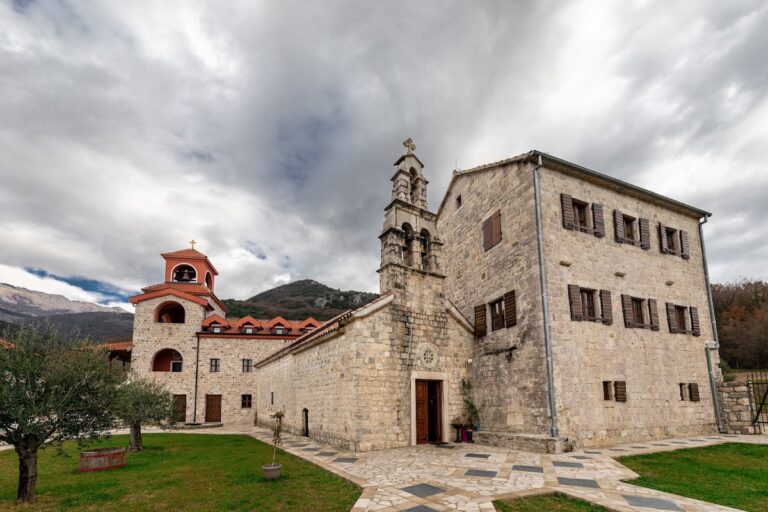
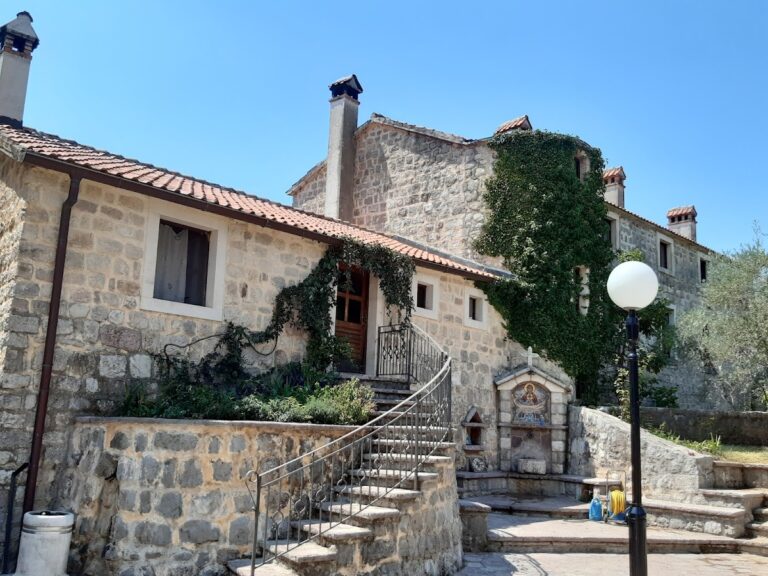
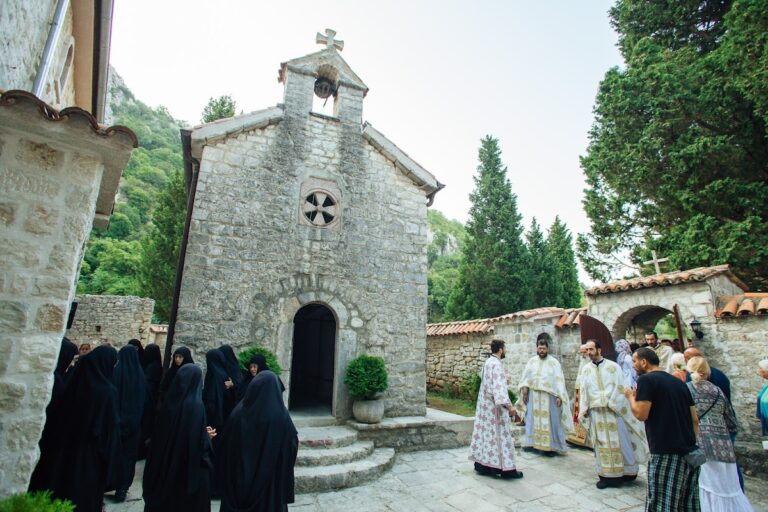
Stanjevići stands in the mountains above Montenegro’s Adriatic coast, at an elevation reported as approximately 600 to 800 metres above sea level. The surviving complex combines a medieval palace site, an eighteenth-century Orthodox church, and remains connected with its later conversion into an Austrian defensive position. Restoration followed the earthquake damage and has supported the re-establishment of the monastic community.
Monastic Buildings
Church of the Holy Trinity
The Church of the Holy Trinity was built around 1724 by Metropolitan Danilo. It forms the religious core of the restored monastery and belongs to the period when Stanjevići became a metropolitan residence and a center of Orthodox life in Montenegro.
Former Crnojević Palace
The former Crnojević palace occupies the site of the medieval residence associated with Đurađ Ćurašev Crnojević. Metropolitan Danilo restored and converted it into the monastery’s residential building in the eighteenth century. Its surviving fabric therefore reflects the transformation of a noble palace into a monastic home.
Fortified Remains
Đurđevac Hill Fortification
A military fortification with a Church of Saint George stood nearby on Đurđevac Hill. It was associated with the medieval complex established during the period of Đurađ Ćurašev Crnojević’s authority over Grbalj and the Svetomiholjska ecclesiastical estate.
Austrian Defensive Works
After the monastery buildings passed to Austria in the late 1830s, the Austrians incorporated them into a defensive fortress. The defensive works were destroyed with explosives during the 1869 uprising and were not rebuilt. The fortress phase remains part of the site’s physical history, alongside the palace and church that define the monastery complex.