Podmaine Monastery: A Serbian Orthodox Monastic Complex near Budva


Site at a Glance
- Rating
- 4.8
- Popularity
- Medium
- Country
- Montenegro
- Primary era
- Early Modern
- External website
- Open
- Eras represented
- Medieval, Early Modern, Modern
- Civilizations
- Venetian
- Site type
- Religious
- Remains
- Monastery
On this page12 sections
History
Podmaine Monastery, also known as Podostrog, is a Serbian Orthodox monastery in Montenegro, near the city of Budva. Its older church was built in the fifteenth century by the Crnojević noble family, although the monastery’s exact foundation date remains unknown. A tradition places its beginnings under the medieval Serbian Nemanjić dynasty, a ruling house associated with the development of Serbian statehood and Orthodox institutions. The monastery is also linked by legend with Saint Sava of Serbia, who is said to have departed from Podmaine on a pilgrimage to the Holy Land.
Origins and the Maine community
The name Podmaine means “beneath Maine.” Maine was an Albanian tribal territory extending below Mount Lovćen between Stanjevići Monastery and Budva. Podmaine served as the community’s traditional meeting place, particularly during the feast of Saint George. This connection gave the monastery a role that extended beyond worship, tying it to the social and communal life of the surrounding territory.
Residence of the metropolitans
Podmaine later became a summer residence of the Montenegrin metropolitan bishops. The metropolitan was the senior bishop of a metropolitanate, and in Montenegro such bishops historically exercised both religious and substantial political authority. Metropolitan Danilo I Petrović-Njegoš died at Podmaine in January 1735 and was buried there. His remains were moved in 1856 to a mausoleum near Cetinje.
Political changes altered the monastery’s surroundings without ending its connection with the Montenegrin metropolitans. Under the Treaty of Passarowitz in 1718, a settlement that redistributed territory in southeastern Europe among the Ottoman Empire, Venice, and the Habsburg monarchy, the Maine community and the surrounding area passed to the Venetian Republic. Podmaine itself remained owned by the Montenegrin metropolitans.
In 1747, Metropolitan Sava Petrović-Njegoš began the construction of a larger church for the monastery. During this period, Rafail Dimitrijević of Risan decorated its interior, and Danilo’s remains were transferred into the new church. The monastery also retained its intellectual and literary connections. The Serbian writer and educator Dositej Obradović lived there for several months in 1764 while visiting the Bay of Kotor region. Petar II Petrović-Njegoš, a later Montenegrin metropolitan and poet, visited frequently, writing part of The Mountain Wreath and the poem Slobodiada at Podmaine. He also used a monastery terrace overlooking the sea for walks.
Austrian control and later decline
During the 1830s, Austrian pressure and military-strategic considerations led Petar II Petrović-Njegoš to sell Podmaine, together with Stanjevići and their estates, to the Austrian Empire. Podmaine was transferred on 12 October 1837 for 17,000 silver florins, while Stanjevići followed in 1839. The Austrians converted the monastery complex into a military fortification and used the smaller church as a prison.
In the 1850s, Filip Tanović, an Orthodox priest from the neighboring Maine area, bought the former monastery and kept its buildings in relatively good condition. Its substantial library was sold to Vuk Karadžić, a Serbian linguist and language reformer. The complex then suffered a fire in 1864. Austrian forces burned it again in 1869 while suppressing the Bokel Uprising, after which the monastery remained unrestored for an extended period.
Nationalization and reconstruction
The Tanović heirs retained ownership until the state nationalized the monastery in 1953. From that year until 1994, Montenegro’s Institute for the Protection of Cultural Monuments administered the complex. The 1979 earthquake caused extensive damage to its buildings. Podmaine reopened in 1995, and the complex was completely reconstructed in 2002. The larger church was restored and repainted during the late 1990s and the 2000s.
Podmaine is affiliated with the Serbian Orthodox Church and the Metropolitanate of Montenegro and the Littoral, the Serbian Orthodox ecclesiastical jurisdiction covering Montenegro and the adjacent coastal region. It continues to function as an active monastery. From February 2009, its abbot was Rafail Bolevich.
Remains
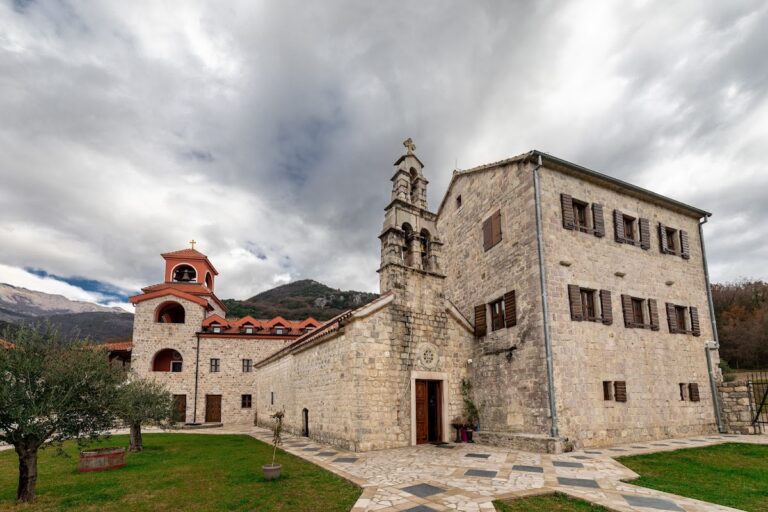
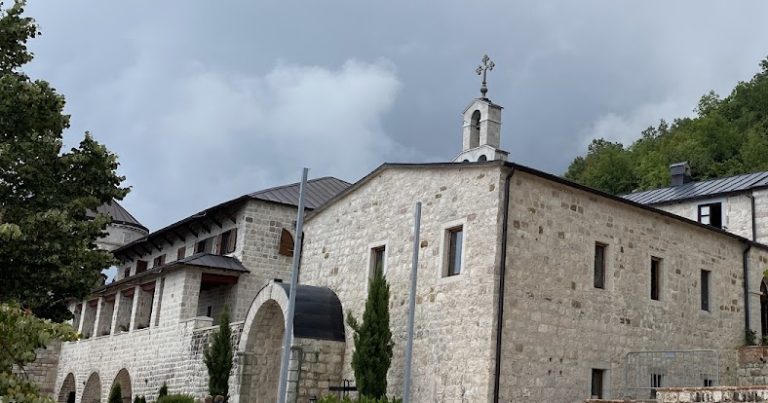
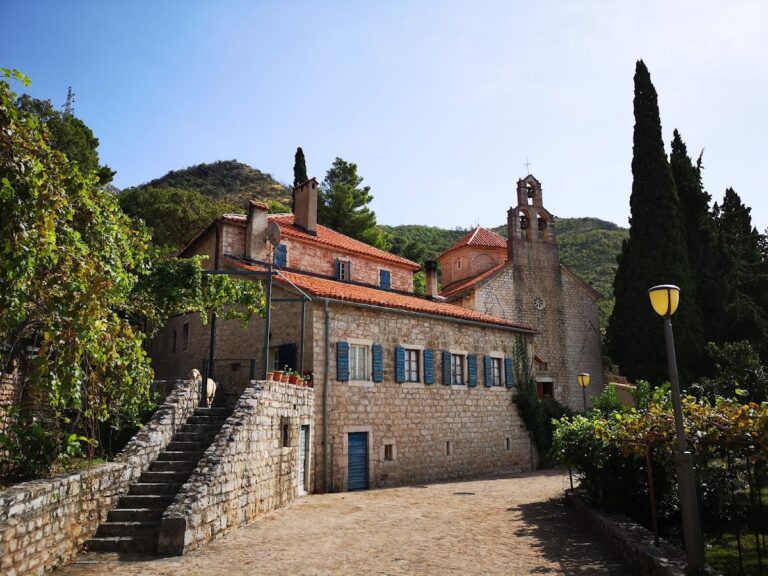
The surviving monastery complex contains two churches and associated outdoor features. Its buildings are described as having Romanesque architectural characteristics. The smaller stone church represents the older fifteenth-century phase, while the larger church was added in the eighteenth century as the principal place of worship. A stone bridge and a sea-facing terrace further preserve elements connected with the monastery’s historical development.
Churches
Church of the Dormition of the Mother of God
The smaller church is a fifteenth-century stone building dedicated to the Dormition of the Mother of God. It was reconstructed in 1630, a date given by an inscription inside the church. The building survives within the complex, and its interior received new frescoes after the modern reconstruction. A fresco is a wall painting created by applying pigment to wet plaster, allowing the image to become part of the wall surface.
Church of Saint Petka
The larger church was built in 1747 as Podmaine’s new principal church. Its interior frescoes were painted by Rafail Dimitrijević of Risan, while the icons on its iconostasis were made by Nicholaos Aspioti of Corfu. An iconostasis is the decorated screen that separates the sanctuary from the main worship space in an Eastern Orthodox church. The church was restored and repainted during the late 1990s and the 2000s.
New frescoes were added to the smaller church after the 2002 reconstruction. One modern work, titled Sinful Bishops and Emperors, has been interpreted by some as a representation of the Last Judgment that includes former Yugoslav communist leader Josip Broz Tito and leaders of the non-canonical Montenegrin Orthodox Church among the damned. The interpretation reflects a religious and political dispute distinct from the Serbian Orthodox affiliation of the monastery.
Bridge and terrace
Stone bridge
A stone bridge built beside the monastery by Metropolitan Danilo has survived. It belongs to the group of features associated with the period when Podmaine served as a residence of the Montenegrin metropolitans.
Sea-facing terrace
Petar II Petrović-Njegoš built a monastery terrace with a view toward the sea. He used the terrace for walks during his frequent visits to Podmaine, when he also wrote part of The Mountain Wreath and Slobodiada.