Village church Chorin: A Medieval Gothic Parish Church in Germany


Site at a Glance
- Rating
- 4.5
- Popularity
- Very Low
- Country
- Germany
- Primary era
- Medieval
- External website
- Open
- Eras represented
- Medieval, Early Modern, Modern
- Civilizations
- Holy Roman Empire
- Site type
- Religious
- Remains
- Church
On this page9 sections
History
Village church Chorin is a medieval Gothic parish church in Germany, probably built between 1230 and 1250. It is an Evangelical church belonging to the Brodowin-Chorin parish in the Barnim church district of the Evangelical Church of Berlin-Brandenburg-Silesian Upper Lusatia. Its single main worship space reflects the hall-church form used in the medieval period.
Medieval parish
The church and its priest held separate land endowments by 1375. The parish priest possessed four hides, historical units of land whose size varied by region and period, while the church held one hide. These holdings formed part of the economic basis of the medieval parish.
By 1573, the parish holdings had been leased. The priest received 32 Scheffel of measured grain, a historical capacity measure with values that varied by time and place. The church then possessed four morgens of land, a deserted farmstead, and three plots whose combined area was eight morgens.
Destruction and rebuilding
The church burned down to its foundations during the Thirty Years’ War, the major European conflict fought mainly between 1618 and 1648. It had been rebuilt by 1688. An inscription in a ceiling beam names the church wardens Jacobus Berlin and Joachim Kinast, who played an important part in this reconstruction.
The rebuilding altered the building as well as restoring it. The windows were enlarged with pointed-arch openings, and a post-Reformation pulpit altar was installed. This type of altar combines the altar and pulpit, reflecting the stronger emphasis on preaching in Protestant worship after the Reformation.
Later alterations and care
A western roof tower was added in the eighteenth century. It was originally half-timbered, but a nineteenth-century renovation covered it with boarding for financial reasons. The church was restored in 1954. In 2022, the tie beam spanning the full width of the building had to be replaced because it was structurally important to the building.
Remains
Church setting and exterior
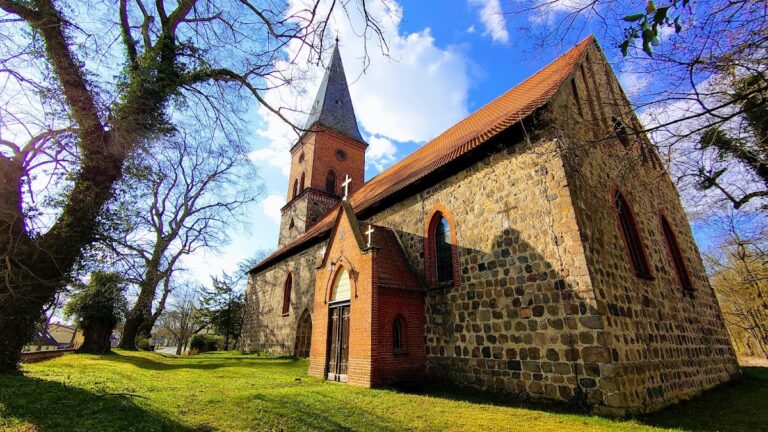
The church is a small rectangular Gothic hall built of carefully executed fieldstone masonry. It stands at the centre of the village green formed by Choriner Dorfstraße, which passes through the settlement from southwest to northeast. A wall made of unworked fieldstones encloses the churchyard.
The boarded western roof tower rises from the west end of the church. The northern portal has been walled up. Above the western portal are three broad blind panels, decorative recessed areas without openings, made from fieldstone. The brick pointed-arch closures and the small round-arched window in this western area date from the nineteenth century.
Gables, windows, and interior structure
The eastern gable has a stepped group of three pointed-arch blind panels, flanked by paired pointed-arch panels. The former pointed-arch eastern window extends upward into the gable, and its upper end cuts into the central group of three panels. This arrangement indicates that the window, the gable panels, or both were altered after their original construction.
Inside, a beam ceiling bears the date 1688 and belongs to the rebuilding after the fire. The eastern window suggests that the interior may once have been covered by a wooden barrel vault. At the western end, a gallery has a projecting central section.
Altar and historic furnishings
The late-seventeenth-century wooden altar wall is well proportioned. It incorporates a polygonal pulpit and passageways on both sides, forming the post-Reformation pulpit altar associated with the church’s rebuilding.
A large wooden crucifix dating from around 1400 retains remnants of its painted finish and stands on a renewed cross. It was probably brought to the village church from Chorin Monastery during the monastery’s secularization in 1662. Secularization was the transfer or suppression of ecclesiastical property and institutions by civil authorities. Chorin Monastery was a Cistercian monastery, and the crucifix is considered highly likely to be the only surviving piece of the monastery church’s interior furnishings.
An inscribed tombstone dated 1775 lies in front of the altar. Other furnishings include a silver-gilt chalice with paten from 1711, a copper baptismal basin from 1680, and a pair of tin candlesticks made in 1707.
Tower and organ
Two iron bells cast in 1958 hang in the tower. The organ was built by Alexander Schuke Potsdam Orgelbau in 1968. It has six stops, one manual, and a pedal.