Sant’Ampelio: Romanesque Church and Shrine in Bordighera, Italy



Site at a Glance
- Rating
- 4.7
- Popularity
- Medium
- Country
- Italy
- Primary era
- Medieval
- Eras represented
- Medieval, Early Modern
- Civilizations
- Genoese, Holy Roman Empire
- Site type
- Religious
- Remains
- Church
On this page7 sections
History
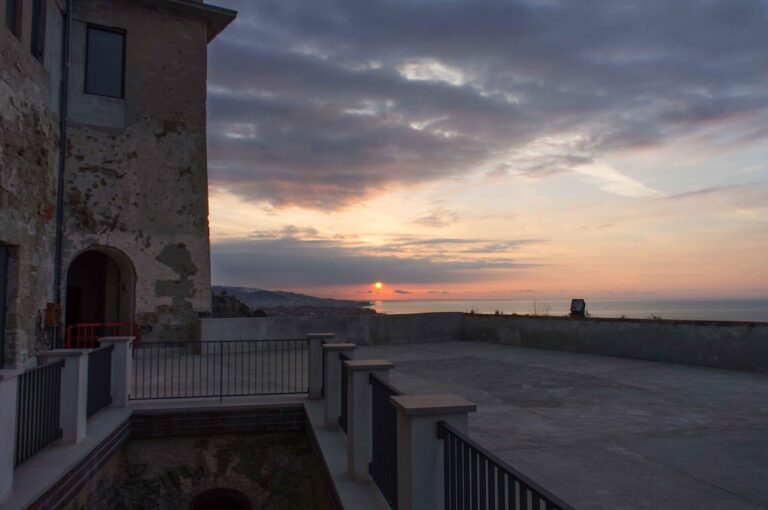
Sant’Ampelio is a Roman Catholic church in Bordighera, Italy, standing on Cape Sant’Ampelio at the end of the Argentina Promenade. Its present building incorporates an 11th-century Romanesque monastic core, a medieval style known for thick walls, rounded arches, and small openings. The church is under the Diocese of Ventimiglia–San Remo and remains an active place of worship.
The hermit Ampelio and the first foundation
Christian tradition holds that the hermit Ampelio arrived on this coast from the Thebaid, a historical region of Upper Egypt, in 411. He is said to have brought date-palm seeds and lived in a cave among the rocks. A small church was later built above the cave, and a monastic priory, a smaller religious house dependent on a larger monastery, developed around it under the Abbey of Lérins.
The tradition surrounding Ampelio helped shape Bordighera’s religious identity. He is credited with planting the town’s first date palms, a story linked to Bordighera’s title, “Queen of Palms.” He is also traditionally described as a blacksmith, and after the transfer of his relics in the Middle Ages he became the patron saint of blacksmiths.
Monastic administration and medieval jurisdiction
In 954, Sant’Ampelio and the territories of Hyères and Bordighera passed from the monks of Lérins to the Benedictine monks of Montmajour Abbey of Arles. Benedictines belong to the Order of Saint Benedict. Montmajour administered the church and monastery and also managed the saltworks and fishponds of Hyères. Pope Innocent III confirmed this dependency in 1204. In 1296, Pope Boniface VIII transferred jurisdiction over the monastery to the Abbey of San Fruttuoso of Capodimonte at Camogli.
Relics, enlargement, and modern restoration
Following an uprising in 1140, the Republic of Genoa removed Saint Ampelio’s relics as a punishment and transferred them to the Church of Santo Stefano in Sanremo. Genoa moved them again on 14 May 1258, sending them to the Benedictine Abbey of Santo Stefano in Genoa. The church at Cape Sant’Ampelio was enlarged during the 15th and 17th centuries.
In 1947, Genoa’s archbishop Giuseppe Siri, a 20th-century Italian Catholic churchman, arranged for the relics to return to Bordighera. They arrived by boat on 16 August and were carried in procession to the Church of Santa Maria Maddalena. A glass case there contains a wax statue enclosing the relics. The church’s restoration began in 2014, and it reopened on 24 May 2015. Masses and weddings continue to be celebrated there.
Saint Ampelio is the patron saint of Bordighera, and his feast is held on 14 May. The celebration includes a procession and fireworks at Cape Sant’Ampelio. The church and its surrounding protected area form part of the cultural heritage protected by the Ligurian heritage authorities, and the church is also identified as a national monument.
Remains
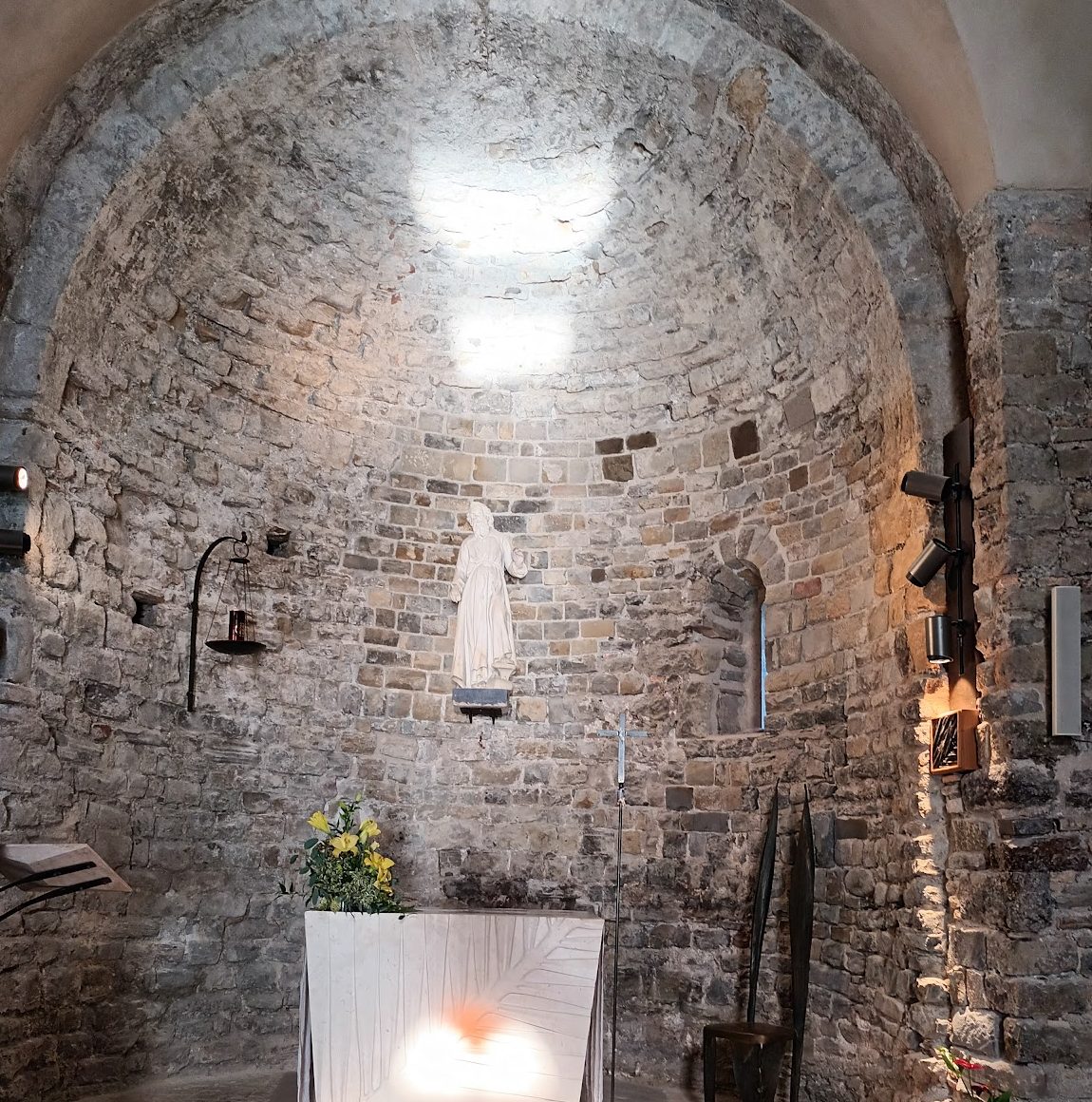
Sant’Ampelio occupies a rocky coastal promontory, with the present church built around an 11th-century Romanesque core. The surviving complex includes the church above a crypt, while objects associated with Saint Ampelio are preserved in the nearby Church of Santa Maria Maddalena.
Church and crypt
The crypt is a chamber beneath the church, used for religious commemoration, and receives light through small openings that overlook the sea. It preserves a square block of La Turbie stone, quarried in the area near Monaco. Tradition identifies the block as Saint Ampelio’s stone bed and the place where he died on 5 October 428.
Statue and preserved relics
A wooden statue of Saint Ampelio stands on the altar. It dates from the period of the church’s enlargements in the 15th and 17th centuries. The saint’s relics are kept in a wax statue inside a glass case in the second chapel on the right of Santa Maria Maddalena in Bordighera. The statue and the chapel’s 1947 frescoes were made by the Bordighera painter Giuseppe Balbo.