Bärenkasten: A Former Frontier Fortress in Oderberg, Germany
Site at a Glance
- Rating
- 3.6
- Popularity
- Very Low
- Country
- Germany
- Primary era
- Medieval
- Eras represented
- Medieval, Early Modern
- Civilizations
- Holy Roman Empire, Kingdom of Prussia, Margraviate of Brandenburg
- Site type
- Military
- Remains
- Fort
On this page9 sections
History
Bärenkasten is a former fortress in Oderberg, Germany, built by the Margraviate of Brandenburg between 1353 and 1355 as a medieval frontier stronghold on the Oder. It replaced a castle on present-day Albrechtsberg that had been destroyed during the 1349 war against the Pomeranians. The earlier castle no longer met the needs of a site protecting the Oder crossing and trade route or supervising customs. A Slavic refuge fortification had occupied the island previously.
Foundation and early importance
Construction began in 1353 on the initiative of Margrave Ludwig the Elder of Brandenburg and ended in 1355. Since Ludwig did not have enough money to finance the work, he authorized the local nobles Henning von Uchtenhagen and Dietrich von Mörner to build the fortress. They received shares in its revenues and the right to live there. Henning von Uchtenhagen sold his share to Johann von Wedel in 1355.
Known originally as Bardyn Castrum, the fortress was later equipped with weapons, including cannon. Its protection helped Oderberg prosper. The Landbuch of Emperor Charles IV, a late-fourteenth-century record of territories, rights, and revenues in Brandenburg, listed the town’s revenues in 1375 as the highest in the margraviate. Weekly markets were held from 1442. Goods from outside the region were sold at one annual market at first, and at two annual markets from 1532.
Neglect and the name Bärenkasten
During a long period of peace, the fortress received less attention and reportedly deteriorated almost to the condition of a ruin. The name Bärenkasten, meaning “bear enclosure,” appears in two seventeenth-century sources. In 1623, citizens of Oderberg complained to the elector about foul waste being discarded from the fortress. During peacetime, the elector used the site as a base for hunting, and the name is thought to refer to bears kept there for hunting and for the entertainment of electoral hunting parties. In 1652, the naturalist and scientific illustrator Maria Sibylla Merian wrote that bears were confined in the fortress. The name continued to be used for the remains.
Rebuilding during the Thirty Years’ War
Plague epidemics struck in 1605, 1611, and 1612 before the Thirty Years’ War began in 1618. This major European conflict involved dynastic, territorial, and religious struggles. In Brandenburg, the threat from Swedish forces based in Swedish Pomerania led Elector Georg Wilhelm to order Bärenkasten to be rebuilt, rearmed, and provided with a garrison. The citizens of Oderberg were required to take part in the construction work.
A garrison of 150 men commanded by Captain Baltasar Kunitz entered the fortress in 1636. Swedish troops under General von Dromont besieged it for several weeks in the following year but failed to capture it. The fighting almost completely destroyed Oderberg.
After the Swedish withdrawal, the fortress was repaired and reinforced with fieldworks, including contre-escarps, defensive works placed beyond a fortress ditch. Swedish forces under General Dromark began another siege on 14 July 1639. Captain August Friedrich von Kötteritz commanded the garrison, which successfully defended the position. Swedish attacks using rafts and boats failed because the Oder was high and its current was strong. The besiegers withdrew, while the damaged fortress remained operational and received further strengthening. Oderberg itself was completely destroyed and remained uninhabited until new residents settled there in 1645.
Expansion and military decline
Friedrich III, elector of Brandenburg from 1688 and king in Prussia as Friedrich I from 1701, continued to enlarge Bärenkasten. Further defensive works and traverses, barriers or earthworks designed to restrict enemy movement or shield defenders from fire, were added. Outer forts equipped with cannon and manned by garrisons were built north of the main fortress to cover the Oder.
After the Great Northern War, a conflict from 1700 to 1721 in which Sweden lost important Baltic territories, King Friedrich Wilhelm I of Prussia made peace with Sweden on 21 July 1720. Prussia acquired parts of Swedish Pomerania, including Stettin, for two million thalers. Stettin was then developed as the principal fortress, and Bärenkasten lost most of its military importance. Its weapons and equipment were removed, its garrison was gradually reduced, and the fortress had no garrison by 1750.
Abandonment and later settlement
Bärenkasten was gradually abandoned. Buildings began to be dismantled in 1754, and the commandant’s house was demolished. Its materials were reused elsewhere, including in a house at present-day Berliner Strasse 50 in Oderberg.
Regulation of the Oder and the Oderbruch during the reign of King Friedrich II of Prussia caused the former fortress island to silt up. By the late eighteenth century, ten settler houses had been built against the inner sides of the fortress walls, forming a colony for 100 people. The settlement had its own cemetery until 1882. In January 1799, King Friedrich Wilhelm III personally granted the blind invalid and former Prussian non-commissioned officer Johann Friedrich Schützler the right to live in one of the houses under a hereditary lease.
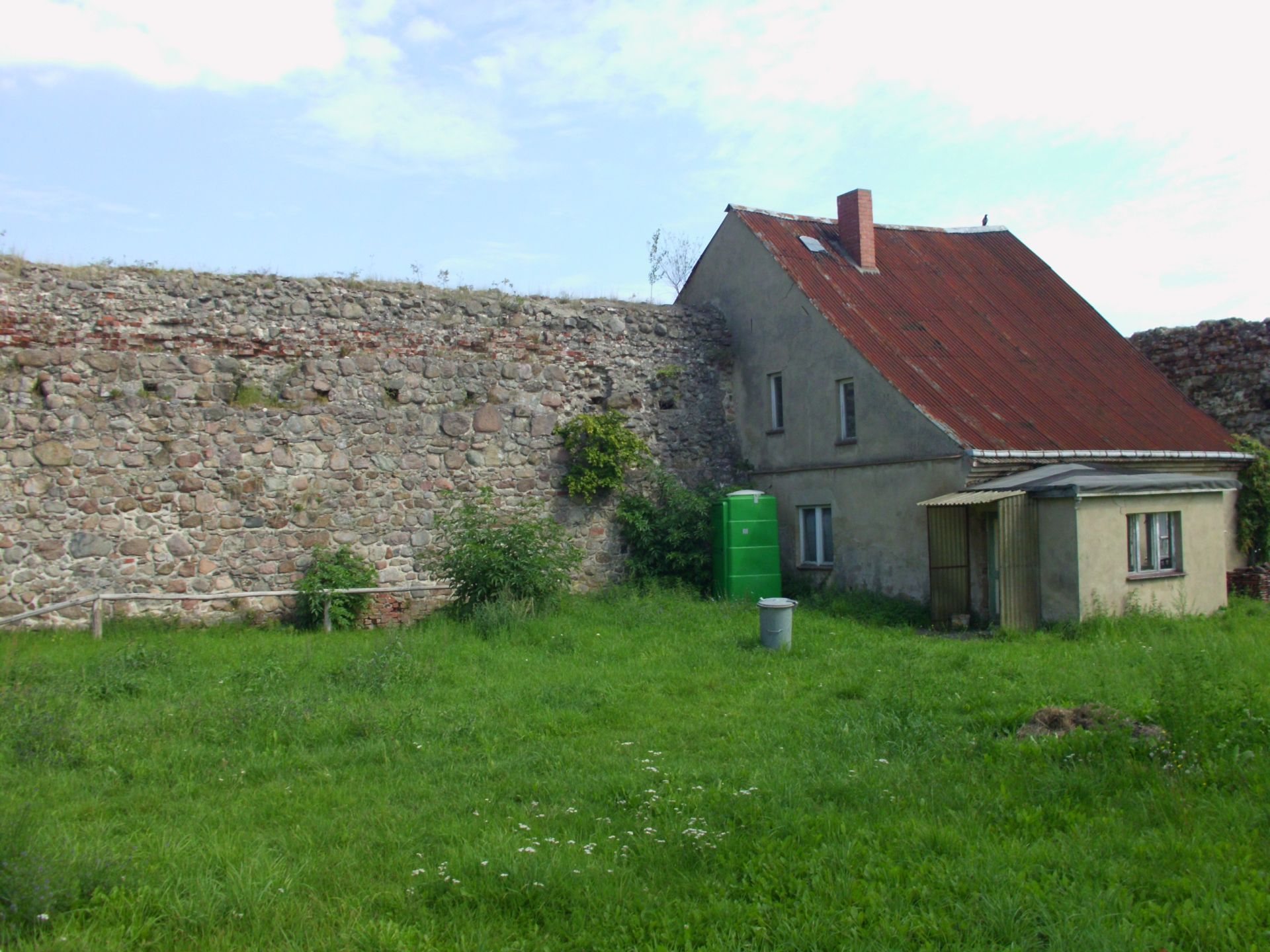
At the beginning of the twentieth century, the houses had become dilapidated. In 1905, fifteen families living in nine state-owned houses were relocated, and those houses were demolished. One house survived because its owners invoked the privileged residential and hereditary-lease rights granted by the king in 1799. Preservation work on the remaining masonry has been carried out repeatedly since 1905, but weathering continues. The ruins now stand within an allotment-garden complex in the middle of Oderberg.
Remains
The surviving remains consist chiefly of the fortress walls and one former settler house. The stronghold once occupied an island in the Oder opposite the historic settlement of Oderberg. Regulation of the river later caused the island to silt up, placing the former fortress within the present city. Around 1688, the complex was described as a three-storey building with an inner courtyard, a battlement walk, four corner towers, and palisades. Ramparts, traverses, and outer forts to the north formed part of its wider defensive system.
Fortress walls and defensive works
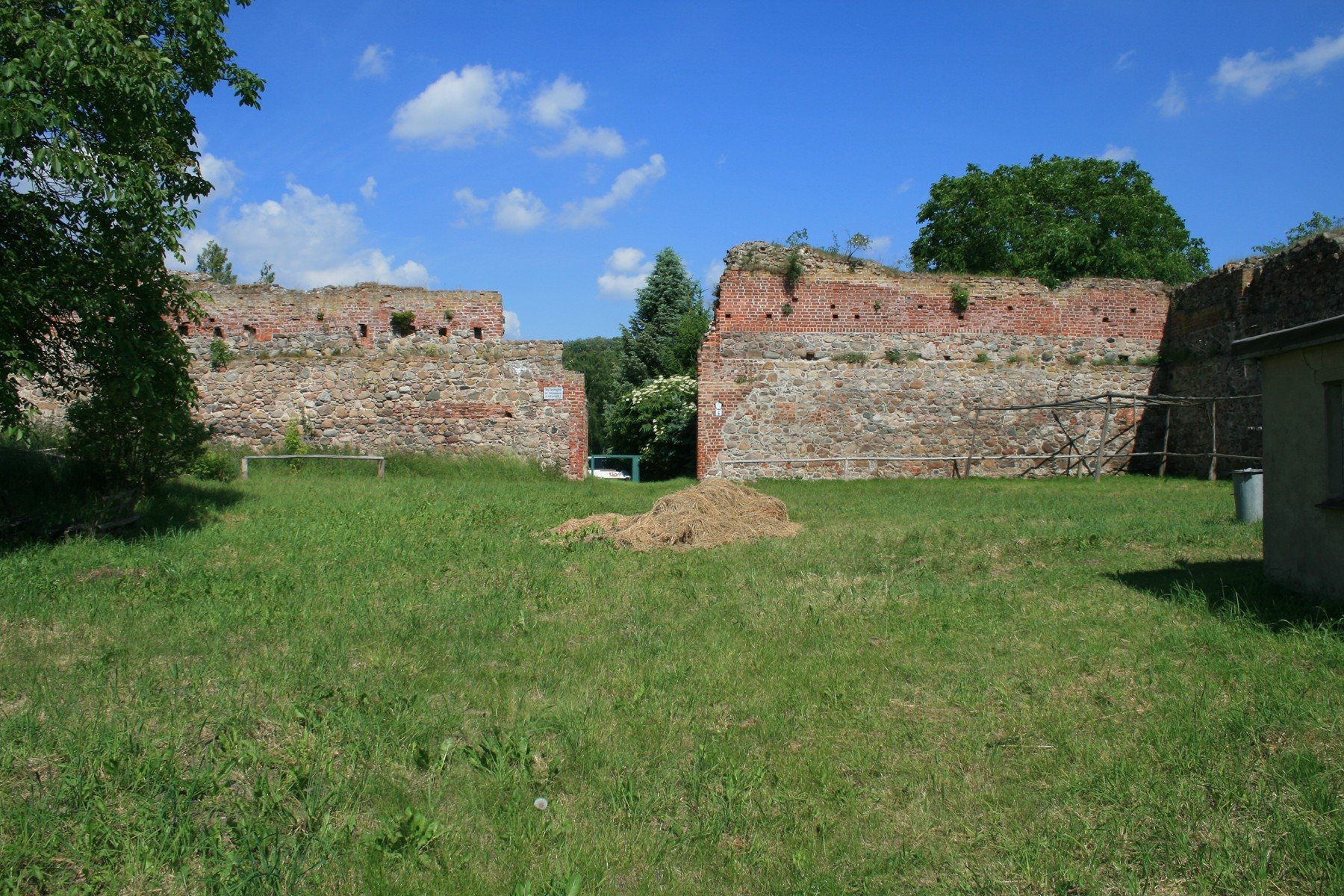
The surviving walls are built of fieldstone and rise approximately 8 metres high, with a thickness of about 3 metres. They were left standing after the eighteenth-century dismantling because fieldstone was abundant and inexpensive, making demolition uneconomical. The walls preserve the principal masonry of the former stronghold, while the outer forts and other defensive works belonged to the larger system that covered the Oder. The fortress was damaged during the Swedish sieges but remained defensible after repairs and reinforcement.
The masonry is now deteriorating, and stones have loosened from the walls. Access to the interior has been closed for safety reasons, while the exterior side remains accessible. Long-term stabilization would require extensive restoration.
Settler house
Ten houses were built against the inner sides of the fortress walls in the late eighteenth century as part of the settlement established after the site’s military decline. Nine state-owned houses were demolished in 1905. One survives, although it is vacant. Its continued existence is connected with the residential and hereditary-lease rights granted to Johann Friedrich Schützler in 1799.