Maria-Magdalenen-Kirche in Eberswalde: A Gothic Brick Parish Church


Site at a Glance
- Rating
- 4.7
- Popularity
- Very Low
- Country
- Germany
- Primary era
- Medieval
- External website
- Open
- Eras represented
- Medieval, Early Modern, Modern
- Civilizations
- Holy Roman Empire, Margraviate of Brandenburg
- Site type
- Religious
- Remains
- Church
On this page12 sections
History
Maria-Magdalenen-Kirche is an evangelical Lutheran parish church in Eberswalde, Germany, built by the medieval Christian community of the settlement that developed near a margrave’s castle. Its present Gothic brick building was begun in 1333, and the church remains a protected monument on the European Route of Brick Gothic. It is dedicated to Mary Magdalene, a New Testament follower of Jesus traditionally regarded in Western Christianity as the first witness to the Resurrection, and belongs to the Evangelical Church of Berlin, Brandenburg, and Silesian Upper Lusatia.
Medieval origins and Gothic construction
Before Eberswalde became a city, the settlement of Eversberg grew near the margrave’s castle. Its first inhabitants probably built a church between 1241 and 1251. Another tradition places its consecration in 1250 by Rutger von Kerkow, the medieval Bishop of Brandenburg. The predecessor was probably a three-aisled Romanesque basilica with cross vaults. It did not survive as an independent building, although the possibility that elements were incorporated into the present church remains unconfirmed and would require further architectural investigation.
Construction of the present church began in 1333. Monks from Chorin influenced its development, linking the building to the architectural culture associated with Chorin Monastery. A major city fire in 1499 damaged the church, prompting rebuilding and alteration in 1503. Decorative features from this phase include lily motifs and an image of Saint Christopher. Further fundamental changes followed in 1726, reshaping the building after its medieval construction.
Reformation and early modern use
The Reformation reached the region in 1539, as Protestant teaching and worship replaced the previous religious order in many churches. The first Protestant service at Maria-Magdalenen-Kirche took place in 1542. The church also became associated with a major event of the Thirty Years’ War, the European religious and political conflict fought from 1618 to 1648. In 1632, the body of Gustav II Adolf, King of Sweden and a leading Protestant military commander, was laid out inside the church for a farewell ceremony after his death in battle.
The Baroque high altar was installed in the choir in 1606. It is regarded as evidence of anti-Counter-Reformation activity, meaning an effort connected with the Catholic response to the spread of Protestantism. A carved altar from the same year also survives in the church. These furnishings reflect the building’s continued religious use during the confessional conflicts and changes of the early modern period.
Nineteenth-century restoration and later conservation
Hermann Blankenstein directed a comprehensive restoration in 1876. The work re-emphasized the church’s basilican character, a layout in which a higher central nave rises above lower side aisles, and strengthened its visual relationship with the nearby Chorin Monastery Church. Friedrich August Stüler designed the upper termination of the tower. Friedrich Kienscherf revised the organ in 1878 and built the surviving organ case, which acquired a Neo-Gothic appearance through the restoration and associated rebuilding.
The interior was comprehensively renovated in 1977, and the exterior facade was renewed in 1993. Archaeological excavations during the redesign of the church square in 2001 revealed a late-medieval forge and the foundations of a sixteenth-century Latin school. The 1518 Barbara Bell was moved to a position in front of the church in 2001 because its body had cracked. A new peal, made by the Rudolf Perner bell foundry, was installed in October 2002.
On 2 December 2019, a smoldering fire began in a small room on the south gallery of the choir. Heat from a lamp ignited a wooden balustrade rather than a short circuit in the outdated electrical system. Soot removal lasted three months. Conservation involved a paste that hardened overnight and could be peeled away, followed by extensive manual cleaning. During work on the Baroque altar, restorers found two previously unknown remnants of vault paintings. The fire damage was covered by insurance, while further renovation of the electrical system and other installations was planned.
Remains
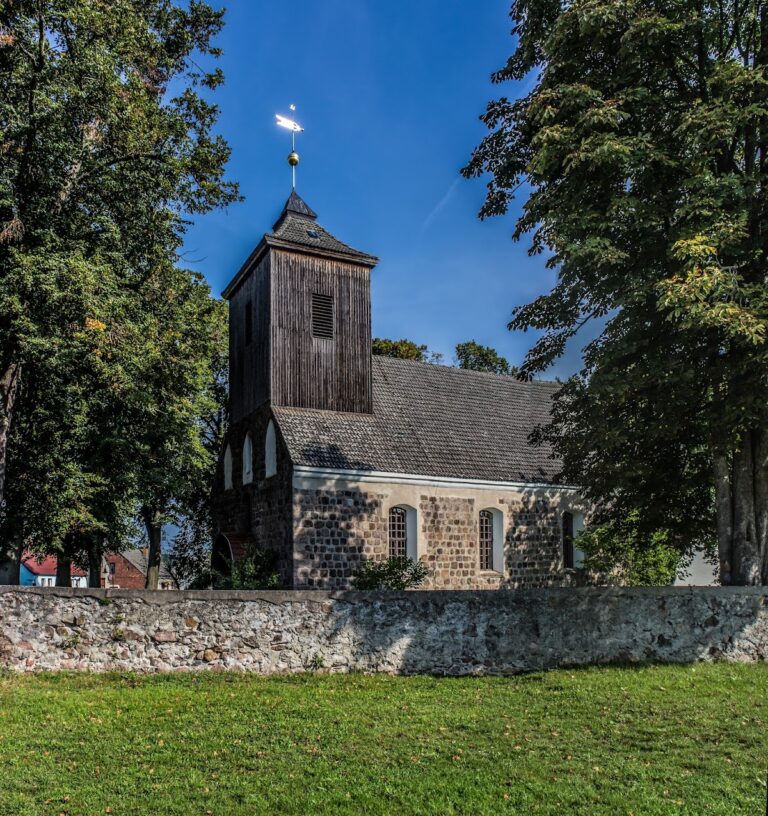
Maria-Magdalenen-Kirche is a Gothic brick church with a basilican plan. A central nave rises above two side aisles, each containing galleries. At the east end, the choir is marked by tall Gothic windows with tracery, the ornamental framework dividing the window openings. A single western tower incorporates a porch or vestibule, and its spire is built of masonry. Nineteenth-century restoration added friezes at the cornice and decorative blind gables, which are gables applied to walls without functioning openings, to the chapels and the fronts of the side aisles.
Medieval brickwork and decorative elements
Portals and terracotta
The portals contain medieval terracotta reliefs and figures. These architectural elements are described as the oldest surviving architectural terracotta elements in Brandenburg. Their molded decoration belongs to the church’s medieval fabric and demonstrates how brick-based Gothic construction could incorporate fired clay for both ornament and figural work.
Post-fire decoration
The rebuilding after the 1499 fire left decorative details that include lily motifs and an image of Saint Christopher. These elements are associated with the church’s early sixteenth-century alteration and remain part of the surviving visual record of that rebuilding phase.
Furnishings and musical heritage
Font and altars
A bronze baptismal font from the predecessor church dates to the second half of the thirteenth century. It connects the present interior with the earlier medieval congregation. The choir contains the Baroque high altar installed in 1606, together with a carved altar dating from the same year. Conservation after the 2019 fire revealed two previously unknown remnants of vault paintings while the Baroque altar was being cleaned.
Organ
Ernst Julius Marx of Berlin built the organ between 1781 and 1783. The instrument cost 1,900 thalers and had 1,622 pipes. Its manuals were faced with ebony, with ivory on the semitones, and the pedal was made of oak. A manual coupler, stop valves, four bellows, and six wind chests formed part of its mechanism. The bellows supplied air, while the wind chests distributed it to the pipes. A drum mechanism allowed kettledrums to be played from the pedal, and a trumpet mechanism operated trumpet-player figures on the pedal towers. Doors could close over the manuals. Kienscherf revised the organ in 1878 and constructed the surviving case, and later rebuilding gave the instrument its Neo-Gothic appearance.
Bell installation
The Barbara Bell, cast in 1518, stands outside the church in front of the building after its cracked body required relocation in 2001. A new peal made by the Rudolf Perner bell foundry was installed in October 2002, providing a later bell installation alongside the preserved historic bell.