Schloss Freienwalde: A Prussian Summer Palace and Rathenau Memorial in Germany


Site at a Glance
- Rating
- 4.1
- Popularity
- Low
- Country
- Germany
- Primary era
- Early Modern
- External website
- Open
- Eras represented
- Early Modern, Modern
- Civilizations
- German, Holy Roman Empire, Kingdom of Prussia
- Site type
- Domestic
- Remains
- Palace
On this page8 sections
History
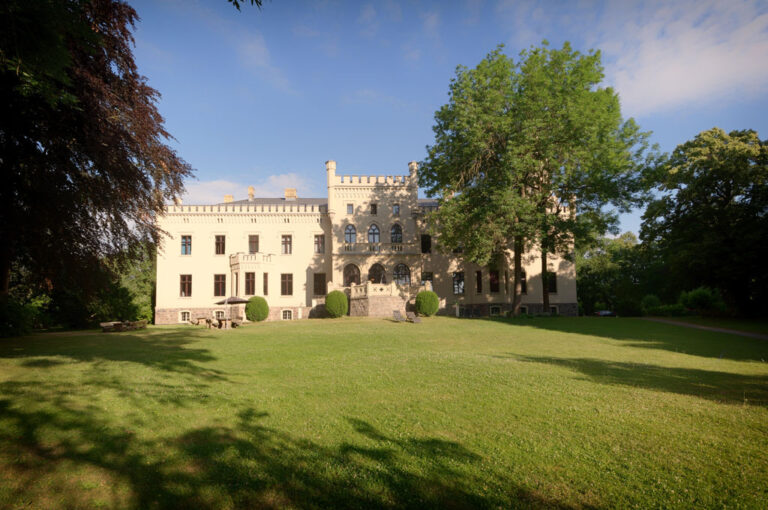
Schloss Freienwalde is a Neoclassical summer palace in Bad Freienwalde, Germany, built for the Prussian Queen Friederike Luise, wife of King Friedrich Wilhelm II, at the end of the eighteenth century. It was established as a royal retreat on a landscaped site and later became closely associated with the industrialist, writer, and politician Walther Rathenau.
Royal summer residence
The southern part of the site, known as Apothekerberg, had already been landscaped for Friederike Luise and included a tea house built in 1790. After Friedrich Wilhelm II died, the queen commissioned the local master mason Anton Hilke to prepare plans for a summer palace. In 1798, Friedrich Wilhelm III asked David Gilly, a leading Prussian architect and civil engineer associated with Neoclassicism, to revise Hilke’s design. Construction was completed in 1799, almost within the planned budget of 20,500 thalers, a silver currency used in Prussia and other German states.
Following Friederike Luise’s death in 1805, the palace remained empty for a time. From 9 August to 16 September 1806, the Prussian Crown Prince Friedrich Wilhelm IV stayed there with his brothers, Prince Wilhelm I and Prince Carl, together with their tutors Friedrich Delbrück and Julius Reimann. In 1822, the landscape architect Peter Joseph Lenné redesigned the grounds as an English landscape park. Prince Anton Heinrich Radziwill spent several summers at the palace in the late 1820s, when the building was apparently renovated. His daughter Elisa Radziwill died at Schloss Freienwalde in 1834 during a tuberculosis cure to which Friedrich Wilhelm III had invited her.
Walther Rathenau and the memorial
Walther Rathenau acquired Schloss Freienwalde from the Crown Estate in 1909. He restored the building, renewed parts of its interiors, and preserved its basic architectural character. After Rathenau was assassinated in 1922, his heirs transferred the palace to the Oberbarnim district in 1926. The transfer required Rathenau’s intellectual legacy and memory to be preserved there permanently.
After 1945, the palace was looted and almost all traces of its connection with Rathenau were removed. During the German Democratic Republic, it served as a Pushkin House for the Society for German-Soviet Friendship, a state-supported organization that promoted relations between East Germany and the Soviet Union.
Restoration and cultural use
After German reunification, the Bad Freienwalde district took over the palace again in 1991. In 1996, the palace and other facilities were transferred to a cultural limited company. Extensive renovation then established a Rathenau memorial site, while the principal upper level, known as the piano nobile, received a permanent exhibition on the building’s history.
The cultural company closed for financial reasons at the end of 2016, and the palace was subsequently put up for sale. A Europe-wide tender process ended on 21 March 2019. The state-recognized Michael Linckersdorff Foundation, established in 2022, took over the palace in early 2023. It maintains the Walther Rathenau memorial and presents Schloss Freienwalde as a place connected with the history of democracy.
Since 2024, the foundation has organized literary and musical salons with writers, historians, and musicians, as well as summer theatre on the palace terrace. In cooperation with the association Music in Brandenburg Palaces, it began a concert series in the park tea house in 2025. Since German reunification, the former royal theatre in the park has again hosted concerts, theatre performances, film screenings, and other artistic events. A Circus Krone event was held there in 1995.
Remains
The palace
Schloss Freienwalde is a small Neoclassical villa with a broad rectangular plan and two storeys. Its facade is organized into five or four bays, meaning vertical sections defined by openings or structural divisions. The original exterior was restrained, with a continuous belt cornice, a projecting horizontal band marking the lower edge of the upper storey. The shallow roof was originally covered only with sheet metal.
The facade apparently gained vertical articulation through cut pilasters during the renovation associated with Anton Heinrich Radziwill’s residence in the late 1820s. A pilaster is a shallow, attached form resembling a column that articulates a wall. Under Rathenau, the belt cornice was removed, the pilasters were smoothed and fitted with capitals, and a semicircular balcony was added to the northern narrow side. The rectangular windows behind the balcony were enlarged and changed into arched openings.
Interiors
Rathenau acquired substantial portions of the largely preserved eighteenth-century interior furnishings from the Royal Court Chamber, the Prussian administrative body responsible for parts of the royal household and its property. Partly deteriorated Parisian wallpapers were renewed with patterns based on models from David Gilly’s palaces at Paretz and Kleinmachnow. Rathenau combined two rooms in the basement but made no other major alterations to the interior. The piano nobile now houses the permanent exhibition on the palace’s history.
Park buildings and performance spaces
The park contains the tea house built in 1790, which also served as the former royal theatre. Since German reunification, the theatre has been used for concerts, theatre performances, film screenings, and other artistic events. The palace terrace is used for summer theatre, while the tea house remains a venue for concerts.
Nearby sites