Fort de Bilt: A Defensive Work of the Nieuwe Hollandse Waterlinie

Site at a Glance
- Rating
- 4
- Popularity
- Very Low
- Country
- Netherlands
- Primary era
- Modern
- External website
- Open
- Eras represented
- Modern
- Civilizations
- Dutch
- Site type
- Military
- Remains
- Fort
On this page13 sections
History
Fort de Bilt is a Dutch defensive work of the Nieuwe Hollandse Waterlinie in Utrecht, Netherlands. Built between 1816 and 1819, it formed part of a defensive system that used controlled flooding, forts, and related military works to protect the central Netherlands. The fort was positioned to block the access route, a road or passage that could be used to reach a defended area, formed by the Biltse street road between Utrecht and De Bilt.
Nineteenth-century fortifications
The fort was modernized in 1848–1852 and underwent a further major improvement between 1875 and 1879. The later work was carried out by Nicolaas van Haaren and included a bombproof barracks for 208 men, ammunition stores, and two artillery remises, protected buildings used to store guns and related equipment.
From the fort’s construction, the road passed around its southern side. The Utrecht–Zeist tramway took the same route from 1879. As traffic increased, the narrow, winding road became an obstruction, leading to a major alteration of the fort’s layout in the twentieth century.
Roads, war, and remembrance
Between 1929 and 1930, the Biltse street road and the double-track route of the now-electrified tramway were driven directly through the fort. This divided Fort de Bilt into northern and southern halves. Concrete machine-gun casemates, protected firing chambers, were added during the 1930s.
During the 1939 mobilization, soldiers planted and formally named a Wilhelmina tree at the fort. The ceremony used chocolate milk from the canteen instead of champagne. The tree was named for Queen Wilhelmina, who reigned in the Netherlands from 1890 to 1948.
During the Second World War, the occupying authorities used Fort de Bilt as an execution site. Name stones placed there state that 139 members of the resistance were executed at the fort. A 2022 investigation by historian Jim Terlingen found numerous errors in the memorial stones.
After liberation in 1945, the fort served for several years as an internment camp for members of the National Socialist Movement and collaborators. Leo Jungblut’s Fort de Bilt Memorial Monument, created by the Dutch sculptor and artist, was installed in 1949.
Educational and protected site
From 2017 to 2022, ProDemos operated an educational remembrance center in the northern half. Its interactive exhibition addressed tolerance, war and peace, and the Dutch resistance during the Second World War. In 2022, the northern half was transferred back to the municipality of Utrecht, while the southern half remained in use by the Royal Netherlands Marechaussee, the Netherlands’ military police and gendarmerie force.
Fort de Bilt has protected national-monument status, and 23 of its components are registered in the national monuments register.
Remains
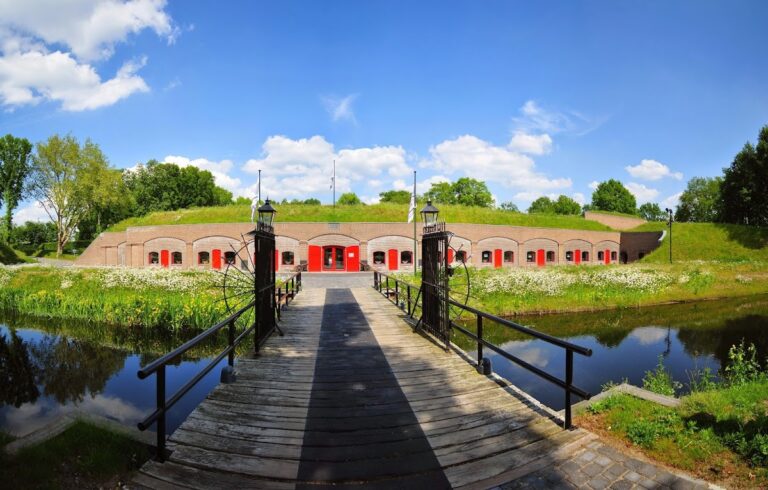
Fort de Bilt is a brick-built defensive complex divided by the road and tramway cut made between 1929 and 1930. Its surviving features include nineteenth-century bombproof structures, later concrete defenses, memorial elements, and associated service buildings distributed between the northern and southern halves.
Fortifications and military buildings
Barracks B2
Barracks B2 is the bombproof barracks added during the 1875–1879 modernization. It was constructed to accommodate 208 men and forms part of the later nineteenth-century military works within the fort.
Ammunition stores and artillery remises
Several bombproof ammunition stores were built during the later nineteenth-century modernization. Two artillery remises, protected structures for storing guns and artillery equipment, were constructed within the fort during the same period.
Machine-gun casemates and associated buildings
Concrete machine-gun casemates were added in the 1930s, after the road and tramway had been routed through the fort. A group shelter identified as P1 and a storage shed identified as M are also associated with the complex.
Memorial features
Fort de Bilt Memorial Monument
The Fort de Bilt Memorial Monument was installed in 1949. It was created by Leo Jungblut and forms part of the site’s postwar commemorative landscape.
Execution-site name stones
Memorial name stones at the former execution site commemorate resistance members executed at Fort de Bilt during the Second World War. The inscriptions state a total of 139 people, although numerous errors in the stones were found during the 2022 investigation by Jim Terlingen.
Wilhelmina tree
The fort includes the Wilhelmina tree planted and formally named by soldiers during the 1939 mobilization. Its name refers to Queen Wilhelmina of the Netherlands.
Nearby sites