Venetian Palace: A Historic Diplomatic Complex in Istanbul

Site at a Glance
- Rating
- 4.1
- Popularity
- Very Low
- Country
- Turkey
- Primary era
- Early Modern
- Eras represented
- Early Modern, Modern
- Civilizations
- Habsburg, Italian, Ottoman, Venetian
- Site type
- Civic
- Remains
- Palace
On this page10 sections
History
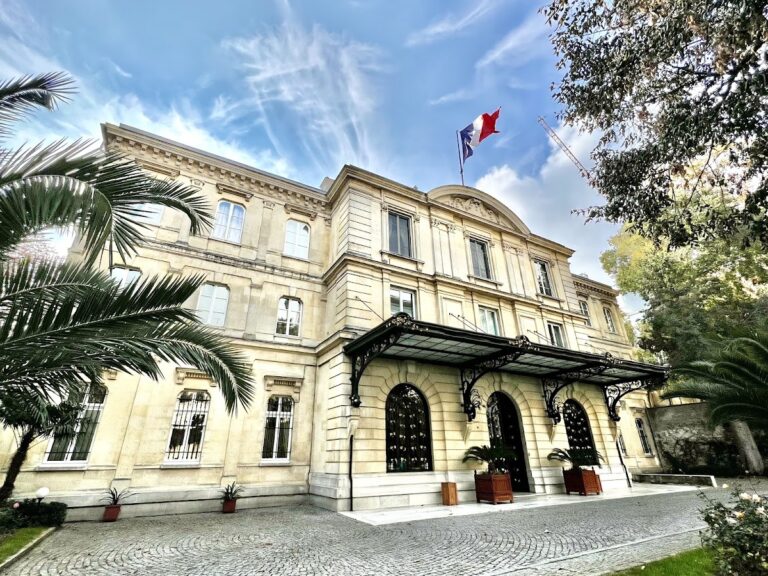
Venetian Palace is a historic diplomatic complex in Istanbul, Turkey, built and repeatedly reshaped by Venetian, Austrian, and Italian authorities in the Pera district. Its present palace took form through an extensive Palladian-classical reconstruction between 1780 and 1782, and the complex now serves as the Istanbul residence of the Italian ambassador to Turkey and houses the Italian Consulate General.
Venice and the Bailò’s residence
Venice maintained close political and commercial relations with the Byzantine Empire from 1082. Emperor Alexios I Komnenos, who ruled from 1081 to 1118, granted Venetian merchants a self-governing quarter in Constantinople, tax exemptions, and other privileges. After the Ottoman conquest of Constantinople in 1453, the Venetian community largely retained local self-government and the right to appoint a Bailò, the senior Venetian diplomatic representative in the city.
From the mid- to late fifteenth century, the Bailò lived in Galata, in a former settlement of merchants from Ancona. The residence later moved northward toward the outskirts of Pera, to an estate rented from the Salvago family and subsequently associated with the Testa and Pisani families. Initially used as a summer residence, the estate became the Bailò’s principal residence from the late sixteenth century.
From the mid-sixteenth century, the residence also contained a school for Oriental languages. It trained dragomans, diplomatic interpreters who were especially important in dealings between European states and the Ottoman government. The school’s educational model influenced similar institutions established by other states.
Eighteenth-century reconstruction
Venice purchased the estate in 1746, partly to prevent its confiscation during wartime. Before that purchase, the Venetian Republic had already paid for maintenance, renovations, alterations, and extensions. Between 1752 and 1754, wooden houses on the property were replaced by masonry buildings, and the gardens were renewed.
Bailò Paolo Renier ordered extensive improvements in 1772. His successor, Andrea Memmo, then called for demolition and reconstruction in the Palladian-classical style, a form of classical architecture based on ordered proportions, columns, pediments, and symmetry. Although Venice initially considered the project too costly, Memmo secured a rebuilding so extensive that the palace was effectively reconstructed by 1782.
Habsburg and Austrian periods
After Napoleon Bonaparte’s Italian campaign and the fall of the Republic of Venice, the palace passed to the Habsburg monarchy under the Treaty of Campo Formio in 1797. France occupied the complex from 1806 to 1815. It then returned to Austria under the Treaty of Vienna and served until 1918 as the diplomatic representation of Austria, and from 1867 of Austria-Hungary, to the Ottoman government.
During the Austrian period, several buildings were added to the compound, while the gardens were enlarged and enclosed by a wall built in 1900. Improvements and alterations were directed by Austrian diplomatic representatives including Heinrich von Calice and János von Pallavicini. In 1882, Calice called for a new embassy building because the embassy’s increasingly unfavorable location and relatively small size made it difficult to compete with the newer diplomatic compounds of other powers.
A cautious partial demolition began in 1914, with usable elements retained where possible. The planned replacement, designed by Ludwig Richter, was delayed by the First World War and became substantially more expensive. Construction, supervised by the contractor Alfred Michelini, remained incomplete when the war ended. During the war, the ambassador lived at the summer residence in Yeniköy on the Bosporus.
Italian diplomatic use
After Austria-Hungary’s defeat and the dissolution of the Habsburg monarchy, Italy claimed the compound as historic Italian property. Carlo Sforza, the Italian high commissioner in Constantinople, had the palace occupied by Italian marines on 1 December 1918. The remaining building work was then completed. On 27 March 1919, the palace became the seat of the Italian high commissioner and, from 1925, the residence of the Italian ambassador to the Republic of Turkey.
The establishment of the Republic of Turkey and the transfer of the capital to Ankara led the Italian diplomatic mission to move. Italy maintained a provisional headquarters in Ankara from 1928 and constructed a new embassy there between 1938 and 1940. Venetian Palace was retained as the Italian ambassador’s second, or official Istanbul, residence. The Italian state has owned the palace since 1919, and the Italian Consulate General in Istanbul occupies another building within the same complex.
Remains
Venetian Palace is a palace complex with gardens and additional buildings on Tomtom Kaptan Sokak in Beyoğlu. Its grounds were divided into public and private sections. Diplomatic receptions and ceremonies took place in the public area, while administrative work was carried out in the private section used by the Bailò and his closest staff. The present arrangement reflects several periods of construction, rebuilding, and expansion.
The palace building
The main palace is a three-storey building in a neoclassical, Palladian-classical form. A projecting terrace rests on columns with capitals and is surmounted by a triangular pediment. The windows follow an ordered arrangement, while interior and exterior decoration contributes to the building’s formal architectural character.
The palace was rebuilt on the foundations of the earlier residence during the 1914 to 1918 campaign, while the general form of the complex was preserved. The foundations were heavily silted because an old drainage channel had been structurally interrupted. Earlier phases remain part of the building’s material history: before the eighteenth-century reconstruction, the estate contained both wooden and masonry structures, and the masonry work of 1752 to 1754 preceded the comprehensive rebuilding of 1780 to 1782.
Nineteenth-century interiors
In 1853, the palace was partly masonry, particularly on the ground floor, and partly wood. Extensive work directed by Gaspare Fossati brought it into an acceptable condition in comparison with the diplomatic residences of other powers. The work followed substantial transformations to a building then regarded as approximately eighty years old.
The restoration involved Gaspare and Giuseppe Fossati, the sculptor Léon Parvillée, the gilder Percheron, the painter Luigi Leoni, and the architect Achille Bottazzi. Their work included stucco and papier-mâché decoration, gilding in the ballroom and imperial salon, a ceiling fresco in the imperial salon, and paintings in the entrance, Blue Room, ambassador’s salon, dining room, and chapel. Other rooms received oil and Genoese white-lead painting, while some surfaces were finished in matt white. Further works were commissioned by Heinrich von Calice in 1887 and János von Pallavicini in 1908.
Gardens and associated buildings
The grounds include enlarged gardens enclosed by the wall built in 1900 and several additional buildings erected during the Austrian period. An adjoining building houses the Italian Consulate General in Istanbul. The Liceo Italiano di Istanbul, the Italian foreign school, directly adjoins the complex to the east.
Material traces of successive occupants
Venetian cultural objects and architectural elements associated with the Austrian period remain connected with the compound. These include an imperial and royal coat of arms, which recalls the building’s use as a diplomatic representation of the Habsburg monarchy and Austria-Hungary before the complex passed into Italian ownership.
Nearby sites