Palais de France: The Historic French Embassy Complex in Istanbul


Site at a Glance
- Rating
- 4.5
- Popularity
- Low
- Country
- Turkey
- Primary era
- Modern
- Eras represented
- Early Modern, Modern
- Civilizations
- French, Ottoman
- Site type
- Civic
- Remains
- Palace
On this page19 sections
History
The Palais de France is a French embassy complex in Istanbul, Türkiye, occupying a property in Beyoğlu, the historic European district formerly known as Pera. France acquired its first embassy plot here in 1589, after the Ottoman authorities granted France the right to maintain a permanent embassy in Pera in 1581. The present palace was built between 1839 and 1847 as a nineteenth-century embassy building, replacing an earlier residence destroyed in the Great Beyoğlu Fire of 1831.
Origins of French diplomacy in Pera
French diplomatic representation in the Ottoman Empire developed within the Franco-Ottoman alliance formed in 1525. The first French ambassador took office in 1535, and the permanent embassy in Pera became the first French embassy established abroad. The property therefore acquired a diplomatic role at a time when European missions were establishing durable institutions in the Ottoman capital.
François Savary de Brèves commissioned an embassy building around 1600. When Henri de Gournay arrived in 1631, he found the residence in poor condition and ordered a grand replacement overlooking Topkapı Palace and the harbor. The embassy complex also included an observatory, a court, and a prison. Its grounds occupied the site where the Ottoman astronomer Taqi al-Din Muhammad ibn Ma’ruf had formerly maintained an observatory.
Fires, rebuilding, and the eighteenth-century press
The palace suffered fires in 1665 and 1767. Reconstruction after the later fire was delayed by the Ottoman-Russian War of 1768–1774. Ambassador Saint-Priest then commissioned a replacement building farther back from the street, completed in the 1770s, with 1777 given as the completion date.
During the late eighteenth century, the embassy operated its own printing press. Following instructions from the Directoire, the French government that ruled from 1795 to 1799, the press began publishing French periodicals in 1795. These included Bulletin de Nouvelles, published from 1795 to 1796, Gazette Française de Constantinople, published from 1796 to 1797, and Mercure Oriental in 1797. They have been described as the first newspapers published in the Ottoman Empire.
War, restoration, and the nineteenth-century palace
The embassy closed after the Ottoman declaration of war on 11 September 1798. The rupture followed the French occupation of the Ionian Islands in 1797 and the invasion of Egypt in 1798. France abandoned the palace, which was used by the British ambassador Lord Elgin from 1799.
Diplomatic relations were restored by the Treaty of Paris in 1802. The French ambassador initially lived in the Palace of Venice because the Palais de France was in poor condition. When that building returned to Austrian control, the French mission resumed use of its older premises. Architect Jean-Nicolas Huyot designed repairs completed by 1818.
The Great Beyoğlu Fire of 1831 completely destroyed the previous palace. France commissioned a new embassy from Pierre-Léonard Laurécisque, a Parisian architect and civil engineer. Construction took place from 1839 to 1847. Its unusually large plan was intended to express the power and splendor of the French state rather than provide only a small diplomatic residence.
The palace was renovated in 1910, when the principal entrance was moved from İstiklal Avenue to Nuri Ziya Sokak to facilitate automobile access. It remained the residence of French ambassadors to the Ottoman Empire until the empire was abolished in 1922 and the French embassy moved to Ankara. The complex subsequently became the residence of the French consul-general and remains the Istanbul residence of the French ambassador when he is in the city.
Religious, educational, and scholarly institutions
Capuchins, a branch of the Franciscan religious order, became active on the grounds in 1626 after taking responsibility for the nearby Church of Saint George. A Catholic seminary associated with the palace chapel opened in 1628 and continued until the French Revolution. It reopened in 1882 as the Saint-Louis Seminary, serving mainly children from French and Levantine families in Istanbul, and closed in 1942.
The church’s religious administration changed over time. French Capuchins cared for it until their order was suppressed in France in 1790. Italian Capuchins served from 1813 to 1881, French Capuchins again from 1881 to 1999, and Franciscans from 2003 onward.
After the seminary closed, its teachers established a secular school in 1942 at the French consulate near Taksim Square. The school expanded into former seminary rooms on the Palais de France grounds in 1944. It was reorganized as the École Française d’Istanbul in 1962 and renamed Lycée Pierre Loti in 1989, honoring Pierre Loti, the pen name of the French naval officer and writer Julien Viaud. The separate Taksim site closed in 1974, while the school expanded into other buildings on the palace property.
A separate building opened in 1874 to train embassy dragomans, officials who served as interpreters and translators for diplomatic missions in the Ottoman Empire. In 1930 it became the French Archaeology Institute of Istanbul, established by the scholar Albert Gabriel. In 1975 the institute became the Institut Français d’Études Anatoliennes, a French research institution devoted to the archaeological, historical, and social-scientific study of Anatolia and the surrounding region.
From 1914 to 1919, while diplomatic relations between France and the Ottoman Empire were suspended, the Church of Saint-Louis-des-Français was temporarily converted into a mosque. It was restored in 1923 and renovated again during the 2010s.
Related French properties in Istanbul
The French consular offices have been located separately since the 1930s, in a former French hospital near Taksim Square rather than on the Palais de France grounds. The hospital was established in the early eighteenth century and was known as Hôpital Saint-Louis from 1734. Its later building was designed by Pierre-Juste Bourmancé and constructed from 1893 to 1896. It was later renamed for the donor Henri Giffard.
France also maintains a separate waterfront property at Tarabya on the Bosporus. Its late-eighteenth-century mansion was built for Prince Constantine Ypsilantis to a design by Antoine Ignace Melling. After Ypsilantis fled to the Russian Empire in 1807, Sultan Selim III donated the property to Ambassador Horace Sébastiani in recognition of his support during the Dardanelles operation. The mansion became a summer residence for later French ambassadors but was destroyed by fire in 1903 or 1913. A smaller building survived a separate fire in 1932, and part of the property received a new Lycée Pierre Loti campus in 2003.
Remains
The Palais de France is organized around the nineteenth-century embassy, its garden, the Church of Saint-Louis-des-Français, and associated educational and research buildings. The main palace occupies the long-established French property in the Tomtom area of Beyoğlu. Its large plan reflects the building’s intended role as a state embassy, while later buildings extend the institutional complex west and south of the main palace.
Embassy and garden
Main palace
The present main building was constructed from 1839 to 1847 after the earlier palace was destroyed in the 1831 Great Beyoğlu Fire. Pierre-Léonard Laurécisque designed it as a large-scale embassy rather than a compact diplomatic residence. The building was renovated in 1910, when its main entrance was transferred from İstiklal Avenue to Nuri Ziya Sokak to accommodate automobiles.
Garden features
The palace garden contains two Ottoman-style fountains designed by Alexandre Vallaury and several eighteenth-century statues. A stone bust in the garden is said to represent Claude Alexandre, Count of Bonneval.
Church and former seminary
Church of Saint-Louis-des-Français
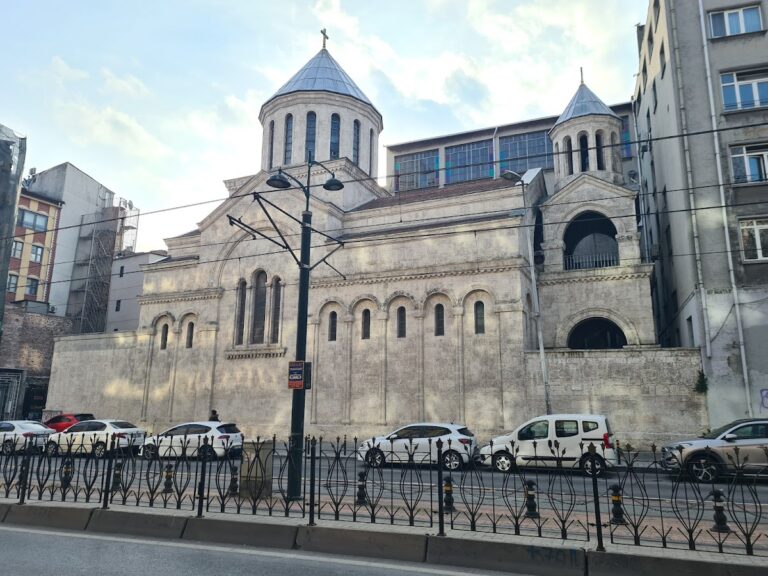
The palace grounds include the Church of Saint-Louis-des-Français, dedicated to Saint Louis, or Louis IX, the thirteenth-century king of France who was canonized as a saint. After a fire in 1660, the Ottoman authorities authorized a new church, consecrated on 25 August 1673. It became a parish church in the early eighteenth century, was rebuilt in wood around 1750, and was rebuilt in stone in 1788.
The church was reconstructed after the 1831 fire at the same time as the palace. It reopened in 1846, followed by a blessing ceremony on 1 May 1847. Its later history includes temporary conversion into a mosque from 1914 to 1919, restoration in 1923, and further renovation during the 2010s.
Former seminary rooms
The grounds retain the former seminary rooms associated with the Saint-Louis Seminary. After the seminary closed in 1942, these spaces became part of the school that developed into the Lycée Pierre Loti. The school is also colloquially called “Le Papillon,” meaning “the butterfly,” and its buildings have expanded west and south of the main palace.
Research and educational buildings
Former dragoman-training building
The building opened in 1874 for the training of embassy dragomans later became the French Archaeology Institute of Istanbul in 1930. Since 1975 it has been associated with the Institut Français d’Études Anatoliennes, whose work focuses on Anatolia and the surrounding region.
Lycée Pierre Loti
The Lycée Pierre Loti occupies former seminary rooms and other buildings on the palace property. Its institutional sequence runs from the secular school founded by seminary teachers in 1942, through its expansion onto the grounds in 1944 and reorganization as the École Française d’Istanbul in 1962, to its renaming in 1989.
Separate French properties
Former French hospital near Taksim
The French consulate building near Taksim Square stands on the site of the former Hôpital Saint-Louis, later renamed for Henri Giffard. The later hospital building was designed by Pierre-Juste Bourmancé and constructed from 1893 to 1896. It is a separate property from the Palais de France.
Tarabya waterfront property
The separate French property at Tarabya retains a smaller building associated with the former ambassadorial summer residence. The original mansion, designed by Antoine Ignace Melling for Prince Constantine Ypsilantis, was destroyed by fire in 1903 or 1913. The smaller surviving building endured a separate fire in 1932, while part of the grounds later became a Lycée Pierre Loti campus in 2003.