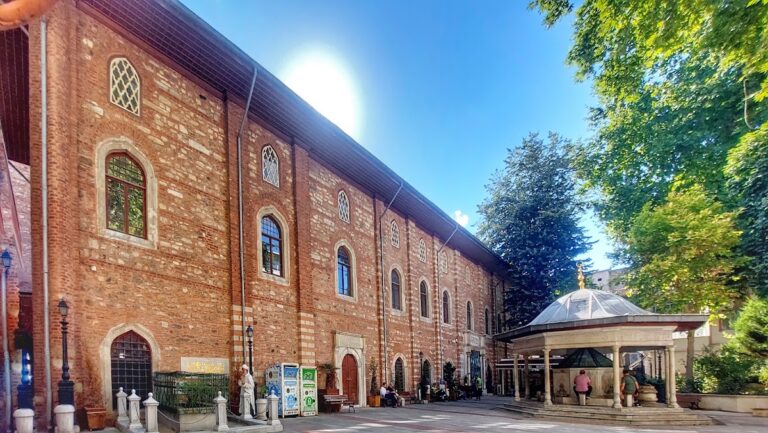
Church of Saint Benoit, Istanbul: A Historic Roman Catholic Church


Site at a Glance
- Rating
- 4.5
- Popularity
- Low
- Country
- Turkey
- Primary era
- Early Modern
- Eras represented
- Medieval, Early Modern, Modern
- Civilizations
- Byzantine, Genoese, Ottoman
- Site type
- Religious
- Remains
- Church
On this page10 sections
History
The Church of Saint Benoit is a Roman Catholic church in Istanbul, Türkiye, founded by Benedictine monks in 1427 within the Genoese settlement of Galata. It is regarded as the oldest Catholic church in the city still in use and remains an active station church and embassy chapel affiliated with the Saint Mary Draperis–Beyoğlu parish under the Apostolic Vicariate of Istanbul.
Foundation in Genoese Galata
On 12 May 1427, the Benedictine friar Dom Nicolas Meynet and monks from Genoa established a monastery on the southeastern slope of Galata Hill. The site lay inside the latest Genoese fortifications of the Peyre Galata citadel. Genoa, a maritime republic, maintained a settlement at Galata, and the new church served this western Christian community.
The church was dedicated jointly to Saint Benedict and the Virgin Mary under the title Sancta Maria de Misericordia, meaning Saint Mary of Mercy. It was also known in Italian as Santa Maria della Cisterna, or Saint Mary of the Cistern. The building stood on the remains of an ancient Byzantine church, near a large Byzantine cistern. On 13 May 1449, the monks joined the congregation of Saint Justina of Padua. By 1450, the small monastery housed 16 monks.
Shortly before the Ottoman conquest of Constantinople in 1453, the monks moved the church’s relics and religious ornaments to Chios and then Genoa to protect them from the expected attack. After 1478, disputes among the monks repeatedly caused the community to close. Sultan Suleyman the Magnificent later threatened to convert the complex into a mosque for Muslims expelled from Spain and resettled in Galata. The intervention of King François I of France secured the monks’ position, and the complex became the royal chapel of the French ambassador to the Ottoman Porte, the Ottoman imperial government and court.
Jesuit administration and seventeenth-century rebuilding
In 1540, the French traveler Pierre Gilles described a giant cistern at the site with 300 columns. The Genoese later dismantled and sold those columns. On 18 November 1583, Jesuits led by Giulio Mancinelli took charge of the church. Pope Gregory XIII had sent them at the request of the Genoese administration of Galata, and they founded a school within the monastery precinct.
Fire repeatedly altered the complex. A blaze in 1610 led to restoration supported by Venetian and French endowments. The church was the sole church spared by the great fire of Galata in 1660, although the monastery was damaged and looted. During the seventeenth century, plague and disputes among the monks repeatedly interrupted monastic life. In 1686, a fire caused by negligence damaged the church. The monks and the French ambassador restored it, while the Mufti of Istanbul donated pillars that still stood at the top of the staircase and approved rebuilding with a lead roof and vaulted coverings, forms normally permitted only for mosques. Another fire in 1696 was followed by restoration in 1697 through the Association of the Merchants of Marseille.
A diplomatic, religious, and charitable centre
By this period, Saint Benoit had become Galata’s most prestigious church. It served as a burial place for the district’s upper classes, several aristocrats, and French ambassadors. It was also used as Istanbul’s national church for Germans, and a hospital was added to the complex.
A further fire damaged the church in 1731, and the French ambassador restored it the following year. On 6 July 1735, the Hungarian exile Francis II Rákóczi was buried there beside his mother, Zrínyi Ilona. Hungarians visited their graves until the remains were transferred to Hungary in 1906.
The suppression of the Society of Jesus in 1773 brought another change in administration. French Lazarist friars, members of the Congregation of the Mission founded by Vincent de Paul, took over the complex in 1783. Toward the end of the eighteenth century, they built a chapel dedicated to Saint Anne, traditionally regarded as the mother of the Virgin Mary.
The Saint-Benoît school and later restoration
After difficulties during the French Revolution, the friars restored the church in 1804. They converted the existing school into the Lycée Saint-Benoît d’Istanbul, which continued as a prominent private school. In 1839, the Daughters of Charity arrived from France and established the girls’ section of the school. The school moved to Bebek in 1840, but returned after part of Galata’s Genoese fortifications was demolished.
In 1865, fire damaged part of the left aisle and the atrium, including several inscriptions. The affected area was roughly restored in 1871. Four years earlier, in 1867, the complex had been enlarged with the Maison de la Providence, which included an orphanage, hospital, and seminary. These successive religious, educational, and charitable uses shaped Saint Benoit as both a church and an institutional complex.
The church continues to function as a Catholic place of worship and diplomatic chapel. Its long history connects Byzantine remains, Genoese Galata, Ottoman Istanbul, French diplomatic life, and the successive Benedictine, Jesuit, and Lazarist communities that administered the site.
Remains
Terrace, entrance, and reused Byzantine elements
The church stands on Kemeraltı Caddesi in Karaköy, the ancient Galata, near the border with Tophane. The complex occupies a terrace at the top of an uphill staircase, with its entrance opening onto the street. The terrace may incorporate part of the nearby Byzantine cistern. During the Ottoman period, the area became a fruit garden known as Çukurbostan, or “Hollow Garden.”
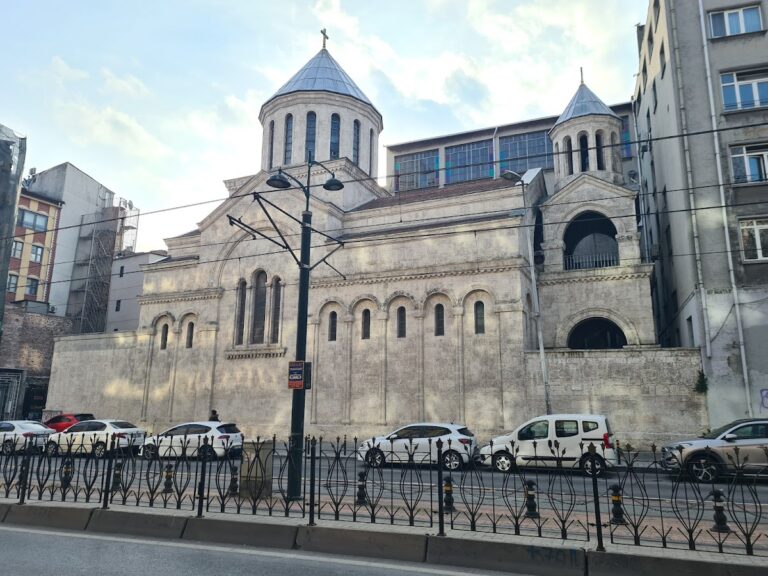
The rectangular building is oriented from southwest to northeast. A western entrance leads into an atrium whose columns and capitals are almost entirely Byzantine spolia, architectural pieces reused from earlier buildings. The walls are built in alternating courses of stone and brick. Inside, three aisles are covered by groin vaults, formed where two barrel vaults intersect. The main and southern aisles belong to the 1752 restoration, while the northern aisle was erected during the 1871 reconstruction.
Church structure
The original church was a small three-aisled building with a single dome, an atrium, and a gallery. Two domes over the side aisles were added later. The first two aisles end to the east in small domed chambers. The southernmost chamber may preserve part of an ancient Byzantine church, linking the present structure to the earlier building on the site.
The interior was decorated with mosaics representing the life and Passion of Christ, which were highly admired. The church’s surviving form therefore combines the early three-aisled plan with later domed additions and rebuilding carried out after repeated fires.
Portal and bell tower
The portal opening onto Kemeraltı Caddesi dates from the fifteenth century. Beside it stands a square-plan bell tower with crenellated moulding, also dating from that period. The tower was originally built as a watchtower, reflecting the church’s position within the fortified Genoese settlement.
Gravestones and commemorative remains
Inscribed gravestones from the seventeenth and eighteenth centuries remain inside the church. They commemorate wealthy Levantine families, church benefactors, and French ambassadors. Levantines were members of long-established European-descended communities in the eastern Mediterranean, including Istanbul.
The church also preserves the memory of Jelena Zrinska, a Croatian noblewoman, and her son Francis II Rákóczi, a Hungarian aristocrat who died in exile in the Ottoman Empire. Their remains were later transferred to Hungary, while the inscriptions and burial associations continue to form part of the church’s historical interior.
Nearby sites