Västerås Castle: A Medieval Royal Fortress and Administrative Residence in Sweden


Site at a Glance
- Rating
- 3.8
- Popularity
- Low
- Country
- Sweden
- Primary era
- Early Modern
- External website
- Open
- Eras represented
- Medieval, Early Modern
- Civilizations
- Swedish
- Site type
- Military
- Remains
- Castle
On this page11 sections
History
Västerås Castle is a medieval royal fortress and administrative residence in Västerås, Sweden, built beside the mouth of the Svartån River where it enters Lake Mälaren. Originally established in the twelfth century, it served the Swedish crown as both a defensive stronghold and the residence of a royal bailiff. The growth of Västerås into a city by the late eleventh century, a bishopric in the twelfth century, and a port for goods from Bergslagen helped create the need for such a fortified centre.
Medieval Stronghold
The castle was enlarged and strengthened in stages as political and military conflicts affected Sweden. During the struggles surrounding the Kalmar Union, the late-medieval union that placed Denmark, Norway, and Sweden under one monarch, Västerås Castle became an important strategic site. It was the first major fortress captured by the forces of Engelbrekt Engelbrektsson, a Swedish political and military leader whose rebellion in the 1430s challenged Danish rule and the union monarchy.
Archbishop Jöns Bengtsson captured the castle in the mid-fifteenth century. Christian I attempted to retake it in 1464 but failed. These conflicts reflected the castle’s continuing role in contests over royal authority and control of central Sweden.
Gustav Vasa and the Assemblies of Västerås
Gustav I Vasa captured Västerås Castle in 1522, after Danish forces had held it for a year. He made the castle a royal residence and convened two national assemblies there. The 1527 Assembly of Västerås began Sweden’s move toward Protestantism and the severing of its ties with the Roman Catholic Church. The assembly held in 1544 established hereditary succession to the Swedish crown in place of an elective monarchy.
Major rebuilding preceded the 1544 assembly and took place from 1540 to 1544. In the late 1570s, King Johan III continued the transformation of the complex by adding a large royal hall and a castle church. The works also raised ceiling heights and enlarged windows, giving the royal parts of the castle a more spacious character.
Royal Prison and Later Decline
The deposed King Erik XIV, who had lost the Swedish throne in 1568, was brought to Västerås Castle in 1573 and imprisoned there for one year. The castle remained connected with the monarchy until the death of Katharina of Pfalz-Kleeburg, the mother of King Karl X Gustav, in 1638. Afterward, it ceased to function as a royal residence and gradually fell into disrepair.
Renovation began in the latter part of the seventeenth century under the architect Mathias Spieler. During the wars of Karl XII, the Swedish king whose wartime government used the castle to hold prisoners of war, the complex served as a prison for captured soldiers. The last prisoner left in 1857. One notable inmate was Carl-Fredrik Lilja, who had stolen money from a county office and escaped from the prison.
Fire, Reconstruction, and Conservation
A major fire in 1736 destroyed the interior furnishings associated with the Vasa period and spread to several nearby wooden buildings. Reconstruction and enlargement began in the mid-1740s under the architect Carl Hårleman and continued through the 1750s. Further interior alterations took place during the nineteenth century.
Restoration in the 1920s was led by Erik Hahr, Västerås city architect, with particular attention to the negotiation hall, adjoining rooms, and the royal residence floor. A collection of prehistoric objects had been maintained in the castle since 1889. After the County Administrative Board moved to a newly built country house in 1961, the castle underwent another renovation in 1965–1966 under the direction of Nils Tesch.
The Västmanland County Museum, a regional museum devoted to the history and culture of Västmanland, occupied the castle after the 1965–1966 renovation and moved to new premises in 2010. A smaller part of the building was then adapted as the county governor’s residence, while another part came into use by Mälardalen University. Västerås Castle has been protected as a historic building since 1935.
Remains
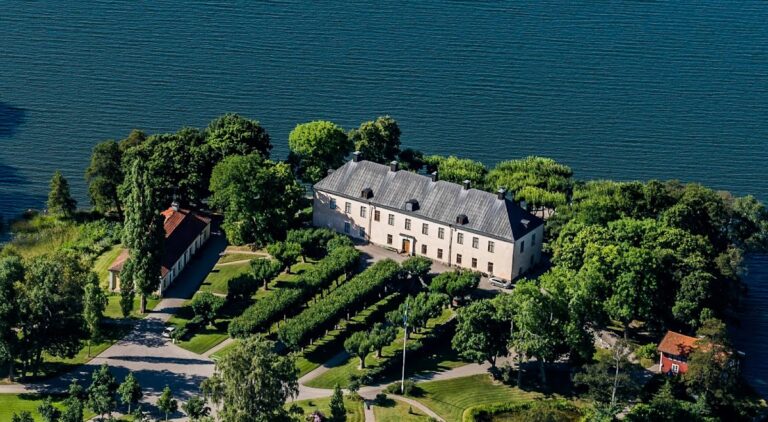
Västerås Castle consists of a surviving medieval keep incorporated into an enlarged castle complex with wings, a courtyard, a principal entrance, and interior stairways. The complex grew through successive rebuilding campaigns, while later repairs followed the destructive fire of 1736. Its characteristic red exterior colour was added during the twentieth century.
Medieval Keep
The four-storey medieval keep stands at the outlet of the Svartån and survives at the northeastern corner of the present castle. Its upper storey was arranged as a position for defensive marksmen, linking the tower directly to the castle’s original military purpose. The keep forms the oldest surviving part of the complex and remains physically integrated with the later buildings.
Sixteenth-Century Royal Complex
Eastern Wing and Main Entrance
The rebuilding of 1540–1544 created a new royal residence floor above the eastern wing and established the present main entrance. This work formed part of the transformation carried out before the 1544 national assembly and gave the castle a more developed royal and administrative arrangement.
Royal Hall and Castle Church
Works under Johan III in the late 1570s added a large royal hall and a castle church. A royal hall was a ceremonial and administrative room for courtly business and political proceedings. The same building phase increased ceiling heights and enlarged windows. The western wing was later extended as the complex continued to grow.
Courtyard and Present Interior
The castle includes a courtyard, a principal entrance, and interior stairways within the enlarged arrangement of medieval and later wings. A smaller section is fitted out as the county governor’s residence. Another section is used by Mälardalen University and includes a hall for chamber-music performances, giving parts of the historic complex a continuing institutional use.