Ängsö Castle: A Medieval Fortified Castle and Museum in Sweden



Site at a Glance
- Rating
- 4.1
- Popularity
- Low
- Country
- Sweden
- Primary era
- Medieval
- External website
- Open
- Eras represented
- Medieval, Early Modern
- Civilizations
- Swedish
- Site type
- Military
- Remains
- Castle
On this page13 sections
History
Ängsö Castle is a historic castle in Sweden, on an island in Lake Mälaren in Västerås Municipality. Its present fortified building was constructed in the 1480s, with medieval lower sections, and it later became an eighteenth-century residence before being converted into a museum.
Medieval estate and fortified castle
The estate was first named “Engsev” in a royal charter issued by King Knut Eriksson between 1167 and 1196. Knut stated that he had inherited Ängsö from his father, Erik Jedvardsson, also known as Eric the Saint. Before 1272, the estate belonged to Riseberga Abbey. It then passed to Gregers Birgersson, an illegitimate son of Birger, the Swedish ruler associated with the foundation of Stockholm.
The present castle was built in the 1480s by Bengt Fadersson Sparre, a royal councillor, a senior member of the royal council. His son, Knut Bengtsson Sparre, also held that office. In 1521, Knut defended Västerås against the forces of Gustav Vasa, the Swedish monarch later known as King Gustav I, and was shot there.
After a prolonged siege, Ängsö Castle fell to Gustav Vasa in 1522. Knut Bengtsson had supported Christian II, king of Denmark, and this allegiance contributed to the castle’s capture. Gustav Vasa returned the estate in 1538 to Knut’s daughter, Hillevi Knutsdotter, who was married to Arvid Trolle.
Changing ownership
Through Hillevi’s daughter Elsa Trolle, Ängsö passed in 1593 to Arvid Posse, a court official under King Johan III. Posse gave the estate to his wife, Brita Bååt, as a morning gift. The ownership records from 1475 to 1710 include members of the Sparre, Trolle, Posse, and Piper families. Among them were Per Sparre, a marshal of the estates and royal councillor; Erik Sparre, a chamberlain; and Arvid Posse, who served at court.
In 1710, Ängsö passed to Carl Piper, a royal adviser, and subsequently to his wife, Christina Piper. The estate remained a Piper family fideicommiss, an inheritance arrangement intended to keep an estate together within a family, from 1710 until 1971. Later holders included Carl Fredrik Piper, Adolf Ludvig Piper, Axel Adolf Piper, Axel Mauritz Piper, Axel Piper, Ludvig Magnus Alexander Piper, Erik Adolf Alfred Piper, Eric Carl Piper, and Eric Carl William Piper.
Eighteenth-century remodelling and museum use
The castle was remodelled and extended during the 1630s. In 1740 and 1741, the uppermost storey and mansard roof were added to designs by Carl Hårleman, an eighteenth-century Swedish architect. The same rebuilding created two garden wings and a new two-storey building, giving the complex its present external form. Several interior fittings from this remodelling survive.
The last fideicommissary, Eric Piper, died in 1968. The Piper family continued to lease and occupy the estate in 2018, although the castle itself had not been inhabited since 1959. That year the building was converted into a museum. It became a protected historic building in 1965. Ownership passed from the Piper fideicommiss to the Foundation for Nature Conservation and Outdoor Life in Västmanland County in 1971, and to Westmannastiftelsen in 2010.
Legends associated with the castle
Several ghost legends are linked with Ängsö. One concerns Anders Luxemburg, the hunchbacked court jester of King Charles XII. According to the story, he entered Ängsö service after the king’s funeral procession stopped nearby. After Anders died at Ängsö in 1744, he was said to haunt the estate in a grey cloak.
Another tradition identifies a female apparition with Brita Bååt. She is said to pass from the King’s Room into the great ballroom at eight o’clock in the evening. The story tells that she encountered skeletons conducting a mass in Ängsö Church, was attacked by two apparitions, and died three days later after fainting from shock. Later research indicates that Brita Bååt was married only once, while parts of the story may derive from Elsa Trolle, who was married three times and outlived all three husbands.
The tradition also associates a sword and a piece of cloth with the apparition story. They hang in the church, while the stone said to have been thrown at Brita Bååt is built into the churchyard wall and is called the Blood Stone. Other stories concern the ghost dog Cottilion, associated with Sophie Piper, and Johan Sigismund Sparre, who was said to have played dice with a dark apparition. The apparition gave Sparre a gold chain and warned that it must not leave the castle or the building would burn. The chain is kept in a display case in the castle stairwell.
Remains
Castle and grounds
Castle building
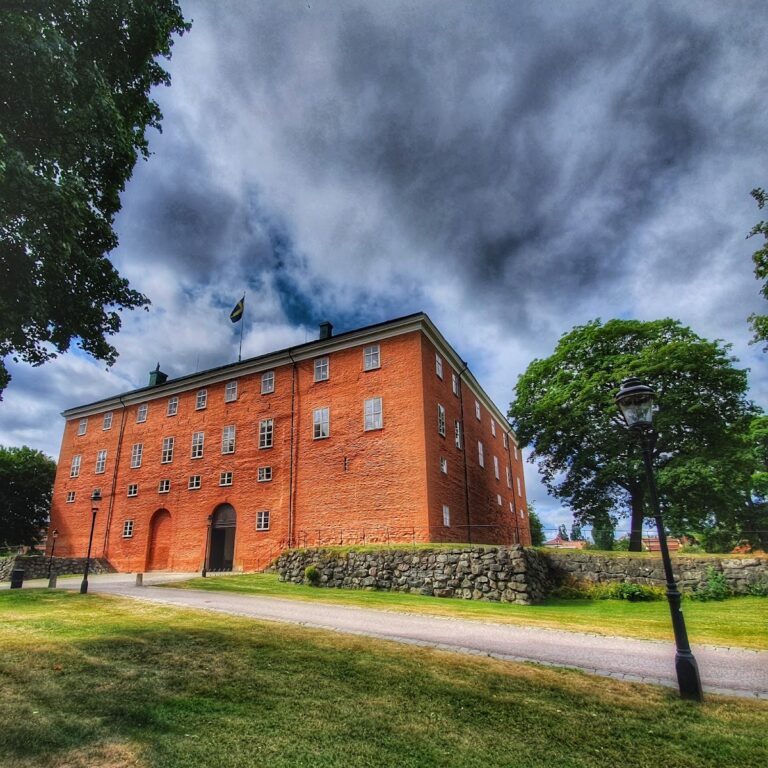
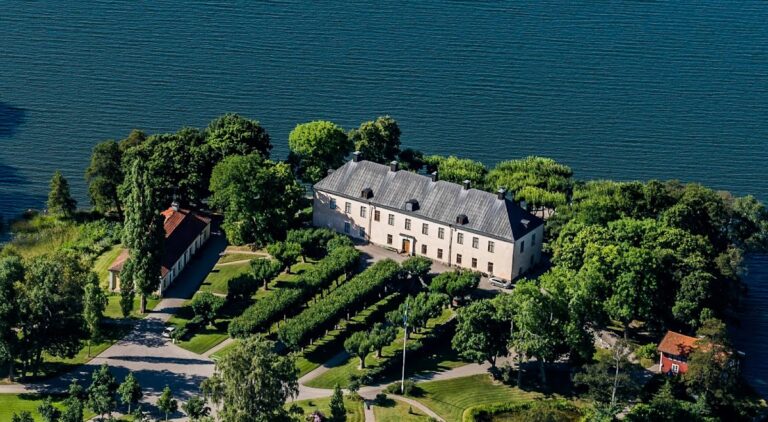
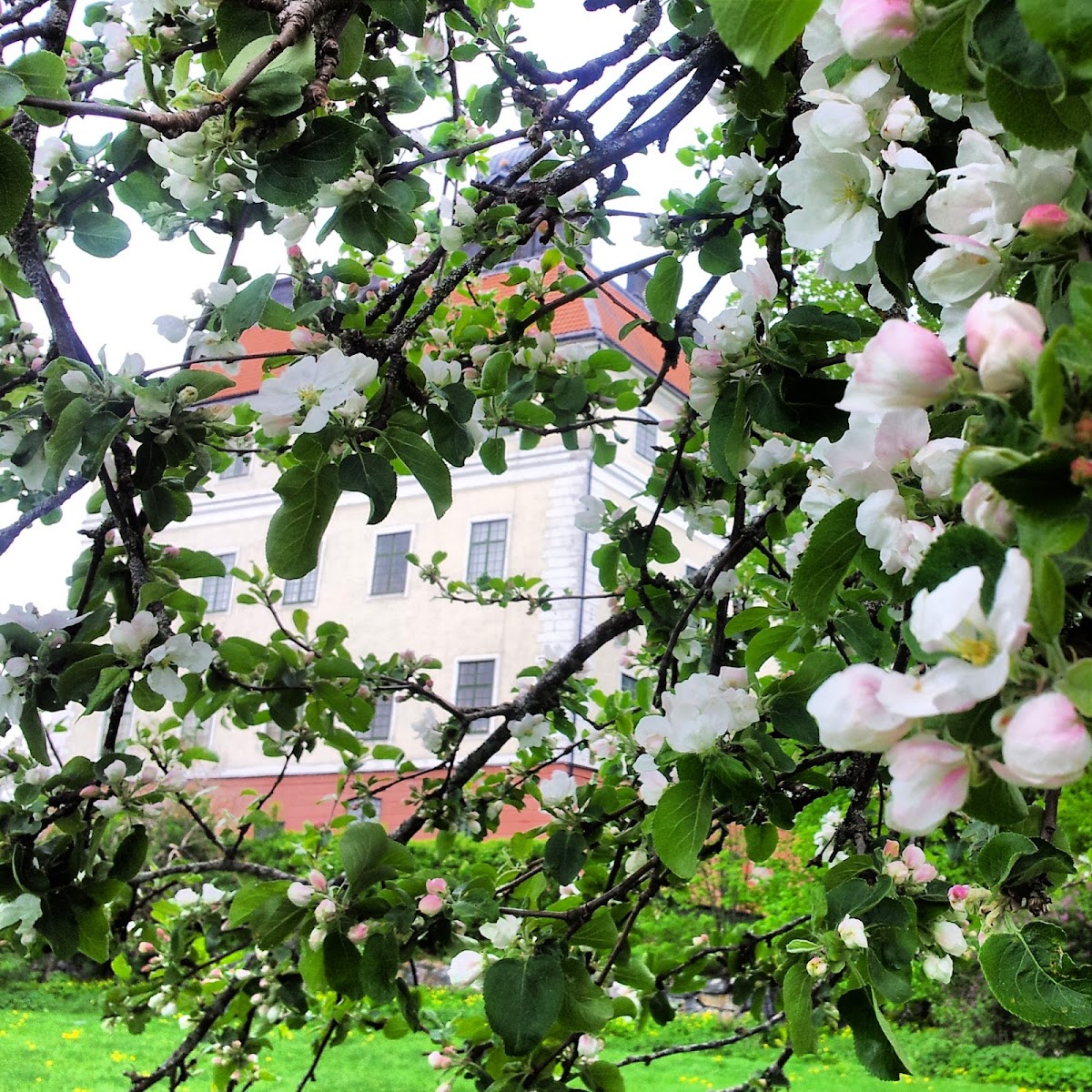
Ängsö Castle is an almost cubic, four-storey structure built of stone and brick. Its lower sections are medieval, while the building’s upper form reflects the remodelling of 1740 and 1741. The added mansard roof has two slopes on each side, with the lower slope steeper than the upper one, and is crowned by a lantern, a raised windowed structure above the roof. The castle is now used as a museum rather than as a residence.
Garden wings and park
The eighteenth-century reconstruction produced two garden wings and a new two-storey building. A large park surrounds the castle, and the complex contains a substantial collection of portraits of Swedish nobility. Several interior room fittings from the eighteenth-century remodelling have also been preserved.
Churchyard and associated objects
Blood Stone and church objects
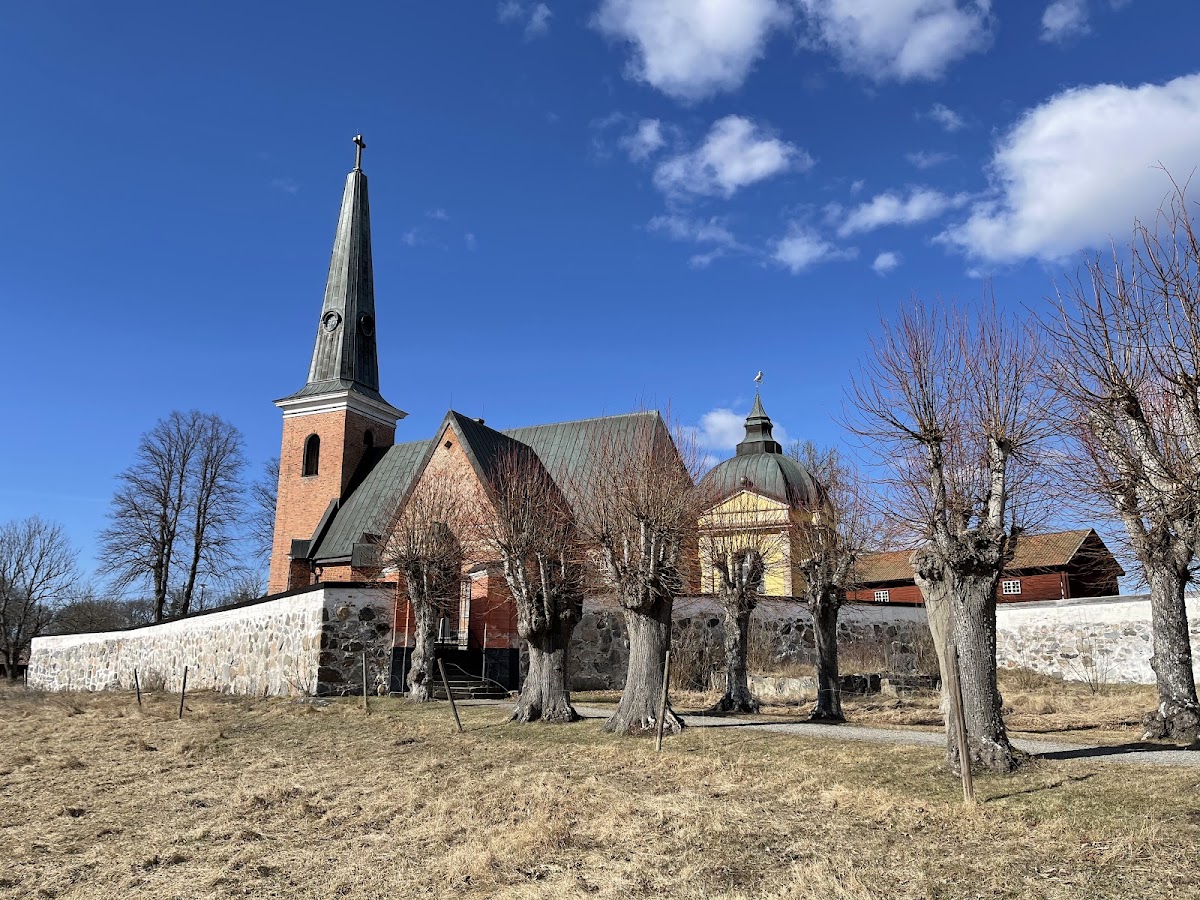
The castle churchyard contains the stone called the Blood Stone, which is built into the churchyard wall. The church holds a sword with an attached piece of cloth associated with the Brita Bååt legend. These objects form part of the material setting of the tradition linking the castle and churchyard.
Cottilion’s gravestone
A gravestone commemorates the dog Cottilion. Its French inscription states that the dog died “at its mistress’s feet.” The legend identifies Cottilion as the dog of Sophie Piper, widow of Adolf Ludvig Piper, and associates its ghost with a scratching sound in the floor of the great dining room.
Gold chain
A gold chain associated with the story of Johan Sigismund Sparre is displayed in a case in the castle stairwell. The legend connects the chain with a warning that it must remain inside Ängsö Castle.