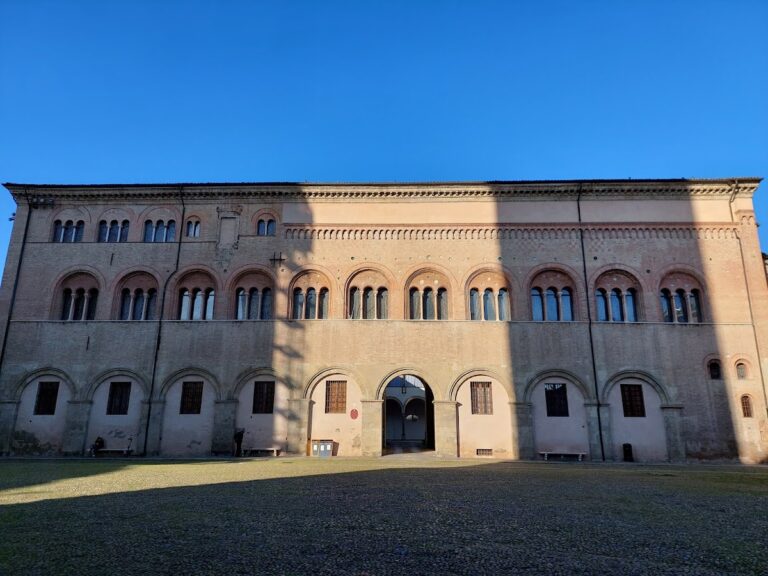
Palazzo Marchi: A Neoclassical Palace in Parma


Site at a Glance
- Rating
- 4.8
- Popularity
- Low
- Country
- Italy
- Primary era
- Early Modern
- External website
- Open
- Eras represented
- Early Modern
- Civilizations
- Duchy of Parma and Piacenza
- Site type
- Domestic
- Remains
- Elite Residence
On this page12 sections
History
Palazzo Marchi is a Neoclassical palace in Parma, Italy, constructed between 1770 and 1774 for the marquis Scipione Grillo, Duke of Anguillara. Neoclassicism was an eighteenth- and early nineteenth-century movement that revived the formal language of ancient Greece and Rome through symmetry, classical columns, pediments, and carefully ordered geometry. The palace was designed by Giovanni Furlani, an architect and abbot.
From ducal administration to the Marchi family
Around 1780, Count Francesco Galantino acquired the palace. Galantino administered the ducal finances, but in 1782 he was accused of administrative irregularities. The building changed ownership again in 1859, when it was sold to the Marchi family.
A few years after acquiring Palazzo Marchi, the family obtained the Fontana di Proserpina. Giuliano Mozzani had made the fountain in the 1720s for the garden of the Reggia di Colorno, a former ducal and royal palace near Parma. The Marchi family installed it in the garden behind their palace, where it remained until its dismantling and sale in 1890.
War, restoration, and cultural use
During the Second World War, Palazzo Marchi housed the provincial military command of the Republican Army, the armed force of the Italian Social Republic, a German-backed state in northern Italy. In the first days of July 1944, partisans raided the building and seized a substantial quantity of weapons and ammunition.
In the following decades, the Marchi family restored the entire palace. Part of the building acquired public cultural uses. It housed the Institute of Verdi Studies for several years and then served as the representative headquarters of the Fondazione Arturo Toscanini from 2003 to 2009. The two institutions are associated respectively with the study of Giuseppe Verdi’s music and the performance of music connected with Arturo Toscanini.
Museum and exhibition history
A museum route opened in the palace in November 2021 and was rehung in October 2023. Its permanent display was expanded to include Parmigianino’s San Rocco, a sixteenth-century painting by the Mannerist artist Girolamo Francesco Maria Mazzola. Palazzo Marchi has also hosted temporary exhibitions, including Persona by the multimedia artist Yuval Avital in September and October 2022.
Remains
Palazzo Marchi occupies the entire northern part of the block between Strada della Repubblica, Via Fra’ Salimbene, and Borgo Lalatta. Its plan combines a formal street facade with an interior organized around courtyards, porticoes, reception rooms, and a decorated piano nobile, the principal residential or reception floor of a historic palace.
Exterior and courtyards
Principal facade
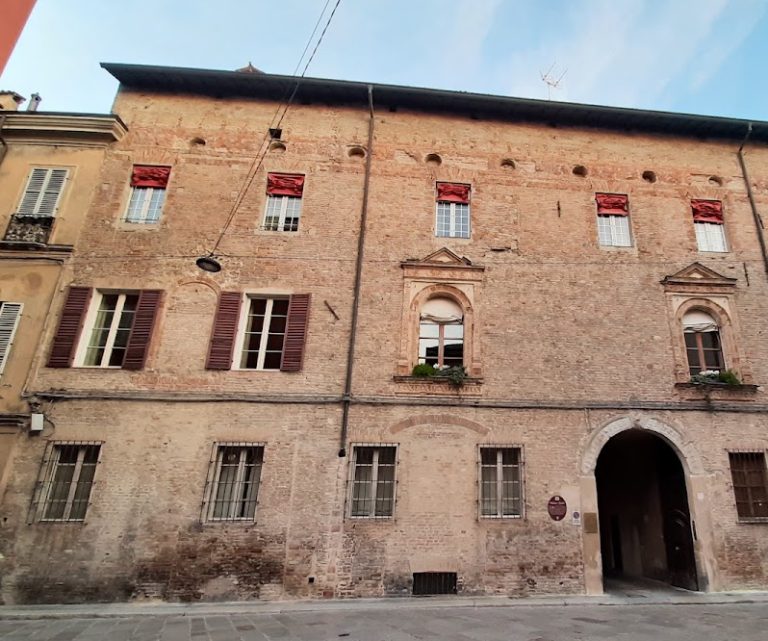
The symmetrical principal facade is entirely covered in faux rustication, an imitation of the rough projecting masonry blocks used to give monumental buildings a robust appearance. Tall rendered stringcourses decorated with panels divide it horizontally. At the center, two marble Doric columns flank the entrance portal and support a balcony with a balustrade. Three large windows open on each side of the entrance, with moulded frames and alternating triangular and curved pediments. The piano nobile has a central French window and six imposing windows framed by fluted pilasters, again with alternating triangular and curved pediments. Seven square windows occupy the upper level, and a dentilled cornice, decorated with small tooth-like blocks, crowns the facade.
Courtyards and staircase
Inside, an elegant square courtyard is enclosed by a four-sided portico. Its round arches rest on tall Doric columns, while four square piers replace the columns at the corners. The portico opposite the entrance leads to a second courtyard that is open on one side. On the right side of the main courtyard, a monumental forked staircase of marble and stone is decorated with numerous terracotta sculptures by the Neoclassical sculptor Giuseppe Carra.
Decorated interiors and collections
Piano nobile rooms
The rooms on the piano nobile retain stucco decoration by Giocondo Albertolli, an architect and ornamental designer known for his stucco work. They also contain eighteenth-century furnishings and paintings, including Parmigianino’s San Rocco. Several of these rooms form the museum route, where works collected by the Marchi family are displayed alongside the palace interiors. The collection includes furnishings, sculptures, silverware, ceramics, prints, and paintings.
Festival Hall
The large Festival Hall is the most lavishly decorated interior described at Palazzo Marchi. Its walls and pavilion vault are covered with richly worked stucco, creating an especially elaborate setting within the piano nobile.
Fontana di Proserpina
The Fontana di Proserpina once stood in the palace’s rear garden after being moved from the garden of the Reggia di Colorno. It was dismantled and sold to a Venetian antiques dealer in 1890, who later sold it abroad. Because the fountain arrived in pieces without drawings showing its original arrangement, its components were divided into two groups and reassembled as two separate fountains. They were placed in front of and behind Waddesdon Manor, a nineteenth-century English country estate and house in Buckinghamshire.