Västerås Cathedral: A Medieval Lutheran Cathedral in Sweden


Site at a Glance
- Rating
- 4.6
- Popularity
- Medium
- Country
- Sweden
- Primary era
- Medieval
- External website
- Open
- Eras represented
- Medieval, Early Modern, Modern
- Civilizations
- Swedish
- Site type
- Religious
- Remains
- Cathedral
On this page22 sections
History
Västerås Cathedral is a medieval cathedral in Västerås, Sweden, built in the Scandinavian Brick Gothic tradition and serving as the principal church of the Diocese of Västerås. It is also the parish church of Västerås Cathedral Parish within the Lutheran Church of Sweden. The church grew from a small stone building into a large cathedral whose surviving fabric reflects roughly seven centuries of architectural change.
From stone church to brick cathedral
The earliest church on the site was probably built in the mid-twelfth century or slightly earlier. It was a small stone church. During the thirteenth century, a much larger brick church was erected over the walls of this earlier building, following the introduction of brick masonry techniques into Sweden. The new church was consecrated on 16 August 1271 to the Virgin Mary and John the Baptist.
The original thirteenth-century building was a Romanesque basilica, with a nave and two side aisles. Its later development transformed it into a five-aisled hall church. In the fourteenth century, the chancel was lengthened and an ambulatory, a passage around the rear or sides of the chancel, was created. Chapels were added around the church and later incorporated into its interior.
Medieval expansion
Further work in the fifteenth century extended the cathedral eastward. A substantial west tower was added, together with two additional chapels on the north and south sides. A chapel built at the southwestern corner in 1517 established the building’s present extent. These successive additions changed the church from its smaller basilican form into the spacious medieval cathedral that survives today.
Reformation and later changes
Västerås Cathedral retains its medieval dedication to the Virgin Mary and John the Baptist. It is sometimes called Vårfrukatedralen, meaning the Marian Cathedral, and the dedication is also rendered as Saint Mary and Saint John. Although the church was formerly Roman Catholic, it is now Lutheran and belongs to the Church of Sweden.
The sixteenth, seventeenth, and eighteenth centuries brought numerous changes to the interior, including new furnishings, tombs, heraldic panels, and other additions. The outer copper roof was laid during the seventeenth century. The tower had first carried a medieval spire and later a Renaissance cupola. After the cupola was destroyed by fire, a Baroque spire was built in 1693 to designs by Nicodemus Tessin the Younger, a leading Swedish architect of the period. A crown above the tower indicates the presence of a royal tomb in the cathedral.
The cathedral is associated with several important figures in Swedish history. King Eric XIV, who ruled from 1560 to 1568, was buried here after being poisoned in 1577 by his brother and successor, King John III. In 1797, King Gustav III ordered that Eric’s remains be placed in a dignified sarcophagus. Other burials include Bishops Peder Swart and Johannes Rudbeckius, Regent Svante Nilsson Sture, and Archbishop Samuel Troilius. The cathedral also hosted the marriage of John III and Gunilla Bielke; a bishop’s staff made for the occasion dates from 1585.
Education, restoration, and present church status
In 1623, Bishop Johannes Rudbeckius founded Sweden’s first gymnasium in a building a few hundred metres from the cathedral. The school is now known as Rudbeckianska Gymnasiet. Rudbeckius served as bishop of Västerås from 1619 until his death in 1646 and was an important educational reformer.
A major restoration in the mid-nineteenth century followed Neo-Gothic principles and removed many Renaissance and Baroque furnishings. The entire church was repainted in a Neo-Gothic style in 1896–1898, although most of those paintings were later lost and the paintings above the organ gallery survived. The restoration of 1958–1961 aimed to reveal or respect the building’s different historical periods rather than impose a single style. Västerås Cathedral is protected as an ecclesiastical monument under Chapter 4 of Sweden’s Cultural Heritage Act because it was erected before the end of 1939.
The cathedral’s great organ was built in 1898 by Åkerman & Lund of Stockholm. It was enlarged during its working life, including alterations by Harrison & Harrison in 1998 and Åkerman & Lund Orgelfabrik in 2009, and underwent comprehensive restoration in 2008. The 1898 basis was retained while the work sought to recreate the instrument’s monumental original sound.
Remains
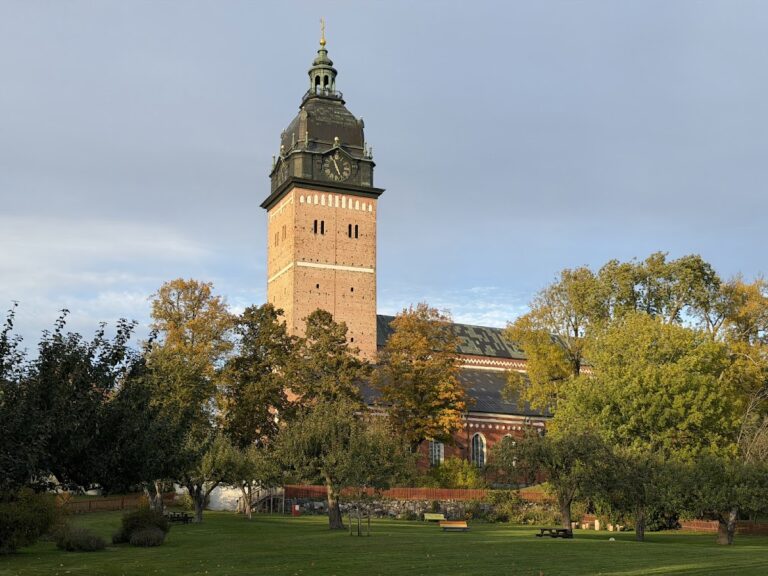
Västerås Cathedral is a five-aisled hall church built chiefly of brick and covered by a copper roof. It measures approximately 93.2 metres in length and 34.4 metres in width. The building’s present layout incorporates the medieval chancel, ambulatory, chapels, eastward extension, west tower, and the southwestern chapel added in 1517.
Medieval structure
Romanesque church
The thirteenth-century church was a Romanesque basilica with a central nave and two side aisles. Its west gable was decorated with round-arched friezes. The pillars show that its original vaults were lower than those of the later church, while a triumphal crucifix still hangs above the former rood-screen location. A rood screen separated the medieval choir from the nave and commonly carried such a crucifix above it.
Chancel and ambulatory
The fourteenth-century lengthening of the chancel and creation of the ambulatory established the eastern circulation and chapel arrangement that remain part of the cathedral’s interior. Chapels once placed around the church were later incorporated into the building, and the fifteenth-century eastward extension enlarged the medieval plan.
Tower and chapels
West tower
The single west tower rises approximately 92 metres, with another measurement giving 91.8 metres. Including the weathercock, its height is given as 102.5 metres. The Baroque spire has an obelisk-like form and is constructed from oak without iron beams or nails. Copper cladding covers the spire, which is surmounted by a crown indicating the royal tomb within the cathedral.
Baptismal or Marian Chapel
The baptismal chapel, also called the Marian Chapel, stands in the south aisle and has a Nordic Renaissance design. Its three-metre-high baptismal cover, made in Lübeck in 1622, carries a marsh-vine motif. The chapel also contains a Renaissance baptismal cover donated by the widow of Simon Depken, as well as the Marian altarpiece made in Antwerp in 1510. The paintings of that altarpiece resemble works by Dirk Bouts of Leuven.
Apostles’ Chapel
The winged altarpiece in the Apostles’ Chapel in the north aisle probably dates from the beginning of the sixteenth century. It is associated with the workshop of Jan Bormann of Brussels. A winged altarpiece uses hinged panels that can be opened or closed to display different images.
Altarpieces and medieval objects
High-altarpiece retable
The high-altarpiece retable dates from 1516. Regent Sten Sture the Younger and Kristina Gyllenstierna donated it, and it is attributed to Jan Gillisz Wrage, Jan Genoots, and the painter Jan van Dornicke. Reliefs of the donors appear on the predella, the raised lower section of the altarpiece.
Lübeck altarpieces
Two fifteenth-century winged altarpieces from Lübeck are kept in the sacristy and the conversation room. One includes two biblical scenes, while its other panels depict saints.
Other sacred objects
A sandstone Veronica panel made in Västerås in 1514 was donated by Bishop Otto Svinhufvud and later lacquered and gilded. A silver altar crucifix from the early fourteenth century was made in Paris. The cathedral also preserves a fourteenth-century reliquary of rock crystal and gilded bronze and a fifteenth-century silk mitre embroidered in red and blue, associated with Vadstena Abbey and made for Bishop Achatius Johannes.
The cathedral uses a modern copy, made in 1955, of a bronze baptismal font cast in Lübeck in 1391. Bishop Bene Korp donated the original, which was intended for Västerås Cathedral and is now in St Nicholas Church in Burg on Fehmarn, Germany.
Burials and memorials
Royal sarcophagus
Eric XIV’s sarcophagus stands in the ambulatory around the chancel. It is made of Carrara marble and was commissioned by Gustav III in 1797 for the king’s remains.
Tombs and epitaphs
The cathedral contains the tomb monument of High Steward Magnus Brahe, made of black and white marble with alabaster figures at the beginning of the seventeenth century. A chandelier donated by Bishop Johannes Brodinus dates from 1681.
Memorials include a Renaissance epitaph of 1625 for the Västerås merchant Simon Depken the Elder and an early Baroque epitaph of 1676 for the apothecary Georg Hoffman. Other epitaphs commemorate Lars Pedersson, Cathedral Parish Priest Nicolaus Dwan in 1709, and Bishop Carl Carlsson in 1708. A painting from 1692 commemorates General Count Pontus Fredric De la Gardie.
Great organ
The great organ retains its 1898 basis and has a façade designed by Agi Lindegren. It was originally built with 40 stops over three manuals and pedals and was among Sweden’s first large organs with tubular pneumatic action. The original instrument also had five high-pressure stops. After later work, it has 65 stops over four manuals and pedals, electropneumatic action, and a Bombarde division that can be coupled to the Hauptwerk and Positiv.
Modern interior
The pulpit dates from 1961 and was made of ceramic by Per-Erik Willo. Paintings above the organ gallery are the surviving elements of the church-wide Neo-Gothic repainting carried out in 1896–1898, while the restoration of 1958–1961 sought to preserve the visible variety of periods within the cathedral.
Nearby sites