Hamat Gader: An Ancient Thermal Bathing Resort in Israel
Site at a Glance
- Popularity
- High
- Country
- Israel
- Primary era
- Classical
- Eras represented
- Classical, Medieval, Early Modern, Modern
- Civilizations
- British, Byzantine, Ottoman, Roman, Umayyad
- Site type
- Sanitation
- Remains
- Baths
On this page20 sections
History
Gadara, Rome, and the healing springs
Hamat Gader is a thermal bathing and healing resort in the Yarmuk River valley of Israel, where Roman construction of a bath complex began in the second century CE. In antiquity, the springs formed a suburb of Gadara, a Hellenistic and Roman city about four kilometres away at modern Umm Qais in Jordan. Their reputation for treating ailments, especially skin diseases, brought visitors to the baths.
Gadara and Hamat Gader passed between rulers during the Hellenistic and Roman periods. The Seleucid king Antiochus III captured Gadara in 218 BCE. Between 103 and 76 BCE, the Hasmonean ruler Alexander Jannaeus seized Gadara and Hamat Gader after a siege said to have lasted ten months. In 63 BCE, the Roman general Pompey restored Gadara to its inhabitants, and it joined the Decapolis, a regional league of cities. Augustus later gave Gadara to Herod, a ruler supported by Rome. After Herod’s death in 4 BCE, the city was separated from his kingdom and attached to the Roman province of Syria.
Ancient writers Strabo, Origen, and Eunapius referred to the springs, and Eunapius visited in the fourth century. An inscription mentioning the Roman emperor Antoninus Pius, who ruled from 138 to 161 CE, may point to imperial assistance for the baths, although it does not establish that he provided it. The Tenth Roman Legion, a major unit of the imperial army stationed at Gadara, undertook the Roman building works.
Jewish rabbinic writings associate several sages with stays at Hamat Gader, among them Rabbi Judah haNasi, a leading teacher traditionally linked to the Mishnah, his grandson Judah Nesi’ah, Rabbi Meir, Rabbi Ammi, Rabbi Asi, and Rabbi Jonathan. Their discussions concerned bathing on the Sabbath, permitted travel boundaries, lodging, medical care, non-Jewish utensils, and food served at inns. One tradition describes Judah haNasi staying with students; another places a legal ruling by Judah Nesi’ah at the baths.
The name Hamat Gader connects the site with Gadara and its hot springs. Rabbinic opinion differed over whether the biblical name Hamat referred to these springs or to those at Tiberias. A Gospel episode about the expulsion of demons has also been associated with Hamat Gader, but the identification is uncertain because parallel versions place the event at other lakeside locations.
Late Antiquity and early Muslim rule
A synagogue was built at Hamat Gader in Late Antiquity, probably during the fifth century. Its construction and decoration indicate a prosperous Jewish community, and visitors to the baths helped finance the building. The complex continued to change during the Roman and Byzantine periods and underwent major structural alterations after the beginning of Muslim rule.
Earthquakes damaged the baths during the seventh century. A local governor ordered repairs in 662, during the reign of Mu’awiyah I, the first Umayyad caliph. Buildings suffered further damage in the earthquake of 749, though some were rebuilt afterward. The tenth-century geographer al-Muqaddasi referred to the bath buildings in the past tense. Another earthquake, in 1033, damaged the complex, after which bathing at the site ended.
From reduced use to renewed development
From the Crusader period until late Ottoman rule, the baths saw little use. An Ottoman tax register from 1596 names the village Hammat Jur. It describes the settlement as empty but lists a watermill for taxation. In the early twentieth century, a railway station at Hamat Gader served a line connecting the Jezreel Valley railway with the Hejaz railway. The route linked Haifa with Daraa in southern Syria and was inaugurated in 1905.
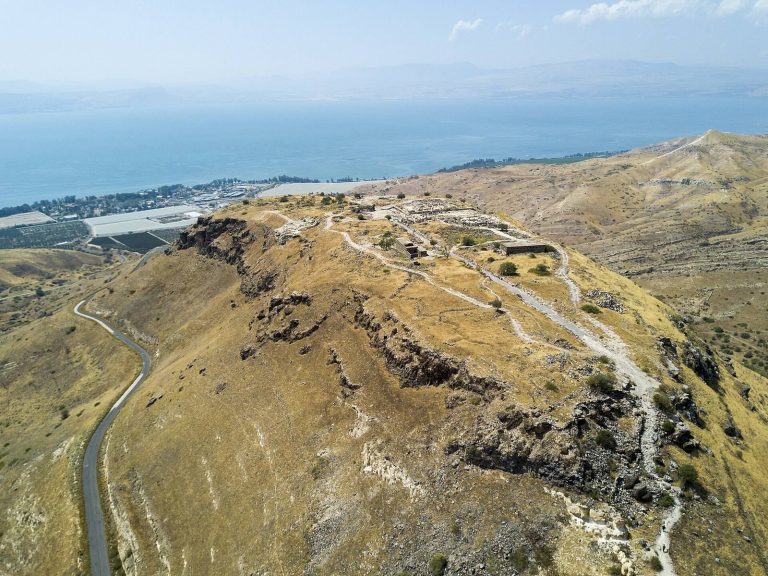
During the British Mandate, local landowner Suleiman Nadif received a concession to develop and operate the springs and began rebuilding the baths in the early 1940s. A 45-room hotel and pension, Marpe, opened under the concession in 1944, with financial backing from Haifa businessman Zeev Sapir. Sapir left in autumn 1947 for security reasons, while the Nadif family continued to run the hotel until the 1967 war. In 1941, the British had established a fortified police post on a bluff above al-Hamma; British police staffed it until the Mandate ended.
On the night of 16–17 June 1946, the Palmach, the Haganah’s elite strike force, blew up the railway bridge over the Yarmuk during the coordinated Night of the Bridges operation. The bridge was not rebuilt. After the 1948 Arab–Israeli War, the 1949 armistice placed al-Hamma in a demilitarized zone, an area where military forces were restricted by agreement. Syria controlled the site until 1967. Although the armistice formally protected local residents and their property, historian Walid Khalidi places the expulsion of Arab residents to Syria between 1949 and 1956.
On 4 April 1951, an Israeli patrol whose members were disguised as police entered the area to assert Israeli sovereignty. Syrian forces opened fire, killing seven patrol members, wounding three, and capturing one. The next day, Israeli aircraft bombed a Syrian police station and another Syrian position. Two women were killed and six residents wounded. A memorial to the seven Israeli dead was established at the site in 2015.
Israel took control of Hamat Gader in 1967. In 1969, militants crossed the Yarmuk from Jordan and attacked the military post and baths, which were then under construction. Explosives destroyed the completed bath building, delaying the resort’s public opening for several years. A plaque commemorating post commander Lieutenant Shmuel Kluger and medic Sergeant David Algrabli, both killed in the attack, was dedicated in 2021. In January 1990, an armed infiltrator from Jordan occupied an old guard post near the site. An Israeli paratrooper was killed during the search, and the infiltrator was found two days later.
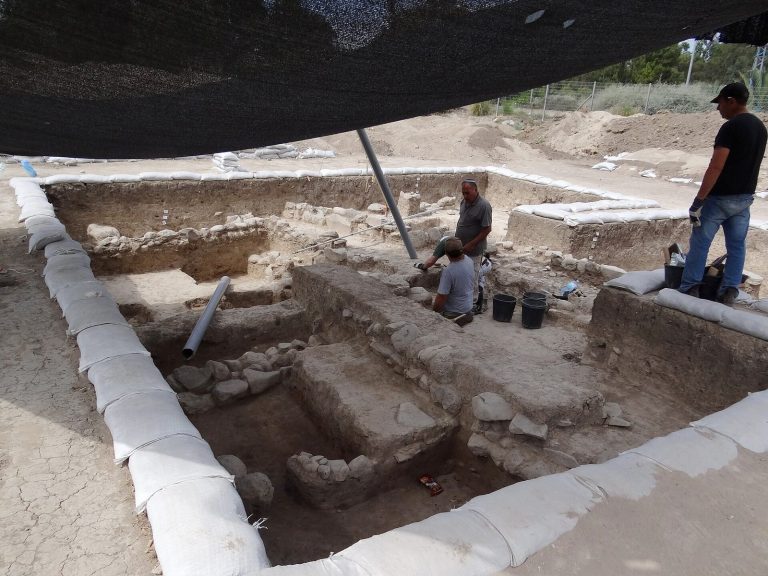
Archaeologist Eleazar Sukenik excavated the synagogue in 1932. Work on the Roman baths began in 1979 and continued for seven seasons. Pamela Tarnter, the site’s first director, oversaw its planning, establishment, and management from 1976 to 1979. Three kibbutzim, Mevo Hama, Kfar Haruv, and Afik, established the modern resort, which is jointly operated by them and Meitzar. The ancient remains have been closed to the public since the 1980s because of safety and conservation concerns.
Remains
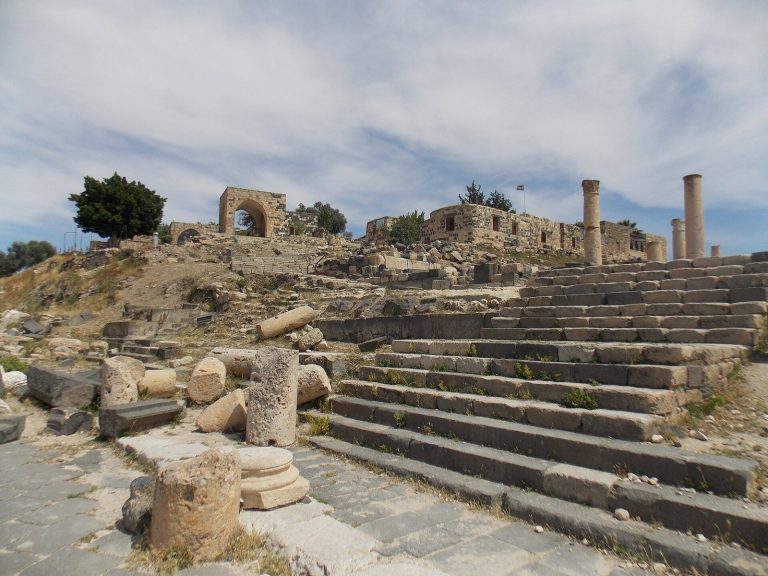
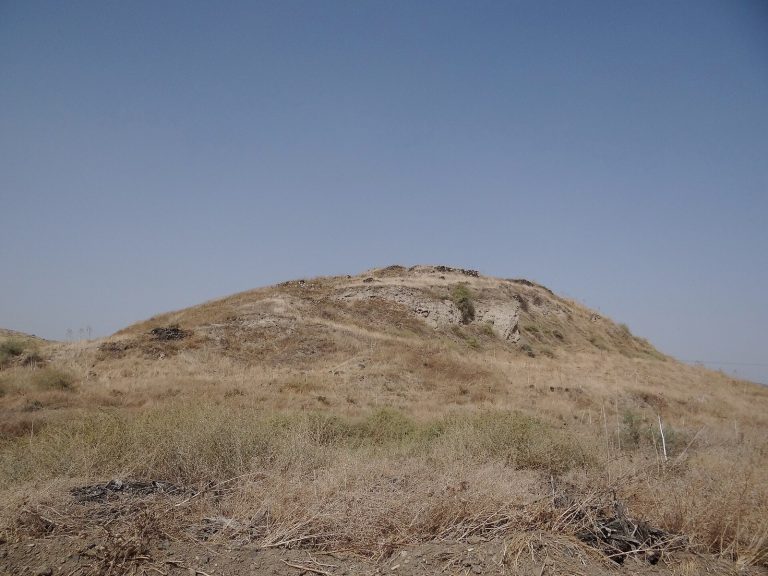
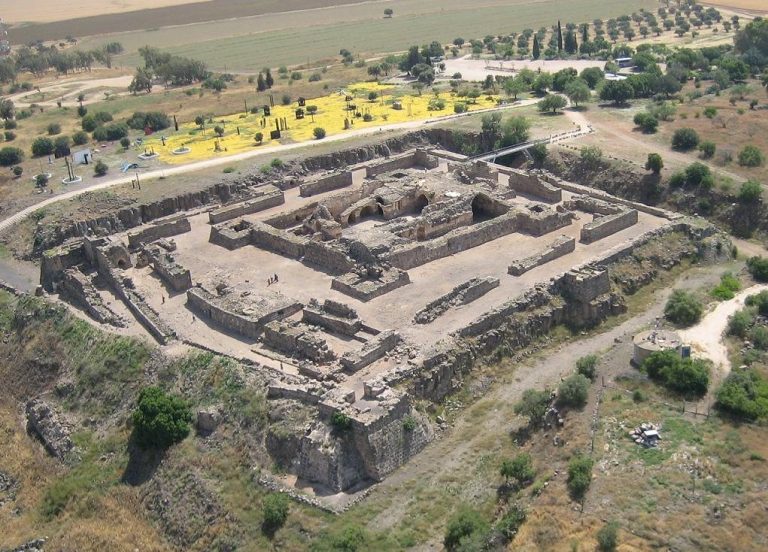
The archaeological area occupies a narrow stretch of the Yarmuk valley near the river channel, about 150 metres below sea level. Bath buildings cluster around a thermal spring, while the synagogue stood on the separate mound of Tell Bani. The remains include basalt masonry, marble-finished bath halls, and mosaic floors in synagogue and early Muslim public buildings.
Springs and valley setting
Five springs rise at Hamat Gader: four hot, mineral-rich sulfur springs and one source of cool, fresh water. Ein al-Maqla, the hottest, reaches about 52°C and supplied the Roman baths. Ein Balsam, which supplies the modern pools, flows at 40–42°C, at a rate of about 500–700 cubic metres per hour. The waters contain sulfur at a concentration of 4.7% and other minerals. Dissolved radium and radon isotopes, produced by uranium decay in deep rocks, make the water radioactive.
The springs emerge along a subsidiary fault of the Yarmuk. Their warmth is attributed to water rising from great depth rather than to volcanic activity; estimates place its source at about two kilometres underground or deeper. One geochemical interpretation describes a mixture of two sources ultimately fed by infiltrated rainwater. Another proposal links the water to an ancient period of higher sea levels, when it may have entered the Jordan Valley through the Jezreel Valley. In 1875, geographer Victor Guérin estimated one spring’s temperature at about 55°C by touch.
Roman and early Muslim public buildings
Roman bath complex
The Roman bath complex covered about 500 square metres and centred on Ein al-Maqla. Water entered an upper pool and then passed through seven pools, each housed in a separate hall. The suggestion that the pools offered successively different temperatures, allowing bathers to acclimatize gradually, remains uncertain. The proposal that separate halls were intended for people with different illnesses is also tentative.
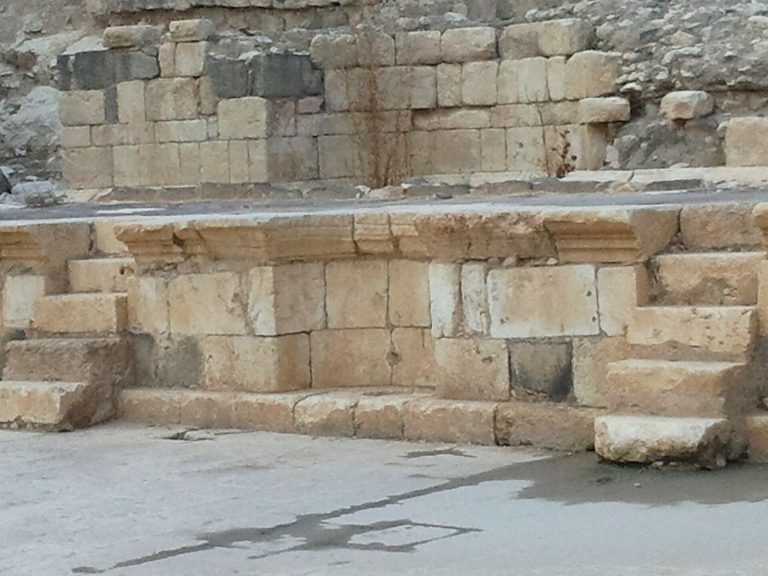
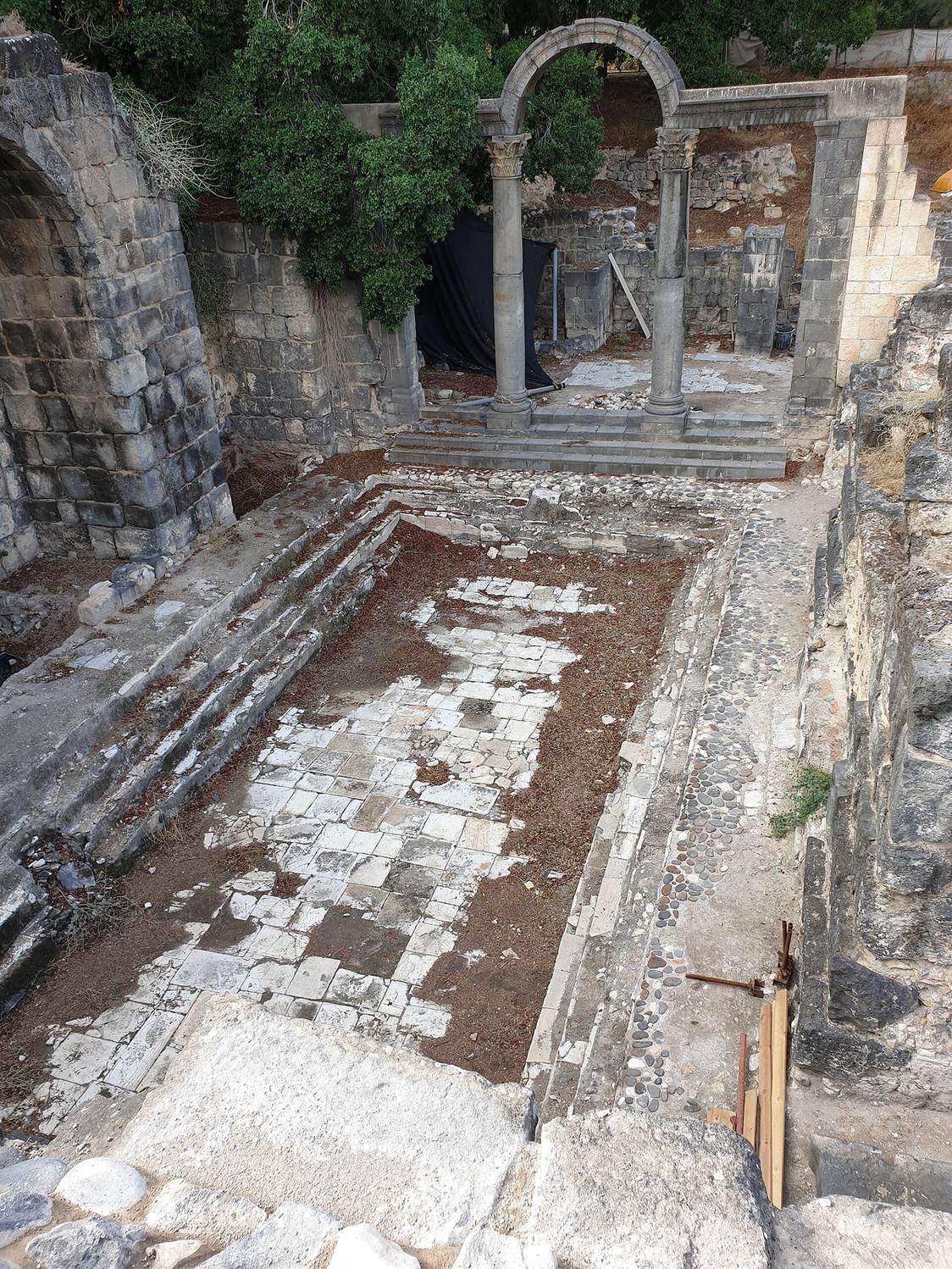
Marble walls, statues, and fountains decorated the halls. Many had roofs and numerous windows, with surviving window glass found during excavation; the windows faced southwest. An entrance corridor about 12 metres long led to the halls through decorated gates. Its basalt-paved floor had stone benches along both sides. One excavated pool, called the Leper’s Pool by the excavators, lay in a long, narrow space between the Art Hall to the north and the oval hall to the south. Pottery lamps were among its finds.
Descriptions of the ruins in the nineteenth century mention well-cut basalt blocks and vaulted halls, most of them then largely demolished. One partly standing hall contained a circular reservoir about 13 metres around and 1.35 metres deep. A hot sulfur spring flowed from it into a stream leading to the Yarmuk.
Roman theatre
A theatre built in the third century had seating for about 2,000 people.
Early Muslim public buildings
Excavations uncovered public buildings from the Umayyad period, including multi-room structures with floors formed from small red, black, and white mosaic pieces. Earthquakes damaged buildings in successive phases, and a thick layer of silt eventually covered the ruins.
Synagogue
Plan and prayer hall
The synagogue complex covered about 180 square metres on Tell Bani and was enclosed by a wall 32.5 metres long. Its nearly square main prayer hall measured about 13 metres on each side and faced south toward Jerusalem. Two rows of columns divided the hall. At its southern end were an apse, a recessed space at the end of a building, and a bema, a raised platform used for worship, set into the wall.
Mosaics and inscriptions
The floor held three mosaics, including one depicting two lions. Four Aramaic inscriptions remain well preserved and legible; damaged sections include records of donations from different places. A Greek inscription was found on the chancel screen, a partition at the front of a worship space. The restored upper part of one mosaic is displayed at the entrance to Israel’s Supreme Court in Jerusalem. Excavation beneath the synagogue also revealed remains of earlier buildings.
Inscriptions and excavated finds
Fountain Hall inscriptions
A marble inscription in the Fountain Hall records bath renovations under Mu’awiyah’s rule and bears the date 5 December 662. Five inscriptions referring to Byzantine empress Aelia Eudocia were found in the hall. A separate marble plaque, measuring 1.81 by 0.71 metres, preserves her 16-line poem praising the springs and baths. The poem may have been written for the opening of the baths or one of their sections.
Finds from the baths
Excavations of the Roman baths in 1979 recovered more than 5,000 coins, thousands of glass bottles, pottery fragments, and inscribed pieces of marble.
Later baths, railway, and settlement
Ain el-Jarab and the Ottoman hammam
Ain el-Jarab lies about 300 paces from the main bath. Its cooler, sulfurous water filled a paved pool with a clear, slightly blue appearance. Stones around the pool had become dislodged, and traces of former buildings surrounded it. Another thermal spring, Ain er-Riah, formed a stream; an Ottoman hammam was later built over it, using water that reached 37°C.
The Ottoman hammam is rectangular and divided into two halls. The larger hall has a pool over the spring and remains continually filled with water; the smaller hall contains hotter water. The building is substantially ruined, and most of the larger hall’s roof is missing.
Railway and police post
The railway station at Hamat Gader and short tunnels along the railway route survive. The British police post built in 1941 stood on a bluff above al-Hamma.
Modern bathhouse and al-Hamma
A separate modern bathhouse, begun after the 1950s several hundred metres from the Ottoman hammam, was designed in a Western style. It included pools of different sizes, changing rooms, and toilets, and is now abandoned. The Palestinian Arab village of al-Hamma included a large mosque with a fountain.