Ugresha Monastery: A Russian Orthodox Monastic Complex in Russia


Site at a Glance
- Rating
- 4.8
- Popularity
- Low
- Country
- Russia
- Primary era
- Modern
- External website
- Open
- Eras represented
- Medieval, Early Modern, Modern
- Civilizations
- Russian
- Site type
- Religious
- Remains
- Fortified Monastery
On this page18 sections
History
Ugresha Monastery is a Russian Orthodox monastery in Dzerzhinsky, Russia, founded in 1380 by Grand Prince Dmitry Donskoy. Its traditional foundation story connects it with the Battle of Kulikovo, Dmitry’s victory that year over forces led by Mamai. According to the tradition, an icon of St. Nicholas the Wonderworker appeared to Dmitry while his army rested on its way to the battlefield. The vision strengthened his faith, and his exclamation that the experience had “warmed his heart” is said to have given the place its name, Ugresha. The foundation documents have not survived, so this account remains a traditional explanation of the monastery’s origin.
Medieval foundation and expansion
The earliest monastic buildings were probably wooden. A wooden Church of St. Nicholas was later replaced by a masonry church around the turn of the fourteenth and fifteenth centuries. The monastery was burned in 1521 when forces of Mehmed I Giray, the Crimean Tatar ruler, raided the area. It had been restored by the middle of the sixteenth century, when Ivan IV, commonly known as Ivan the Terrible and the first Russian ruler to use the title tsar, visited the monastery. He confirmed its exclusive rights to 14 villages, as well as to forests and meadows granted earlier. Later charters enlarged these economic privileges.
During the sixteenth century, Ugresha’s superiors held considerable ecclesiastical and political authority. They took part in church councils and in the selection of Moscow metropolitans and patriarchs. The monastery also formed part of the chain of walled monastic settlements defending the approaches to Moscow from the south.
Political refuge and royal patronage
Ugresha became involved in the political conflicts of the early seventeenth century. False Dmitry I fled there in 1602, while False Dmitry II and Marina Mniszech stayed at the monastery briefly in 1610. In 1611, during the Time of Troubles, Prokopy Lyapunov and Ivan Zarutsky assembled troops at Ugresha before marching against Moscow. The monastery’s abbot Jonah later died in captivity after joining a diplomatic mission to King Sigismund III Vasa.
The monastery expanded substantially during the seventeenth century because it stood near royal residences and routes used by the tsars. Michael Romanov, the first ruler of the Romanov dynasty, visited at least nine times and presented valuable gifts. Alexis Romanov made regular pilgrimages, including a visit on 11 July 1668 accompanied by Patriarch Paisius of Alexandria, Patriarch Macarius III of Antioch, and Patriarch Joasaph II of Moscow.
Ugresha also served as a place of religious and political detention. In 1666, its authorities held the Old Believer leaders Avvakum Petrov and Nikita Pustosviat. Old Believers were Orthodox Christians who rejected the seventeenth-century liturgical reforms associated with Patriarch Nikon. Acting on the tsar’s instructions, Abbot Vincent tried to persuade them to accept those reforms. In 1698, following the suppression of the Streltsy revolt, some of the rebellious musketeers were imprisoned at Ugresha. The monastery continued to receive prisoners and disabled people sent by Moscow diocesan authorities during the eighteenth century.
Decline and nineteenth-century revival
The loss of royal patronage, the secularization of monastic estates in 1764, and restrictions on the number of monks caused a prolonged decline. Ugresha became a third-class institution, receiving state support for 12 monks at 950 rubles a year. By the end of the eighteenth century, only 25 monks remained, about one quarter of the former number. In 1834, the community had fallen to six monks, and closure was considered.
The revival was led chiefly by Abbot Hilary, who governed the monastery from 1834 to 1852, and by his successor Pimen. Hilary improved the community’s spiritual life and directed repairs and expansion made possible by private donations. Pimen continued the work, and five churches and a smaller dependent monastic settlement known as a skete were built during his administration. Ugresha regained importance as a pilgrimage center.
From 1849, the Alexandrov family provided sustained assistance, donating goods worth approximately 300,000 rubles and purchasing a Moscow house for the monastery worth 110,000 rubles. Peter Kumanin financed the Saints Peter and Paul skete between 1852 and 1860, while the merchant Dmitry Rogatkin funded the Church of the Kazan Icon of the Mother of God in 1869 and 1870. The monastic population rose from 30 monks in 1855 to 94 in 1867 and 130 in 1875, although it fell to 46 in 1893 before increasing again.
The monastery also developed educational and charitable functions. From 1866, the monks operated a three-class school for local peasant children. During the Russo-Turkish War of 1877 to 1878, one monastic building was made available as a military hospital. Ugresha was attacked by French forces during the 1812 invasion of Russia. In 1833, Ignatius Bryanchaninov, a Russian Orthodox bishop and spiritual writer, was officially appointed abbot, but Emperor Nicholas I assigned him to another monastery and appointed Hilary on Ignatius’s recommendation.
Construction of the Transfiguration Cathedral began in 1880 under Abbot Nil, and the building was completed and opened for worship in 1894. A chapel dedicated to St. Nicholas was also constructed during Nil’s tenure.
Revolution, closure, and wartime damage
After the Russian Revolution, the monastery buildings housed a children’s colony connected with the People’s Commissariat of Finance. Its institutions included an orphanage for mothers with young children, an institute for noble girls, and a boarding school for boys. In 1919, the monastery was formally converted into the Nikolo-Ugreshskaya Labour Commune. About 40 monks remained, an arrangement through which Archimandrite Makary attempted to preserve the community.
The monastery closed in 1925. The church in the Saints Peter and Paul skete continued functioning for approximately one further year before closing in 1926. The complex was then used for children’s institutions and labour communes, including a commune for about 1,300 homeless people associated with Felix Dzerzhinsky. The nearby town was later renamed Dzerzhinsky.
Church valuables and furnishings were confiscated, and in 1930 objects remaining in the monastery cathedrals were transferred to the Kolomenskoye museum. Several churches were destroyed or adapted for administrative, residential, storage, educational, workshop, and recreational uses. The sixteenth-century St. Nicholas Cathedral was completely demolished in 1940. During the Second World War, the pond was concealed with boards, logs, and dummy buildings. The cathedral domes and the dome and upper levels of the bell tower were removed so that German aircraft could not use them for orientation.
Restoration and renewed monastic life
Restoration of the enclosing walls and bell tower began in the early 1970s, but the restored Bishop’s House burned in 1977. After the war, the monastery was recognized as a monument, with the Palestinian Wall specifically identified as restored at that stage. The first Divine Liturgy since the 1920s was celebrated on 19 December 1990. The complex was returned to the Russian Orthodox Church in 1990 and 1991, with the formal transfer approved by the Moscow Regional Executive Committee on 28 February 1991.
Archimandrite Veniamin Zaritsky became the first post-Soviet vicar after Ugresha received stauropegic status. This form of Orthodox jurisdiction places a monastery directly under a patriarch rather than under the ordinary authority of a diocesan bishop. During the 1990s, numerous buildings were restored and new churches were constructed. A theological school opened in 1998 and became the Nikolo-Ugreshskaya Theological Seminary in 1999. The monastery also established museums devoted to Nicholas II and historic religious art.
The Church of Saints Matthew and Paraskeva reopened in 1994, the Saints Peter and Paul Church in 1995, the Church of the Joy of All Who Sorrow Icon in 1999, and the Transfiguration Cathedral in 2000. The new Church of St. Pimen was completed in 2002, followed by the Passion of Christ church-chapel in 2004. The St. Nicholas Cathedral was reconstructed by 2006. A decree issued by Patriarch Kirill on 27 April 2021 provided for the transfer of the administration of the Moscow Metropolis and the Kolomna Diocese to the monastery while retaining its stauropegic status. In practice, the metropolitan administration remained at Novodevichy Monastery, and the residence of the Metropolitan of Krutitsy and Kolomna remained in Kolomna. Archimandrite Methodius Zinkovsky became monastery vicar and rector of the theological seminary on 13 October 2022. Ugresha remains an active stauropegic monastery and a federal-level cultural heritage site of the Russian Federation.
Remains
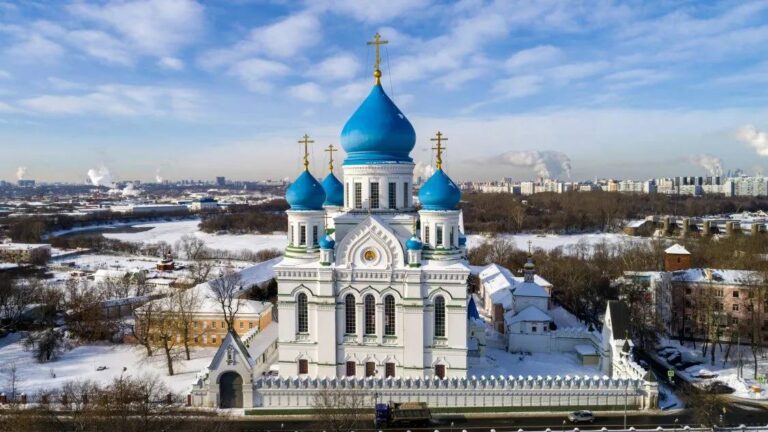
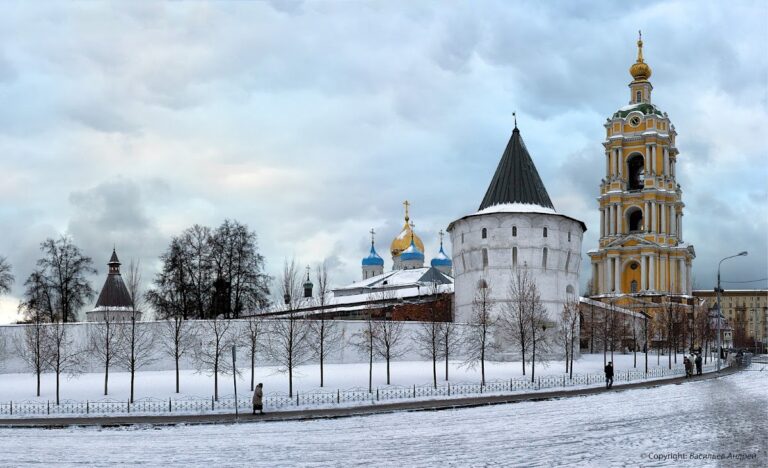
Ugresha survives as a walled architectural complex built chiefly of stone and brick. Its Byzantine-Russian character reflects successive building campaigns from the fourteenth, seventeenth, and nineteenth centuries, together with later reconstruction. The complex includes churches, the former royal and patriarchal chambers, residential and service buildings, a hospital, an orphanage, pilgrim accommodation, a skete, and enclosing walls. The surviving buildings therefore represent the monastery’s changing religious, royal, charitable, and institutional functions.
Central churches and royal chambers
St. Nicholas Cathedral and Chapel
The monastery’s original center was the wooden Church of St. Nicholas, replaced by a masonry church around the turn of the fourteenth and fifteenth centuries. A later sixteenth-century St. Nicholas Cathedral was demolished in 1940 and reconstructed by 2006 to a project by Hieromonk Arseniy. Nearby, the St. Nicholas Chapel stands at the place traditionally associated with the appearance of the saint’s icon. Designed by Alexander Kaminsky, it once preserved a fragment of the pine tree connected with that tradition. The chapel was later converted into a transformer station, restored by 1998, and consecrated by Patriarch Alexy II.
Transfiguration Cathedral
Alexander Kaminsky designed the Transfiguration Cathedral, which was built between 1880 and 1894. The five-domed, late nineteenth-century building has balanced proportions and a monumental but relatively light appearance. After the monastery closed, floors were inserted and rough rectangular windows were made. The building was then used successively for a factory kitchen, dining hall, workshops, classrooms, and a gymnasium. It was in very poor condition when returned to the Church. Restoration led to its reconsecration on 28 May 2000. A new iconostasis, the screen of icons separating the sanctuary from the main body of an Orthodox church, was installed in 2004, and the interior painting was completed in 2009 using the original as a model.
Church of the Dormition
The Church of the Dormition of the Mother of God occupies the second floor of the Tsar’s and Patriarch’s Chambers. Established in the seventeenth century as the church “of the Dormition at the Sovereign’s vestibule,” it belongs to a building enlarged in the nineteenth century. The roof form was changed during that expansion, and a chapel dedicated to Mary of Egypt was added. After the monastery’s closure, the church was divided among residential rooms and a school. It was consecrated again on 1 May 1991.
Walls and bell tower
Palestinian Wall
The northern section of the enclosing wall was designed symbolically as a representation of the Holy City of Jerusalem. Known as the Palestinian or Jerusalem Wall, it is a distinctive part of the complex and was the feature specifically identified as restored after the Second World War.
Bell Tower of the Beheading of John the Baptist
The bell tower of the Church of the Beheading of John the Baptist was first built with three levels in the eighteenth century to a design by Ivan Zherebtsov. A church dedicated to the Beheading of John the Baptist was installed on its second level in 1840, and the tower was enlarged to six levels in 1850. It reached 93 metres and held 18 bells, including the Blagovestnik bell, which weighed 19.7 tonnes. The upper two levels were destroyed during the Second World War.
Later churches and dependent settlement
Saints Peter and Paul Skete
The Saints Peter and Paul skete, a smaller dependent monastic settlement, was built with its church between 1852 and 1860 using funds from Peter Kumanin. Its church was the last monastery church to remain open after the general closure in 1925, continuing until 1926. It was restored and reopened in 1995.
Other churches
The Church of the Image of Christ Not Made by Human Hands was dismantled after an unsuccessful appeal for financing in 1777. Nineteenth-century additions or reconstructions include the refectory Church of Saints Matthew and Paraskeva, the hospital Church of the Joy of All Who Sorrow Icon, and the Church of the Kazan Icon of the Mother of God. The hipped-roof Passion of Christ church-chapel was completed in 2004, while the new Church of St. Pimen was completed in 2002.
Relics and religious furnishings
The monastery preserves an ark containing a fragment of the relics of St. Nicholas, transferred from Greece on 22 May 2000. Other religious objects include a reliquary containing relics of St. Pimen of Ugresha, an icon with a fragment of the relics of John the Baptist, an ark containing relics of the fathers of the Kiev Caves, and an ark with a fragment of the relics of Ignatius Bryanchaninov. The collection also includes the Tikhvin Icon of the Mother of God, a seventh-century reliquary cross, and an icon of the Great Martyr and Healer Panteleimon dated to the nineteenth or twentieth century. Historic religious artworks are held in one of the monastery’s museums.
Nearby sites