Tsuchiura Castle: A Flatland Castle in Japan
Site at a Glance
- Rating
- 3.8
- Popularity
- Low
- Country
- Japan
- Primary era
- Early Modern
- External website
- Open
- Eras represented
- Early Modern
- Civilizations
- Tokugawa
- Site type
- Military
- Remains
- Castle
On this page13 sections
History
Tsuchiura Castle is a Japanese flatland castle in Tsuchiura, Japan, developed by regional warrior houses from the medieval period and substantially reshaped during the Edo period, when the Tokugawa shogunate ruled Japan from 1603 to 1868. Its early history is uncertain. A tradition links an initial fortification around 938 to 947 with Taira no Masakado, a tenth-century provincial warrior associated with a major rebellion in eastern Japan, but the earliest historically documented foundation dates to the Eikyo era, 1429 to 1441. The castle became known as Kijo, or “Turtle Castle,” because its low, moated form was thought to resemble a turtle floating on water.
Medieval stronghold and Sengoku conflicts
The documented founder was Wakaizumi Saburo, a local warrior connected with the Oda clan, whose lineage descended from Hatta Tomoie. During the Sengoku period, the era of widespread regional warfare in the fifteenth and sixteenth centuries, Oda commander Sugaya Katsusada seized the castle in 1516. Members of the Sugaya family and Shida Norisada subsequently held it.
The expanding Satake clan placed increasing pressure on the Oda. After being displaced from Oda Castle, Oda Ujiharu and Oda Moriharu used Tsuchiura Castle as a base. The Oda lost their power after Makabe forces defeated them at the Battle of Tehaizaka in 1569. The Satake then attacked Oda territory directly, and Oda Ujiharu submitted to them in 1583.
In 1590, during Toyotomi Hideyoshi’s campaign against the Hojo, Sugaya Norimasa allied with the Hojo. Forces associated with the Satake and Tokugawa Ieyasu attacked him, and both the Sugaya and Oda houses were destroyed. After Tokugawa Ieyasu entered the Kanto region, he assigned Tsuchiura to his second son, Yuki Hideyasu, who had been adopted into the Yuki family. The castle consequently became a subsidiary stronghold within Hideyasu’s territory.
Formation of the Edo-period domain
After Hideyasu was transferred to Kitanosho in Echizen, Matsudaira Nobukazu took control of Tsuchiura. Nobukazu and his son, Matsudaira Nobuyoshi, are associated with the formation of the castle town and with gates along the Mito Kaido, the highway connecting Edo, the seat of the Tokugawa government, with Mito in Hitachi. Nobukazu held the domain at 35,000 koku, a historical measure of assessed agricultural productivity, and later received an additional 5,000 koku for his house.
In 1617, Matsudaira Nobuyoshi moved to Takasaki, and Nishio Tadanaga entered Tsuchiura with 20,000 koku. Nishio Tadateru ordered major construction between 1620 and 1627. The East and West Turrets were built, and in 1622 the front entrance of the main bailey, the castle’s principal enclosed area, was converted into a turret gate. In 1649, Tadateru was transferred to Tanaka in Suruga, and Kutsuki Tanetsuna became lord of Tsuchiura.
Under Kutsuki Tanetsuna, the turret gate was rebuilt in its present Taiko Yagura Gate form in 1656. An ammunition store and a gunpowder store followed in 1658, while the back gate and Geki Gate received tiled roofs. During the tenure of Kutsuki Tanemasa, tiled roofs were added to all the walls on the earthen ramparts.
The Tsuchiya domain and major reconstruction
Tsuchiya Kazunao entered the castle in 1669 with a fief of 45,000 koku. The Tsuchiya family had previously served the Takeda family before entering Tokugawa service, and Kazunao became a daimyo, a major lord governing a domain under the shogunate. Apart from a five-year interruption, the Tsuchiya family controlled Tsuchiura from 1669 until the Meiji Restoration, which ended the shogunate and brought an imperial government to power in 1868.
A rice storehouse was built in the second bailey in 1678. From 1682 to 1687, Matsudaira Nobuoki of the Okochi-Matsudaira house temporarily ruled Tsuchiura. When he became castellan of Osaka Castle in 1687, Tsuchiya Masanao returned with 65,000 koku. Three later increases brought the Tsuchiya holdings to 95,000 koku, making the family the second-largest domainal power in Hitachi after Mito Domain. The Tsuchiya house then ruled for eleven generations, approximately 200 years, until the Meiji Restoration.
Matsudaira Nobuoki directed a major reconstruction in 1684, supervised by his commissioner Yamamoto Kansuke Harumasa. The main and rear entrances were built according to the Takeda school of castle construction. In 1685, the Hyogo and Fuwa entrances and their gates were constructed, the Kasumi Gate was altered, and the Mito entrance was improved as a double semicircular barbican, a fortified approach designed to delay attackers and expose them to defensive fire.
Abolition, destruction, and preservation
Excavation in 1986 established that a major fire had struck the main bailey during the Sengoku period, although its precise date is unknown. The castle itself was abolished in January 1873 under government order, two years after the domains were abolished. The main-bailey palace was first reused as the office of Niihari Prefecture and later as the Niihari district office. Most other buildings in the main bailey initially remained, but the walls on the ramparts were demolished. Buildings in the second bailey and elsewhere were removed, except for the Outer Bailey Palace, and many moats were filled.
The main-bailey palace burned in 1884. The damaged East Turret and bell tower were removed, and a district-office building replaced the palace. In 1899, the main and southern part of the second bailey became Kijo Park. The Outer Bailey Palace, which had later been used as the Niihari district court, was destroyed in an arson attack in 1905. The former main-bailey grounds continued to serve the district office until its abolition in 1926. After the office was relocated in 1932, the main bailey was levelled and converted into an open square.
The West Turret was dismantled in 1950 after damage from the 1949 Kitty Typhoon, on the condition that it would be reconstructed in wood. Its stored timbers were used for a wooden reconstruction in 1992. The East Turret was reconstructed in wood in 1998 as an affiliated exhibition facility of the Tsuchiura City Museum. The Tohoku-Pacific Ocean Earthquake of March 11, 2011, damaged the Taiko Yagura Gate, the East and West Turrets, and other surviving or reconstructed buildings. Repairs to the turret gate, Kasumi Gate, both turrets, and the earthen walls were completed by June 22, 2012.
Tsuchiura Castle became Ibaraki Prefecture’s first designated historic site and was selected as one of Japan’s Continued 100 Fine Castles in 2017.
Remains
The completed Edo-period castle occupied low ground near Lake Kasumigaura and was enclosed by several broad water moats. Repeated flooding did not submerge the castle. Its concentric plan placed the main bailey inside an inner earthen rampart and a water moat, with a parapet wall above the rampart. The main bailey formed a slightly elongated rectangle oriented east to west. It measured approximately 95 by 55 metres to the tops of the ramparts, 101 by 64 metres including the rampart bases, and about 118 by 82 metres including the water moat. Bends in the former moat and rampart lines have since been straightened.
Main bailey
Taiko Yagura Gate
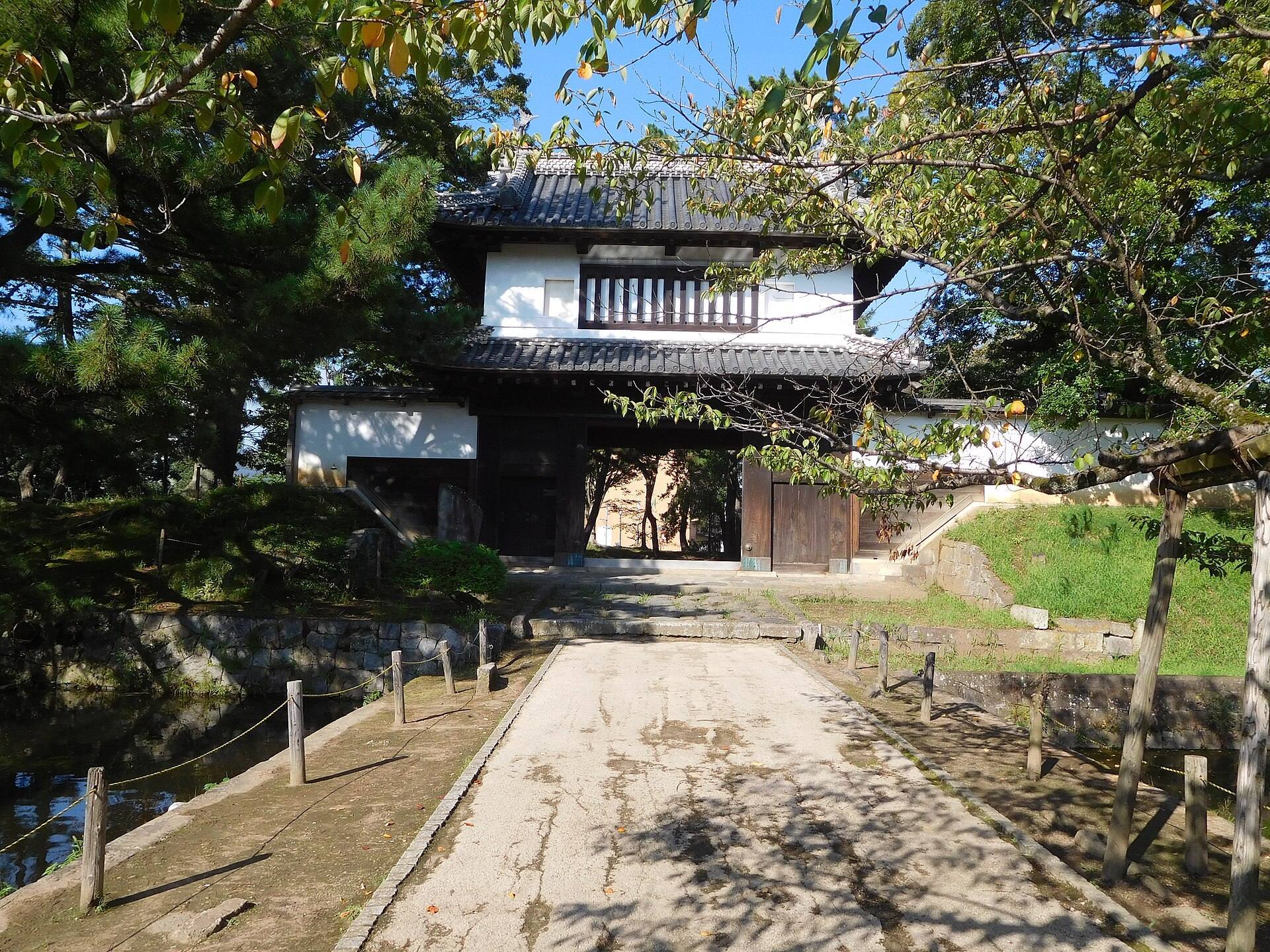
The southern entrance to the main bailey is the two-storey Taiko Yagura Gate, a yagura or Japanese castle turret that could serve defensive, storage, or gatehouse functions. Built in its present form in 1656, it is the surviving Edo-period turret gate. The structure was once tilted after excessive pigeon droppings accumulated on its roof. It remains one of the principal historic buildings at the castle.
Kasumi Gate and turrets
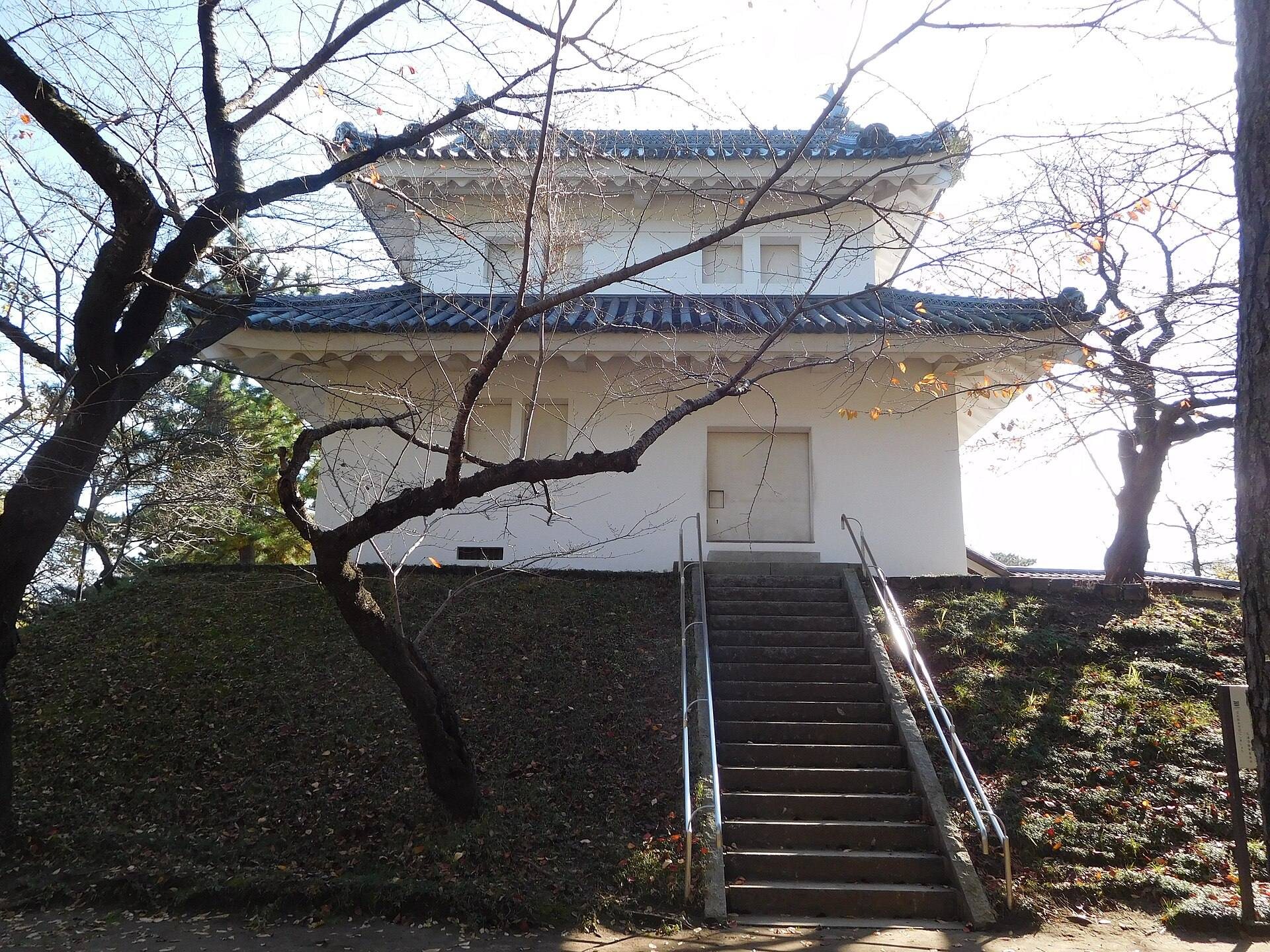
The Kasumi Gate formed the northeastern entrance to the main bailey and was altered during the reconstruction of 1685. The East and West Turrets stood on the eastern and western sides. Both are now wooden reconstructions. The West Turret uses timbers preserved after its dismantling in 1950, while the East Turret functions as an exhibition facility connected with the Tsuchiura City Museum.
The main bailey also contained the palace, a bell tower, and earthen walls. The palace site later became administrative property, and the palace burned in 1884. The district-office building that replaced it was subsequently relocated. The surviving and reconstructed main-bailey fabric therefore consists of the Taiko Yagura Gate, Kasumi Gate, earthen ramparts, water moats, East Turret, and West Turret. Tsuchiura is described as the only castle in Ibaraki with surviving Edo-period building remains.
Second and third baileys
Second bailey
The second bailey contained rice stores and stables on its southeastern side, a partition gate and horse-riding grounds to the southwest, and the Hyogo Gate and arms storehouse to the northwest. The northeastern Kamei Enclosure held barracks, a shield storehouse, and an Inari shrine. Inari is a Japanese deity associated especially with rice, agriculture, prosperity, and commerce. These buildings disappeared after the Meiji Restoration through demolition or sale.
The site of the former second-bailey gate contains the relocated Former Maekawaguchi Gate. A moat between the Tsuchiura City Museum grounds and the second-bailey area was created later and was not part of the Edo-period castle.
Third bailey and Inui Enclosure
The third bailey, also called the Inui Enclosure, lay northwest of the main bailey. A gunpowder store stood there during one period, although the area was mainly open ground. Roads and later urban planning have largely erased its former topography.
Outer bailey and relocated gates
The Outer Bailey formed part of the Tatsumi Enclosure and was created in the latter half of the seventeenth century. It contained the Outer Bailey Palace, but no structures preserving its former appearance remain. Other relocated elements survive away from the main castle area. The former domain-school Ikubunkan gate remains at Tsuchiura First Junior High School. The Red Gate of the Inner Palace was moved to Tsumaki in Tsukuba, part of the West Gate was relocated to Kamisakaida in Tsuchiura, and a Koraimon gate, a gateway with roofed side sections, survives at Kidamari, although its original position within the castle is uncertain.