Ichinoya-Yasaka Shrine: A Gion-Belief Shrine in Tsukuba, Japan


Site at a Glance
- Rating
- 4.1
- Popularity
- Low
- Country
- Japan
- Primary era
- Early Modern
- External website
- Open
- Eras represented
- Early Modern
- Civilizations
- Tokugawa
- Site type
- Religious
- Remains
- Sanctuary
On this page14 sections
History
Ichinoya-Yasaka Shrine is a Shinto shrine in Japan, located in Tamatori, Tsukuba, Ibaraki Prefecture. It is traditionally said to have been founded in 859, during the reign of Emperor Seiwa, when a deity from Yasaka Shrine in Yamashiro Province, near present-day Kyoto, was enshrined here. The earliest secure evidence reaches only to the Nanboku-cho period, the fourteenth-century era when rival Northern and Southern Imperial Courts competed in Japan, through the date of a sacred mirror preserved by the shrine. The shrine may have existed earlier, but that remains uncertain.
Early traditions and warrior patronage
One tradition associates the shrine with Fujiwara no Hidesato, who is said to have visited between 938 and 947. He reportedly dedicated an arrow and prayed for victory during the campaign against Taira no Masakado. Later, the Oda clan supported the shrine while it controlled the surrounding region. The site was known as “Tamatori’s Flower Garden,” received repeated visits from the clan, and accepted offerings of bows and arrows.
The shrine was burned during the warfare surrounding the fall of Oda Castle in the Tensho era, from 1573 to 1593. Tamatori village lay along the invasion route to the castle. The Yuki clan also provided patronage. Although the shrine stood in Hitachi Province, the Yuki held power in neighboring Shimosa Province, and one of their donation documents refers to a person who appears to have served as the shrine’s ritual official.
Rebuilding and Edo-period organization
Local residents rebuilt the shrine buildings during the Bunroku era, from 1593 to 1596. The lord of Tamatori Domain commissioned the principal sanctuary in May 1676, and a later domain lord commissioned the worship hall in April 1711. A torii gate was added in 1713.
During the Edo period, the shrine was generally called Tenno Shrine. For part of this era, it was controlled by Yakushiin, a Tendai Buddhist institution. Its rites were conducted by a betto, an official who managed or represented a religious institution and whose office here combined Buddhist monastic and lay characteristics, rather than by a negi, the Shinto ritual official responsible for conducting shrine rites.
An administrative notification from the period 1716 to 1736 recorded a precinct of 2,552 tsubo, approximately 8,436 square meters. The grounds included an area for horse fodder, a purification pond, a forest associated with the festival’s temporary sacred lodging place, and fields exempt from taxation. Festival visitors helped support tea stalls and a settlement in front of the shrine. Thirty residents of Ichinoya later petitioned to separate their area from Tamatori Village, but the judicial office rejected the request, and Ichinoya remained part of Tamatori.
Modern religious identity and festivals
During the Meiji period, the shrine was classified as a former village shrine under the modern shrine-ranking system. In 1994, its precinct measured 3,746 tsubo, approximately 12,383 square meters, while shrine-owned land measured approximately 5,494 square meters. The name of the shrine is also preserved in the name of the University of Tsukuba’s Ichinoya student residence.
The principal deity is Susanoo no Mikoto, a major Shinto deity associated with storm and sea-related powers and, in Gion belief, with protection from epidemic disease and calamity. Ichinoya-Yasaka Shrine has been revered for protection from disasters and illness and for safety at sea. Although inland, it has attracted worshippers connected with fishing. It is regarded as a center of Gion, or Ushi-Tenno, belief in Ibaraki. This religious tradition developed through interaction between Buddhist and Shinto practices and centers on protection from epidemics and other calamities. The shrine also serves as the local ujigami, or tutelary deity, of the Tamatori district.
The annual festival is a Gion festival held on the seventh day of the sixth lunar month and commonly called the Garlic Festival. Tradition places its beginning in the Tenmei era, from 1781 to 1789, when famine and epidemic disease led the domain lord Hotta Masahide to recommend regular garlic consumption. Another tradition says that Susanoo learned garlic’s medicinal value from Sukunabikona, a deity associated with medicine, healing, agriculture, and the establishment of settlements, during an expedition to the Korean Peninsula.
The Garlic Festival traditionally lasts fourteen days, with the seventh day as its principal celebration. During the grand festival, eight bearers carry a portable shrine while holding paper in their mouths and remaining silent; more than ten people provide security. Garlic is sold at festival stalls, then traditionally hung at household entrances and given to neighbors as protection from illness and misfortune.
A festival record describes a portable-shrine procession that included a betto, bearers of sacred offerings, a long-handled sword, a halberd, a portable seat, and an official who placed a sacred offering on a participant’s head. The record was produced in the early-modern period, so its reliability for conditions in 1445 is uncertain. When walking was the principal means of transportation, the portable shrine’s evening procession was said to attract exceptionally large crowds. Other observances include New Year’s Day and Setsubun festivals, festivals on May 6 and September 6, and a harvest-new-grain thanksgiving ceremony on December 21. In 1990, researchers from institutions in Tsukuba Science City and university faculty reportedly formed a larger proportion of worshippers than long-established local residents, while graduate students sometimes held wedding ceremonies at the shrine.
Remains
Ichinoya-Yasaka Shrine occupies a precinct containing the principal sanctuary, worship and offering halls, a torii gate, ritual facilities, subsidiary sanctuaries, shrine land, and an ancient burial-mound group. The principal sanctuary follows the nagare-zukuri style, in which the front slope of a gabled roof extends forward to create a covered entrance. The recorded 1994 extent of the precinct was approximately 12,383 square meters, with about 5,494 square meters of shrine-owned land.
Principal shrine buildings
Principal sanctuary
The principal sanctuary is a one-bay nagare-zukuri building, with a projecting roof protecting the front entrance. It is traditionally dated to 1676, when the lord of Tamatori Domain commissioned it. A protective shelter built in 1867 encloses the sanctuary.
Worship and offering halls
The worship hall and offering hall are constituent buildings of the shrine complex. The worship hall was commissioned by a later lord of Tamatori Domain and constructed in 1711. Together with the principal sanctuary, these buildings form the central architectural group of the precinct.
Torii and ritual facilities
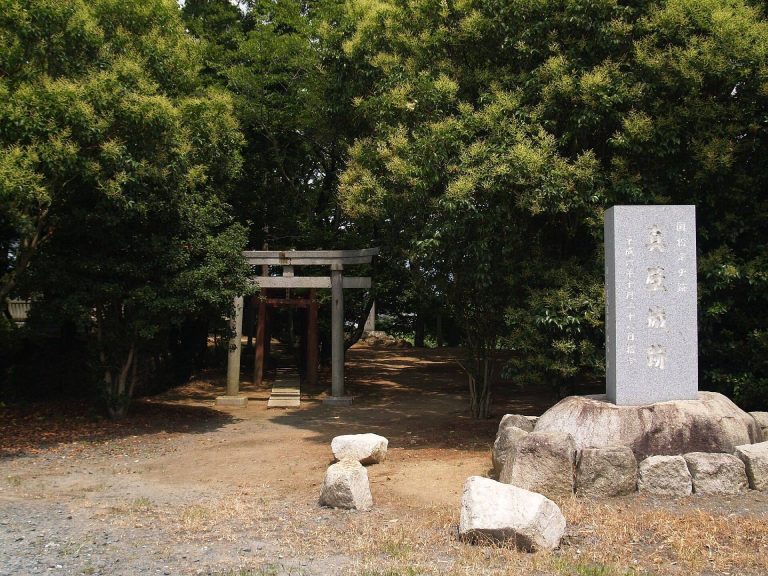
A torii gate dating to 1713 stands within the precinct. The grounds also contain a hand-washing pavilion and a shrine office measuring 17.5 tsubo, approximately 57.85 square meters, positioned to the rear left of the hand-washing pavilion.
Subsidiary sanctuaries and archaeological features
Subsidiary sanctuaries
The precinct contains subsidiary sanctuaries dedicated to Inari, Tenmangu, and Iwa-Dainichi. Inari is associated especially with rice, agriculture, prosperity, and commerce, while Tenmangu shrines are dedicated to Sugawara no Michizane, the scholar and court official traditionally revered as Tenjin, the deity of learning.
Ancient burial-mound group
An ancient burial-mound group is located within the shrine grounds, adding an archaeological feature to the religious complex.
Shrine treasures
Sacred sword and mirrors
The shrine treasures include one sacred sword, two mirrors donated by the Oda clan, and an eight-lobed mirror decorated with floral and paired-bird motifs. The date of a sacred mirror preserved by the shrine provides the earliest secure evidence associated with the institution, placing that evidence in the Nanboku-cho period.