Troyan Monastery: A Stauropegial Orthodox Monastery in Bulgaria
Site at a Glance
- Rating
- 4.8
- Popularity
- High
- Country
- Bulgaria
- Primary era
- Modern
- External website
- Open
- Eras represented
- Early Modern, Modern
- Civilizations
- Bulgarian, Ottoman
- Site type
- Religious
- Remains
- Fortified Monastery
On this page14 sections
History
Troyan Monastery is a functioning male Orthodox monastery of the Bulgarian Orthodox Church in Bulgaria, near the town of Troyan. Traditionally dated to around 1600, it was founded no later than the late sixteenth century and is dedicated to the Dormition of the Mother of God. The monastery is stauropegial, meaning that it comes directly under a patriarch or senior ecclesiastical authority rather than a local bishop. It remains an active religious institution and is recognized as a cultural monument.
Foundation and early development
The foundation is attributed to Hegumen Calistrat. Its origin is also associated with monks from Mount Athos, the autonomous monastic region in northern Greece, who brought a copy of the Three-Handed Virgin icon. This Orthodox image of the Virgin Mary is traditionally connected with a miracle involving a third hand, while its older wonder-working prototype was preserved at Hilandar, a Serbian Orthodox monastery on Mount Athos.
The first complex included a wooden church dedicated to the Nativity of the Mother of God, residential quarters for the monks, and a small guesthouse. An Ottoman band later attacked and devastated the monastery, and Hegumen Calistrat was killed during the assault.
Expansion in the eighteenth century
During the first half of the eighteenth century, Troyan Monastery expanded and became economically prosperous. A school operated within the monastic community, and its reputation grew after teacher Nikola Varbanov took responsibility for it in 1765. Local monks produced manuscripts during the eighteenth and nineteenth centuries, reinforcing the monastery’s role in education and literacy.
Hegumen Christopher of Sopot initiated major building works during the eighteenth century. He erected new structures, strengthened the wooden church, and established the monastery’s water-supply system in 1771. Around 1780, Hegumen Pakhomiy organized the construction of a new stone principal church on the site of the earlier building.
After 1785, Hegumen Paisiy directed the construction of many residential buildings and served as abbot for 32 years. At the end of the eighteenth century, he also founded the monastery’s first dependency, the Skete of Saint Nicholas, east of the main complex.
Rebuilding and stauropegial status
In 1820, Hegumen Parteniy built a new enclosing wall. Ottoman authorities accused him of constructing a fortress to support Alexander Ypsilantis, a Greek revolutionary leader active in the struggle against Ottoman rule, and imprisoned him in Lovech for several months. Following prolonged efforts by the clergy, the monastery became stauropegial on 4 December 1830 and was placed directly under the authority of the Patriarchate of Constantinople.
Parteniy founded a second dependency in 1832, the Skete of Saint John the Forerunner, also known as Zelenikovets. Patrons in Troyan, Koprivshtitsa, Teteven, and Tryavna contributed to the construction of a new principal church. A sultan’s authorization for the work was secured in March 1835 with the assistance of Stoyan Beylikchi.
The present principal church was built in 1835 by Konstantin of Peshtera on the site of an older church. Metropolitan Ilarion of Tarnovo consecrated it on 6 August 1835 in honor of the Dormition of the Mother of God.
Education, national activism, and later history
During the nineteenth-century Bulgarian National Revival, a movement of cultural, educational, religious, and political renewal under Ottoman rule, the monastery served as a local center of learning and literacy. It also sheltered Bulgarian national activists. Vasil Levski, a leading revolutionary organizer in the movement for liberation from Ottoman rule, established a private revolutionary committee at the monastery. The complex preserves the room where he is said to have hidden and met with fellow revolutionaries.
The monastery did not participate directly in the April Uprising because Ottoman troops were stationed there. During the Russo-Turkish War of 1877–1878, a conflict that led to the restoration of Bulgarian statehood, its monks and the surrounding population supported General Pavel Kartsov’s detachment during its crossing of the Balkan Mountains.
Patriarch Maxim of Bulgaria had earlier been a novice at Troyan Monastery and was buried in the Church of the Dormition on 9 November 2012. The monastery is the third-largest in Bulgaria and continues to function as a religious community.
Remains
Courtyards and residential buildings
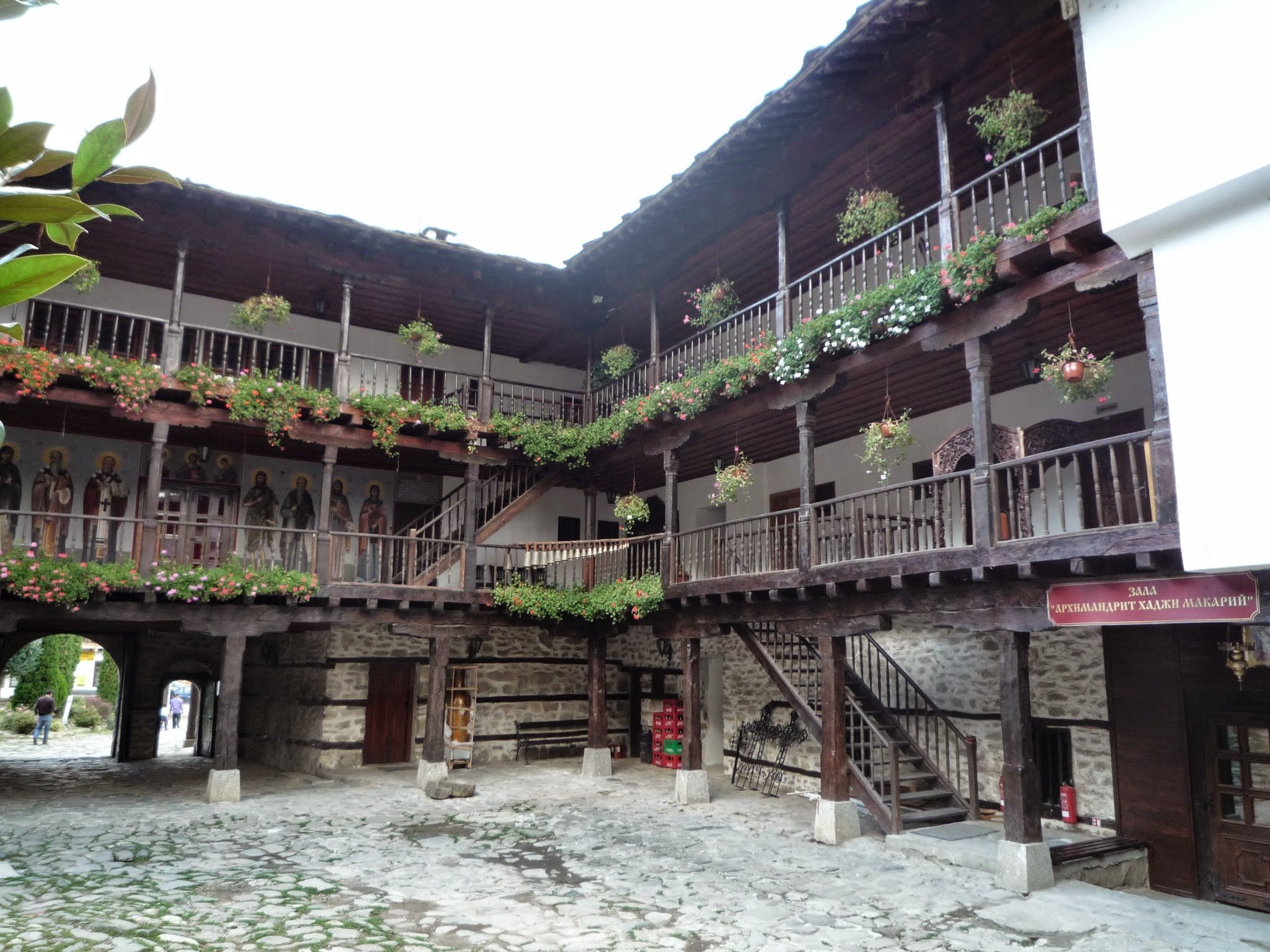
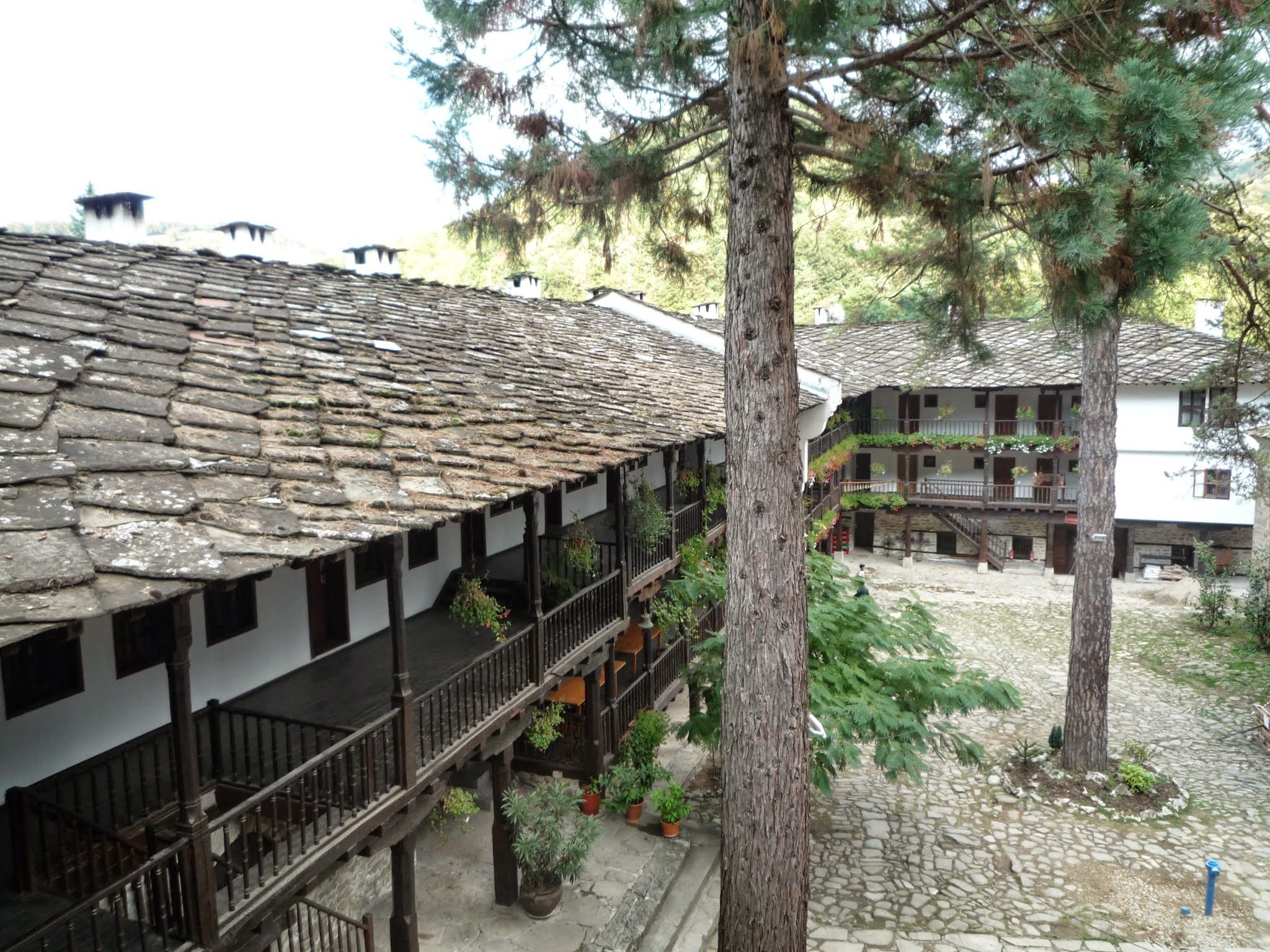
The monastery stands beside the Cherni Osam River near Oreshak, on the slope of the Balkan Mountains and about 10 kilometers from Troyan. Its buildings are arranged around three courtyards. The northern courtyard has an administrative function, the central courtyard serves guests, and the southern courtyard contains the main church. Residential wings enclose these spaces and rise two or three stories, an unusually tall arrangement for the period. Built mainly of wood in the Bulgarian National Revival style, they acquired their present form between 1835 and 1855.
Defensive and service structures
Residential-defensive tower
A residential-defensive tower occupies the northwestern corner of the complex. Its position forms part of the monastery’s enclosed architectural arrangement.
Bell tower
The five-story bell tower was built in 1866 by Ivan Stoynov Kamburov of Mlechevo. Its levels contain a bell chamber, the Chapel of Saints Cyril and Methodius on the second floor, and a food storehouse on the ground floor. The upper sections were damaged and demolished in 1898, and the tower was restored to its earlier appearance in 1987. Saints Cyril and Methodius were ninth-century Byzantine missionaries whose work among Slavic peoples contributed to the development of Slavic Christian literacy.
Church of the Dormition
The Church of the Dormition has a separate narthex, the entrance area of an Orthodox church, and an open arched gallery along its western side and part of its northern side. The building follows an east-west axis and has a dome in its eastern section. Because it was built about 20 meters north of the older church, in the area of the monastery cemetery, a vaulted ossuary was formed beneath the altar area within the substructure.
The carved wooden iconostasis, the screen separating the sanctuary from the main worship space, dates to 1839. Zahari Zograph painted the interior and exterior, including the galleries, in 1847–1848. His decoration includes scenes of the Last Judgment and the Wheel of Life, along with donor portraits and a self-portrait on the northern wall. The Kazanlak painter Petko Ganin repainted the murals in the early twentieth century.
The church houses the Three-Handed Virgin icon, regarded as wonder-working and treated as one of the monastery’s principal relics. The image is dated to the seventeenth century and is traditionally believed to have been at Troyan Monastery since its foundation.
Monastic dependencies
Skete of Saint Nicholas
The Skete of Saint Nicholas was founded in 1785 about 1 kilometer southeast of the monastery, on the western slope of Mount Ivan, whose elevation is given as 1,046 meters.
Skete of Saint John the Forerunner
The Skete of Saint John the Forerunner, also called Zelenikovets after its locality, was founded in 1832 about 8 kilometers southeast of the main monastery in the locality of Zelenikovets.