Trebula: A Samnite City and Italic Sanctuary in Italy
Site at a Glance
- Country
- Italy
- Primary era
- Classical
- Eras represented
- Classical, Medieval
- Civilizations
- Roman, Samnite
- Site type
- Religious
- Remains
- Church
On this page7 sections
History
Trebula is an ancient city and sanctuary just outside Quadri, Italy, associated with the Samnite Carricini, one of the peoples of Samnite Italy. The site dates to the second century BCE, and the sanctuary’s architecture reflects Hellenistic influence, Greek cultural traditions that spread after Alexander the Great’s conquests. Such forms became fashionable after 217 BCE and during the second century BCE.
Samnite and Roman phases
In the early first century BCE, the Social War, fought between Rome and its Italian allies, preceded a political change at Trebula. After the conflict, the city became a Roman municipium, a community incorporated into the Roman state with civic status, alongside nearby Cluviae and Iuvanum.
An inscription from Emperor Hadrian’s reign (117–138 CE) refers to a vicus, or local settlement, of Trebula. The sanctuary may have been dedicated to Jupiter Trebulanus, though this identification is uncertain; Jupiter was the chief god of Roman religion. Trebula’s name may derive from trebe or traebe, possibly referring to a settlement built with wooden beams. Another proposed meaning is “farmstead.”
The medieval church
Benedictine monks, members of an order following the Rule of Saint Benedict, built the Church of Madonna dello Spineto between the ninth and eleventh centuries. The Catholic church came under Benedictine jurisdiction. A papal bull of 1183 recorded it as dependent on the Diocese of Valva, an ecclesiastical district governed by a bishop. Pope Clement III confirmed that affiliation in a bull dated 5 April 1188.
The church had abbey status by 1577. In 1765, a pastoral visit by the bishop of Valva described it as served by an abbot-curate, an abbot who also carried out pastoral duties.
Investigations of the temple and a limited area beside it took place in 1990–1991 and 1995, then resumed in 2006–2009 under the Abruzzo Superintendency for Archaeological Heritage. Restoration work is under way on the church ruins.
Remains
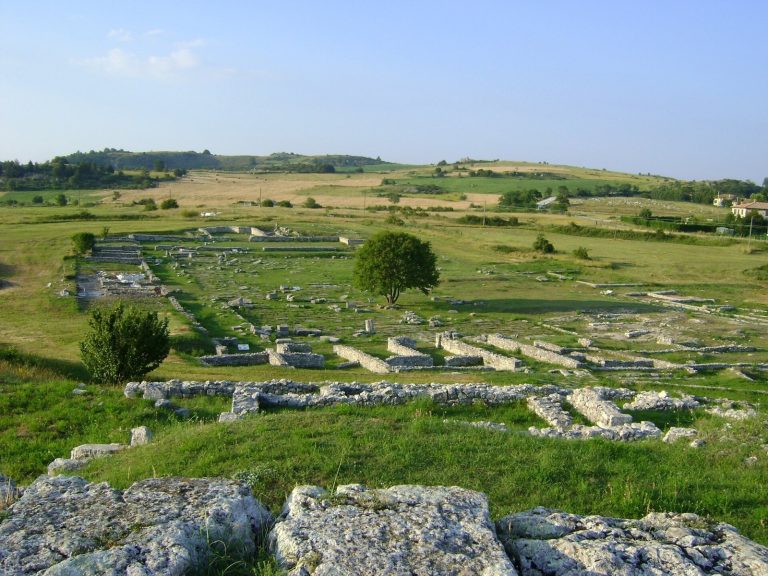
The site occupies a hillside just outside Quadri, below the town’s sports field. The slope faces toward Pizzoferrato in Abruzzo and Pescopennataro in Molise. The remains include a north–south Italic temple, a small Roman amphitheatre, and a rectangular Romanesque church built directly over the temple.
Italic temple and sanctuary
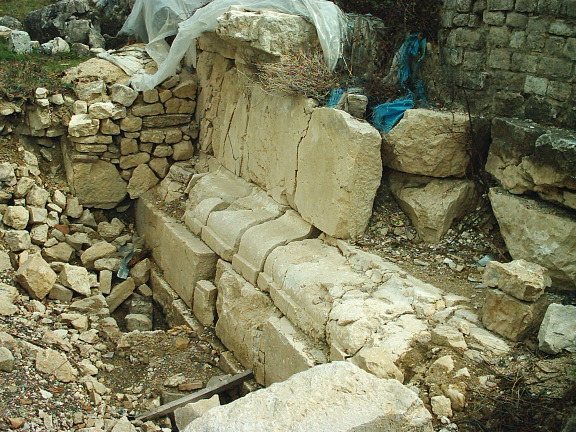
Only the temple’s podium survives. The pavement in its enclosed inner chamber reflects the building’s Hellenistic-influenced style. On the sanctuary’s paving of polygonal stone blocks, the area once occupied by an altar can still be identified. Excavations also brought parts of the sacred enclosure to light.
Roman amphitheatre
A small Roman amphitheatre forms part of the site, and a portion of its arena has been excavated.
Church of Madonna dello Spineto
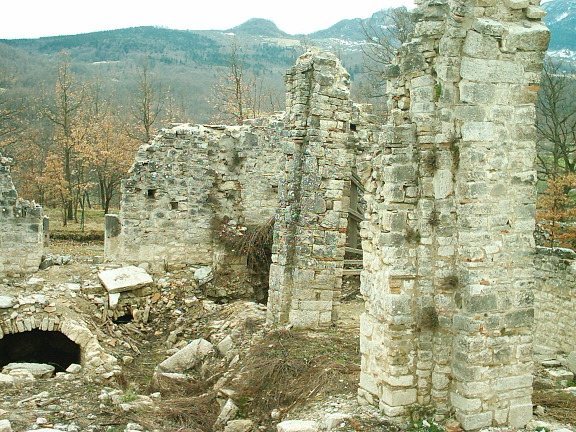
The Romanesque church has a rectangular plan. Its south-facing entrance was preceded by a vestibule. Inside, three aisles ended in three apses, or semicircular sanctuary ends. Two pillars survive between the central aisle and the aisle to its left, with the points where arches began still visible. A bell tower stood beside the right side of the facade. On one flank, a circular furnace base used for casting bells remains. The church now stands in ruins.