Tottori Castle: A Japanese Mountain Fortress and Domain Center


Site at a Glance
- Rating
- 4.2
- Popularity
- Low
- Country
- Japan
- Primary era
- Early Modern
- External website
- Open
- Eras represented
- Medieval, Early Modern
- Civilizations
- Tokugawa
- Site type
- Military
- Remains
- Castle
On this page16 sections
History
Tottori Castle was a Japanese castle in Tottori, Japan, built and expanded during the Sengoku period and the Edo period. It developed from a mountain fortress into the center of the Tottori Domain and was also known as Hisamatsu Castle or Hisamatsuyama Castle.
Origins and the Sengoku period
The traditional account places the castle’s construction in the Tenbun era, approximately 1532 to 1555, under Yamana Masamichi, the shugo, or provincial military governor, of Inaba. Recent research instead allows for the possibility that the first fortification was established by the Tajima branch of the Yamana clan under Yamana Suketoyo during its conflict with the rival Inaba Yamana clan. The castle therefore emerged in an era when competing regional lords fought for control of Japan.
Takeda Takanobu was the first securely confirmed lord of Tottori Castle. He had served the revived Inaba Yamana family, but grew increasingly powerful during the Eiroku era and used the castle as his base. After defeating Yamana Toyokazu, he installed Yamana Toyohiro as a nominal provincial governor and later formed ties with the Mori clan.
In 1573, Yamana Toyokuni attacked Takanobu in alliance with remnants of the Amago clan led by Yamanaka Yukimori. Takanobu surrendered, and Toyokuni later arranged his assassination. Toyokuni moved the main stronghold of the Inaba Yamana clan from Tenjinyama Castle to Tottori Castle. Later that year, Kikkawa Motoharu attacked Toyokuni, who surrendered, and Mori Toyomoto, lord of Ichiba Castle, became lord of Tottori. The castle surrendered again to Amago forces in 1574.
The 1575 Geitan peace agreement extended Mori influence directly to Tottori, prompting the Amago forces to withdraw and allowing Toyokuni to return as lord. The castle then remained a contested base in the struggle involving the Yamana, Amago remnants, Mori, and Oda forces.
Oda and Toyotomi campaigns
Hashiba Hideyoshi led the first campaign against Tottori Castle in 1580 on behalf of Oda Nobunaga. Toyokuni endured a siege of approximately three months before surrendering to Nobunaga in September. The castle changed hands again later that month when Mori forces arrived. Ushio Harushige entered as military commander, and after several changes of commanders, the Mori retainer Kikkawa Tsuneie became lord in March 1581.
In April 1581, Toyokuni’s secret attempt to communicate with the Oda faction was exposed when retainers of Mori Toyomoto killed his messenger. Toyokuni fled to Hideyoshi, while the remaining Yamana retainers continued serving the Mori. Hideyoshi consequently began a second campaign against Tottori Castle.
Hideyoshi organized the attack as a starvation siege, following the method he had used against Miki Castle. Merchants bought rice throughout Inaba at high prices, while troops blocked supplies arriving by river and sea. More than 2,000 nearby villagers were driven into the castle, which was defended by approximately 1,400 soldiers. The garrison had stored provisions for only about 20 days. As the siege continued, the defenders consumed livestock and plants, and starvation caused widespread deaths. Later accounts even describe cannibalism.
On 25 October 1581, Kikkawa Tsuneie committed seppuku, a ritual suicide historically practiced by samurai, in return for the lives of the garrison, and Tottori Castle surrendered. Hideyoshi distributed rice porridge to the starving soldiers, many of whom died soon afterward. Their deaths have been interpreted as a possible early Japanese example of refeeding syndrome, a potentially fatal metabolic reaction after food is rapidly restored following prolonged starvation. This remains a medical interpretation of the historical evidence.
After the surrender, Miyabe Keijun, a former retainer of the Asai clan and a commander attached to Hideyoshi, entered the castle as castellan. Tottori became a base for Oda operations in the San’in region. The Mori front then withdrew westward toward the area around Yabase Castle and eastward toward the area around Ugoishi Castle.
Domain administration and Edo-period rebuilding
In 1585, after distinguished service in Hideyoshi’s Kyushu campaign, Miyabe Keijun received 50,000 koku in parts of Inaba and Tajima. A koku was a historical measure of agricultural production used to assess a lord’s domain. Miyabe thereby became the formal lord of Tottori Castle. He later served as one of the five commissioners of the Toyotomi administration and, after retiring, as a companion to Hideyoshi. His son, Miyabe Nagafusa, inherited the domain.
During the Battle of Sekigahara in 1600, the Miyabe family supported the western army. Nagafusa was absent, so the chief retainer Ibuki Sanzaemon and members of the family defended the castle. It surrendered after a vigorous attack by Kamei Koremi and other forces of the eastern army, and Nagafusa was dispossessed after the war.
Ikeda Nagayoshi then entered Tottori with a 60,000-koku domain after receiving credit for the eastern army’s attack on Minakuchi Okayama Castle. The Ikeda family carried out major alterations that transformed Tottori into an early-modern castle. In 1617, Ikeda Mitsumasa entered Inaba and Hoki with a 325,000-koku domain, and the castle and its town were enlarged to suit a major daimyo, or major feudal lord. Control later passed to Ikeda Mitsunaka, from another branch of the Ikeda family, whose descendants governed the domain for twelve generations until the Meiji Restoration.
Dismantling and preservation
The 1873 Abandoned Castle Ordinance designated Tottori Castle for retention, transferred it to the Ministry of the Army, and placed it within the Fourth Military District. When Tottori Prefecture was incorporated into Shimane Prefecture in 1876, the army decided that castles were unnecessary outside the prefectural capital, Matsue. Most of Tottori Castle’s buildings were dismantled between 1877 and 1879, although Tottori Prefecture was restored in 1881.
After the dismantling, the grounds became a park and the site of a high school. Tottori Castle was designated a National Historic Site in 1957, and the protected area was expanded in 1987 to include Taikoganaru, Hideyoshi’s siege fortification. The castle was selected as one of Japan’s Top 100 Castles in 2006.
A thirty-year preservation and restoration plan adopted in 2005 sought to reconstruct aspects of the castle’s late-Edo-period appearance in timber. Repairs to the Tenkyumaru rolled stone wall were completed in 2011, and the Otemon gate was reconstructed in timber between November 2019 and March 2021. The restored gate opened on 13 March 2021.
Remains
Tottori Castle was a tiered-plan hirayama castle, combining a mountain fortress with lower castle grounds. Its mountain section centered on Yamauenomaru at the summit of 263-meter Mount Hisamatsu. The foothill section contained Tenkyumaru, Ninomaru, Sannomaru, Uzenomaru, and Marunouchi. Surviving walls, turret platforms, foundations, wells, and other remains preserve construction phases from the Sengoku period through the Edo period and into the late Edo period.
Mountain fortress
Yamauenomaru
Yamauenomaru occupied the summit and contained the principal tower, a well, a banner turret, a lookout turret, and several covered defensive turrets. Two stepped baileys, or enclosed castle precincts, lay to its east. A detached fort stood below the main bailey on the western side and included a lower turret and a riding ground.
The principal tower underwent three recorded phases. In 1573 it took the form of an independent three-story, three-level watchtower. It was altered in 1605 into a compound two-story, two-level tower with a basement, and a three-story, three-level turret was rebuilt in 1728. The tower platform includes additions from the Keicho-period rebuilding. Three-tomoe roof tiles associated with Toyotomi-period castles were excavated immediately below its eastern side, indicating that an earlier Miyabe-period platform was enlarged and reused.
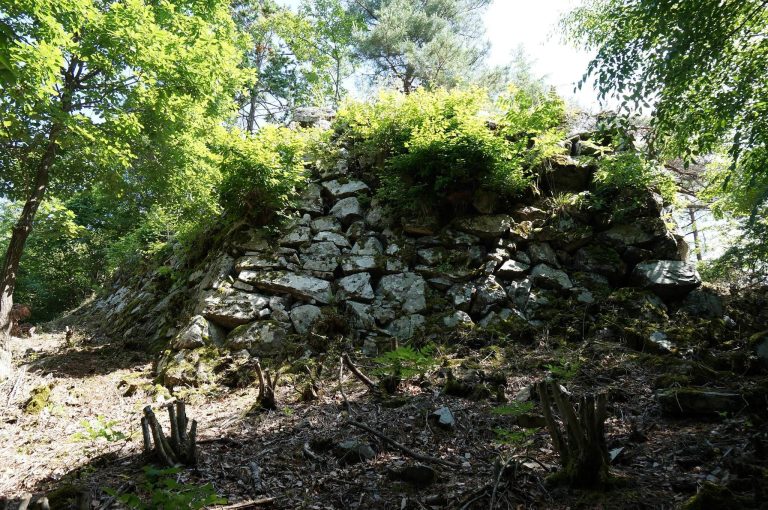
The stepped two- and three-level stone walls of Yamauenomaru may largely date from the Miyabe period, although this attribution remains a scholarly interpretation. The ridges called Nishisaka, Nakasaka, and Higashisaka retain numerous Sengoku-period remains. Additional traces of fortification continue along the northern ridge toward Karigane-yama Castle and on the mountainside toward Enkoji.
Siege landscape
Numerous flattened areas directly below Yamauenomaru are traditionally identified as locations of temporary huts where people who had taken refuge inside the castle were quartered during Hideyoshi’s siege. Outside the castle, Hideyoshi’s Taikoganaru fortification formed a semicircular encampment approximately 12 kilometers long. It extended along three sides of Tottori Castle and isolated the garrison from the town, supplies, and reinforcements.
Foothill enclosures
Tenkyumaru
Tenkyumaru occupied the highest ground in the foothill section, one level above Ninomaru. It contained a three-story turret and the Ofuroyamon gate. The enclosure was associated with Tenkyuin, the sister of Ikeda Nagayoshi and wife of Yamazaki Iemori, lord of Wakasaonigajo Castle. After leaving the Yamazaki family, she lived there, and her residence reportedly remained after Ikeda Mitsumasa entered the domain.
The Ishiguro Fire of 1720 destroyed Tenkyumaru, which was then neglected for a long period. An instructional school was established there late in the Edo period, during a time of political and social unrest. Excavation and restoration of the stonework showed that the enclosure had been enlarged during Ikeda Nagayoshi’s major Keicho-period reconstruction, incorporating earlier Miyabe-period masonry. Its earlier arrangement had three stonework levels on the east and two in the central area. The present convex plan is thought to have resulted from alterations under Ikeda Mitsumasa.
Around 1807, the lower part of Tenkyumaru’s stone walls was reinforced against bowing with a spherical rolled-stone wall. This method was more commonly used in harbor and river engineering than in castle construction. The restored wall is an exceptionally rare castle example of the technique.
Ninomaru
Ninomaru was the castle’s center during the early Edo period and contained the lord’s palace. Its principal entrance was the Kurogane Gate, and the enclosure was surrounded by the three-story turret, Hashiriyagura, and Hishiyagura. After a new palace was built in Sannomaru in 1718, Ninomaru was used less frequently.
The Ishiguro Fire destroyed the enclosure’s buildings, after which the three-story turret and Hashiriyagura were rebuilt. A Ninomaru palace was reconstructed in 1844, the western side of the three-story turret was enlarged in 1849, and a corner turret and climbing stone walls were added. Hishiyagura was rebuilt late in the Edo period. The stone quarry associated with Edo-period rebuilding survives on the mountainside behind the Ninomaru three-story turret.
Uzenomaru
Uzenomaru lay one level below Ninomaru and west of the three-story turret. Its name came from the residence of the castellan Takagi Uzen. After the Second World War, housing for occupation forces was built there, affecting the foundations and other remains. A group of gorinto stone monuments, a well, and a monument commemorating the castle’s safety remain in one corner.
Sannomaru and Matsu Palace
Under Ikeda Nagayoshi, Sannomaru initially held samurai residences. Under Ikeda Mitsunaka, it became the residence of the heir and the retired lord. After its expansion in 1718, it housed the domain lord and was called Ninomaru. When the lord’s residence returned to Ninomaru late in the Edo period, the enclosure again became known as Sannomaru.
During the Bunkyū era, the Matsu Palace of the Mito Tokugawa family was moved from Koishikawa in Edo to Sannomaru, which consequently was also called Matsu Palace. The enclosure is now occupied by Tottori West High School.
Marunouchi
Marunouchi, now including the high school grounds and Hisamatsu Park, contained residences for domain retainers until the era of Ikeda Mitsumasa. The retainers were later moved outside the inner moat. Rice granaries, weapons storehouses, and a riding ground were then installed, and some influential townspeople were permitted to enter because of the granaries.
Gates, moats, and surviving construction
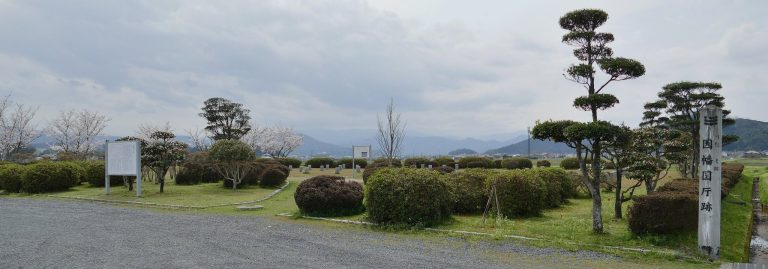
The site retains numerous stone walls, turret platforms, building foundations, wells, and related remains on the summit and in the foothill enclosures. Their masonry ranges from rough fieldstone construction to fitted and closely jointed work, reflecting changing techniques from the early Edo period through the late Edo period. Most identifiable Azuchi-Momoyama-period remains lie beneath later Edo-period construction, while the lower part of the turret platform below Tenkyumaru is considered to contain Miyabe-period rough-stone masonry.
The historic dressing room of Ogimiden survives in a corner of Horuin Garden and has undergone later repairs and alterations. The Nakashikiri Gate, also called the Nishisaka Lower Gate, has been reconstructed below Ninomaru. The Otemon gate and Giboshi Bridge have likewise been reconstructed.
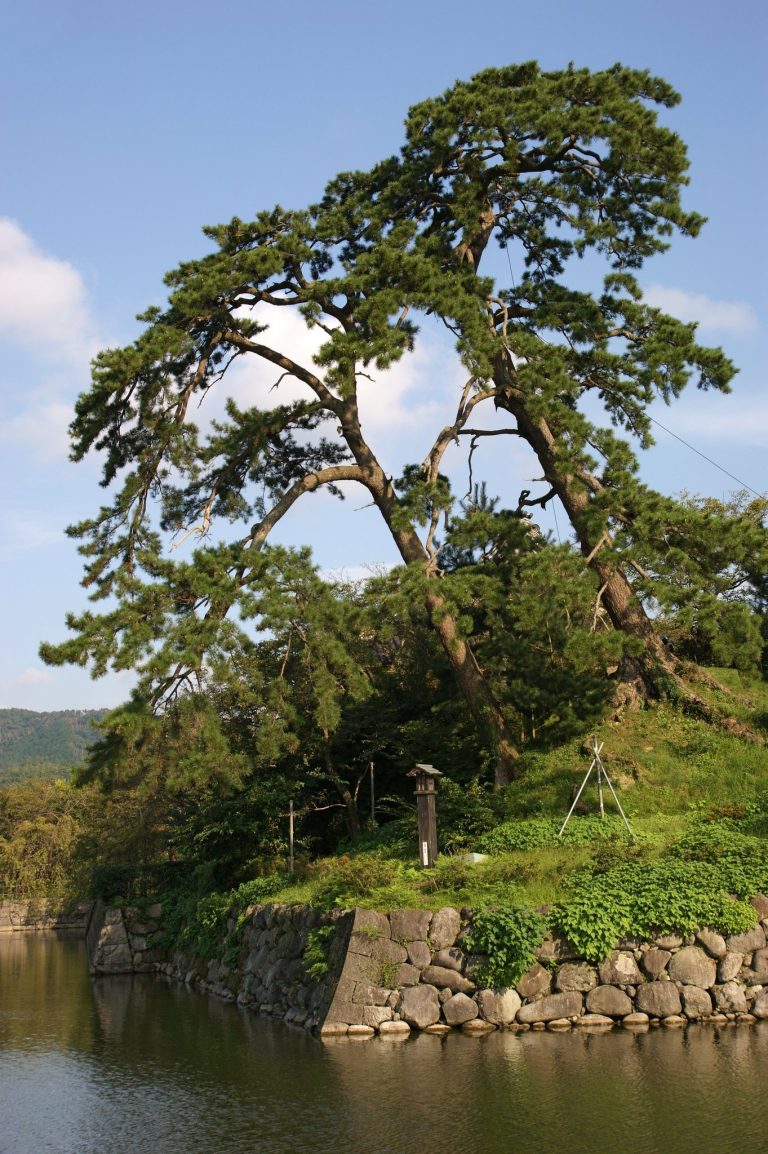
The inner moat survives in an incomplete form. The Yagenbori outer defensive ditch once formed part of the castle’s wider enclosure and survived in several parts of the city until postwar land readjustment and road-widening works filled it. The Fukurogawa River formed another defensive line. Bamboo planted on the castle-side embankment obstructed attackers’ view, and a bamboo defensive planting remains near Tachikawacho, although much of the bamboo was replaced by cherry trees after the Meiji period.
Nearby sites