Tenjinyama Castle (Inaba): Administrative Stronghold of the Inaba Yamana Clan
Site at a Glance
- Rating
- 3.8
- Popularity
- Very Low
- Country
- Japan
- Primary era
- Medieval
- Eras represented
- Medieval
- Civilizations
- Unclassified
- Site type
- Military
- Remains
- Castle
On this page9 sections
History
Tenjinyama Castle (Inaba) is a medieval hill castle in Japan, located in Tottori. Built and used by the Inaba branch of the Yamana, a powerful medieval Japanese warrior clan, it served as the clan’s provincial administrative residence and principal defensive stronghold during the era of regional warfare known as the Sengoku period.
Origins and early conflicts
The castle’s beginnings are uncertain. A traditional account places the transfer of Inaba’s provincial administrative seat from Futagami Castle to Tenjinyama in 1466 and attributes the move to Yamana Katsutoyo, although that date presents chronological difficulties. The first dependable documentary references date from 1512 and 1513.
In 1512, Yamana Toyoshige launched a campaign from Tenjinyama against Yakamiguchi. He was attacked by Yamana Nobutoyo and Yamana Toyoyori, leaders of the Yamana branch governing neighboring Tajima, and was killed. The castle was then involved in the Fuse Tenma Gate battle on March 29, 1513, the Fuse Masaki Gate battle on April 26, 1513, and the Fuse Senrinji battle on December 3, 1522.
Struggle for control of Inaba
By 1528 or earlier, Yamana Nobumichi had become Inaba’s shugo, a provincial military governor. He opposed his kinsman Yamana Suketoyo, the governor of Tajima, and was eventually defeated and killed. In 1543, Suketoyo pursued Nobumichi to Tenjinyama and ordered another attack after the castle resisted. Two years later, Nobumichi’s forces built Tottori Castle as a fortress against the Tajima Yamana family.
After Nobumichi’s death, the provincial governorship passed first to Yamana Toyosada and then to Yamana Munetoyo, both sent from the Tajima branch of the clan. During the rule of Yamana Toyokazu, his senior retainer Takeda Takanobu established himself at Tottori Castle and rebelled against the Yamana. In December 1563, Takeda attacked Tenjinyama, forcing Toyokazu to abandon the castle and withdraw to Shikano Castle. In 1564, Takeda killed Yamana Yajiro, a son of the deceased Nobumichi who had been based at Tenjinyama, during the battle at Tatsumi Pass.
Abandonment and later history
In 1573, Yamana Toyokuni, assisted by the Amago clan, expelled Takeda Takanobu from Tottori Castle and transferred the Inaba administrative seat there. Tenjinyama was traditionally regarded as abandoned at this point, and its reported three-story keep was said to have been dismantled and moved to Tottori Castle. The exact date of abandonment remains uncertain. The last reliable reference to Tenjinyama as an administrative center dates from 1563, while a document from around 1573 records the Mori clan’s intention to develop it as a forward defensive base and send sails and mats from Shikano Castle. The castle may therefore have been abandoned by both the Mori and Amago sides in the early 1570s.
When Ikeda Mitsumasa was transferred from Okayama to Tottori in 1617, Tenjinyama was considered as a possible site for a new castle. Its defensibility and the prospect of developing a castle town favored the location, but the work required to restore a site abandoned for nearly half a century was judged excessive. Tenjinyama never again became Inaba’s administrative capital.
Archaeology and preservation
Construction at the former Tottori Agricultural High School in 1972 exposed a complex archaeological site extending from the Yayoi period through the Sengoku period. Coins, Haji ware, white and celadon porcelain, traces of a water moat, post holes, and a charred well frame indicated a castle town affected by fire. Excavation ended after slightly more than a month, and the remains beneath the new school building were destroyed. The castle site was designated a Tottori Prefectural Historic Site on August 3, 1976, under the name Tenjinyama Castle Site. Residential development and improvements to National Route 9 have further damaged the surrounding fortifications, although parts of the castle remain archaeologically legible.
Remains
Tenjinyama Castle occupied two small hills beside Lake Koyama. Tenjinyama rises about 25 meters, while neighboring Uzuyama reaches about 40 meters. Whether Uzuyama belonged to the castle proper remains disputed. The complex included hilltop enclosures, moats supplied by the lake, defensive slopes, and associated compounds extending around the two hills.
Tenjinyama hill
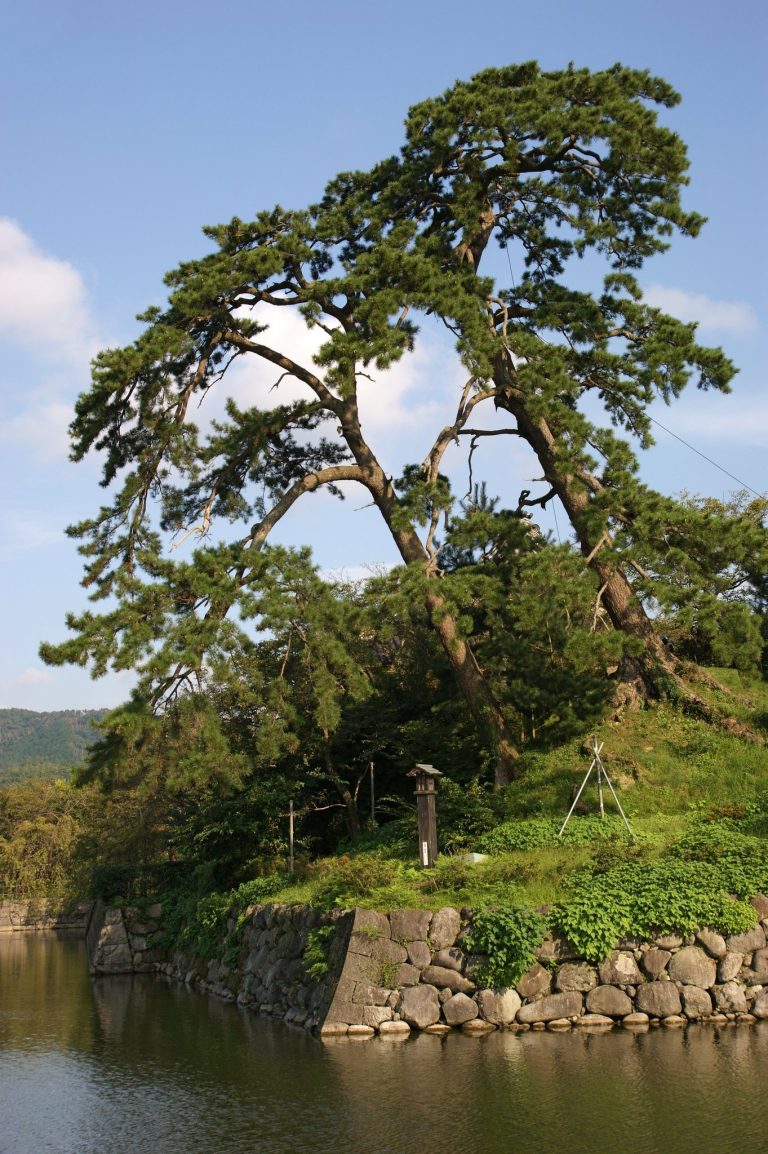
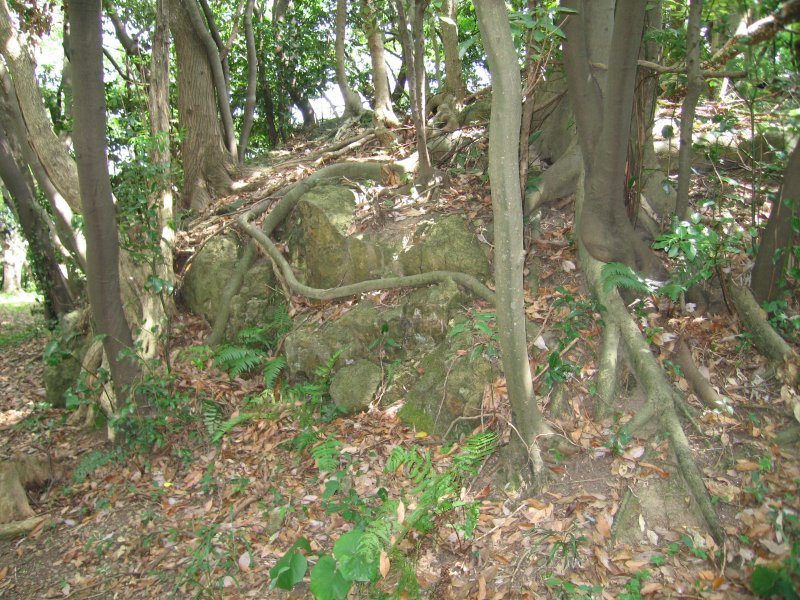
An inner moat encircled Tenjinyama and was fed from Lake Koyama. Part of the moat still carries water for agricultural irrigation. The administrative residence stood near the foot of the hill, where a traditional map and local tradition also place a presumed three-story keep. That keep no longer survives. The summit contains a large enclosure with a well at its northern end. At the western end, a rock outcrop about 5 meters high is thought to have supported a turret. Two lower enclosures extend south of the outcrop and are divided by a dry moat, a ditch without standing water. Two stepped belt enclosures, or narrow defensive terraces, occupy the southeastern side, where the main approach probably ran. On the Lake Koyama side, a steep cut slope was formed to hinder entry.
Place-names east of Tenjinyama preserve the former upper, middle, and lower Hasuhara areas. These areas were probably wetlands thick with lotus plants and functioned as a natural water barrier. The place-name Tenmanno Nawate is thought to preserve the line of the principal approach. An excavation in 2004 exposed a moat about 12 meters wide and 1.7 meters deep. The excavation did not reveal an associated earthwork embankment or angled defensive corner.
Uzuyama hill
Broad cleared enclosures extend along the Uzuyama ridge. Historical mapping places fortified compounds associated with the senior retainers Nakamura and Masaki there. It also places Hie Shrine on the hill, a Shinto shrine traditionally said to have been brought from Omi by Yamana Tokiuji, the first governor of Inaba. Senrinji, a temple with a three-story pagoda, stood at the southern foot. Several enclosures around Hie Shrine survived residential development because the area remained sacred. A broad enclosure to the left of the shrine approach was identified in a 2002 survey as the rear-hill castle of the Sanno Shrine.
At the eastern end of the ridge, Fuse Tumulus No. 1 is a keyhole-shaped burial mound that is also a national historic site. Dry-moat and earthwork traces were cut into the mound, showing that the ancient burial monument was incorporated into a fortification. A small two-level enclosure at the hilltop is thought to have served as a lookout. Two ridges extend eastward in a horseshoe shape, with small stepped enclosures along their crests.
The southern and eastern foot of Uzuyama was formerly bordered by a water moat fed from Lake Koyama. The place-name Funairi, meaning a boat landing, has supported the interpretation that a water-transport commercial district developed nearby. Many enclosures on Uzuyama have since disappeared beneath housing, while several remain around Hie Shrine.
Outlying fortifications
A group of outer fortifications surrounded the main castle, including Urasan Castle, Tokuyoshi Castle, Niiyama Castle, Nabeyama Castle, Ashiyama Castle, Masaki-ga-hana, and Miyayoshi Castle. These sites are thought to have maintained close communication with Tenjinyama as a coordinated defensive system in which multiple castles functioned together as one enclosure. The foot of Tenjinyama is now occupied by Tottori Prefectural Tottori Ryokufu High School, but earthworks, enclosure remains, dry-moat traces, cut slopes, the presumed keep platform, and the well remain comparatively clear on the hill.